
How to Explain AI Assisted Work in an Interview
A practical disclosure framework builders can use to explain AI-assisted work: what the tool handled, what the builder did, what evidence backs it up, and where human judgment made the difference.
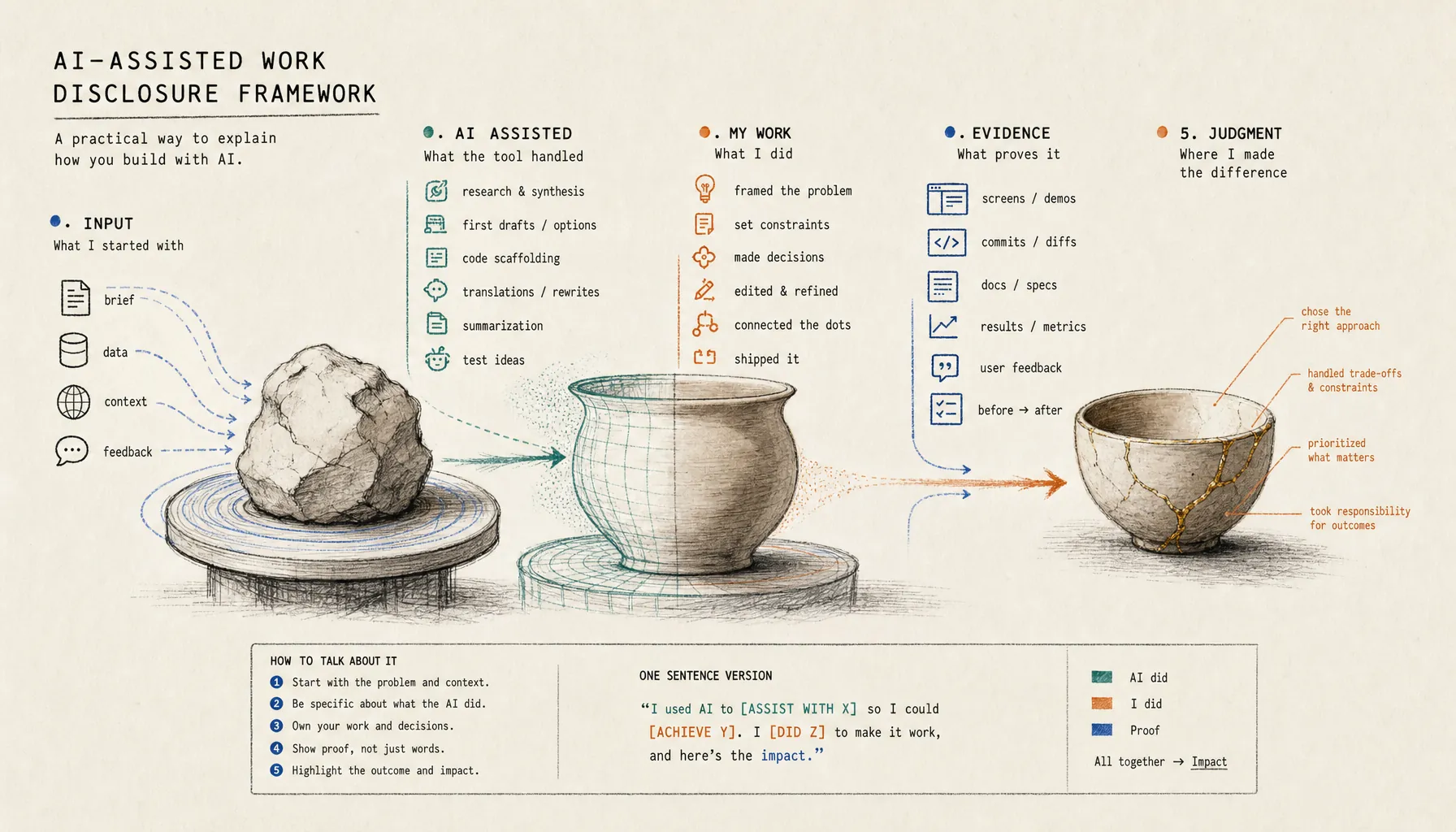
How to Explain AI Assisted Work in an Interview
In 2026, the worst answer you can give about AI assisted work is still the laziest one: “I used AI” or “I built it myself.” Neither tells companies hiring builders what they actually need to know: what problem you were solving, where the tool stopped, where your judgment started, and whether the work held up in the real world.
This article gives builders a plain way to talk about AI assisted work in an interview without inflating the output or erasing the thinking. For the bigger hiring picture, see Get Hired as a Builder in 2026: Proof, Judgment, and Process.
Key Takeaways
- Explain AI assisted work by separating four things: the problem, what AI produced, what you changed, and what evidence shows the result worked.
- A strong interview answer names the tool boundary. For example: “Claude generated test cases, but I picked the failure modes, rewrote the edge cases, and verified behavior against production logs.”
- Bring artifacts, not claims: prompts, drafts, diffs, commits, design notes, evaluation data, screenshots, Loom walkthroughs, or decision logs.
- Overclaiming makes you look slippery. Underselling hides your judgment.
- The best answers show where human judgment changed the result: scoping, rejection, verification, trade-offs, constraints, and final accountability.
How should you explain AI assisted work in an interview?
You should explain AI assisted work by saying what the AI did, what you did, what you rejected, and what evidence proves the final result.
Here is the clean version: “I used AI to speed up the first pass, but I owned the problem framing, the acceptance criteria, the implementation choices, and the final verification.” That works because it does not pretend the tool did nothing. It also does not dump the work on the tool.
Your job is to show the seam. AI helped somewhere. You decided where. That seam is where the hiring signal lives.
A useful answer has four parts:
- Task: what you were trying to build or solve.
- AI role: the exact work the model handled.
- Builder role: the judgment, edits, constraints, tests, and decisions you owned.
- Proof: the artifact that shows the work survived contact with reality.
That is also why proof matters more than polish. A polished answer can be rehearsed. A proof trail is harder to fake. Provn’s frame for Proof of Work for Builders: Definition and Examples starts from the same idea: hiring should look at the work, not guess from credentials.
Why do interviewers ask about AI assisted work?
Interviewers ask about AI assisted work because AI made output cheaper. That makes judgment worth more.
You can already see it on software teams. According to the Stack Overflow 2024 Developer Survey on AI tools, a large majority of developers reported using or planning to use AI tools in development work. At this point, the exact tool is not the interesting part. What matters is whether a builder can direct it, inspect it, correct it, and still ship something solid.
Companies hiring builders also have a measurement problem. AI can crank out resumes, cover letters, mock case answers, product specs, code scaffolds, and portfolio copy. That creates noise fast. The better hiring screen asks for evidence of process. For the hiring-side version of this problem, see Hiring Managers Look for in Builders in 2026: Signals and Requirements.
This is not an anti-AI argument. It is a signal problem. The National Institute of Standards and Technology AI Risk Management Framework focuses on transparency, validity, reliability, and accountability in AI systems. The same principles apply in a builder interview, just on a smaller scale. If a builder cannot explain how the work got made, the interviewer cannot tell whether that builder can do it again under pressure.
The same issue shows up in resume screening. A stack of AI-written applications can look polished and still tell you almost nothing about capability. That is why the difference between AI Resume vs Proof of Work in 2026: Screening and Signals matters.
What evidence should you bring for AI assisted work?
You should bring evidence that shows the work changing from raw AI output into something judged, tested, and shipped.
The best evidence is not one finished artifact. It is a short chain of custody. Companies hiring builders want to see how the work moved from prompt to draft, from draft to revision, from revision to test, and from test to decision. That chain proves authorship in the way hiring actually cares about it: not who typed every word, but who controlled the work.
| Evidence | What it proves | Interview use |
|---|---|---|
| Prompt or task brief | You knew what to ask for and which constraints mattered. | Show the original problem framing. |
| Raw AI output | You are not hiding tool use. | Compare it with the final version. |
| Diffs, commits, or version history | You changed the work in a meaningful way. | Point to exact edits and why you made them. |
| Evaluation notes | You tested quality instead of accepting output on faith. | Explain pass, fail, and revision criteria. |
| Final artifact | The work reached a usable state. | Demo the result and name the limits that still remain. |
If you keep a builder portfolio, add an “AI role” note to each project. One paragraph is enough. The point is not confession. It is inspection. A portfolio that shows process will carry more weight than one that only shows screenshots. That is why Proof of Work Portfolio for Builders in 2026: Examples and Checklist treats artifacts as hiring evidence, not decoration.
What is the 5-step script for explaining AI assisted work?
The best script is short enough to say in 90 seconds and specific enough that the interviewer can check it.
Use this structure when asked, “How much of this did AI do?”
- State the problem you were solving in one sentence.
- Name the AI tool and the exact task it handled.
- Identify the parts you personally designed, edited, rejected, or verified.
- Show one artifact that proves your intervention changed the result.
- Explain one trade-off you made and what you would improve next.
Example: “I built a support ticket triage prototype. I used GPT-4 to generate an initial classifier prompt and sample labels. I rewrote the label taxonomy after reviewing 120 historical tickets, removed categories that support agents did not use, and tested the prompt against edge cases like billing disputes written in technical language. The original model over-routed those tickets to engineering. My final version reduced that error in the test set, but I would still add human review for high-value accounts.”
That answer has a backbone. Task. Tool. Judgment. Evidence. Limit. For the live-demo version of this structure, use Builder Interview Demo in 2026: Steps and Script.
How do you avoid overclaiming or underselling AI assisted work?
You avoid both mistakes by describing control, not effort.
Overclaiming sounds like taking ownership of work the model mostly produced. Underselling sounds like the tool did everything and you just clicked accept. Both hide the real signal. The interviewer needs to know who made the decisions that shaped the final outcome.
| Weak answer | Better answer | Why it works |
|---|---|---|
| “I built the whole thing myself.” | “AI generated the first parser, but I rewrote the error handling and added tests for malformed inputs.” | It separates generation from engineering judgment. |
| “AI helped with some parts.” | “I used Cursor for boilerplate and used my own review checklist for auth, rate limits, and logging.” | It names the boundary. |
| “The model designed the flow.” | “The model suggested three flows. I rejected two because they added steps before activation.” | It shows selection logic. |
There is a legal and ethical version of this too. The U.S. Copyright Office AI initiative has repeatedly focused on the difference between human authorship and machine-generated material in copyright policy discussions. Hiring is not copyright registration, obviously, but the practical lesson carries over: human contribution has to be visible.
If the interviewer presses on judgment, do not hide behind tool names. Explain the decision. Our related piece on Judgment Calls in AI Work in 2026: Trade-Offs and Answers goes deeper on that skill. The paired issue is covered in AI Tool Knowledge vs Problem Judgment: Hiring Difference.
What does a strong AI assisted work answer sound like?
A strong answer sounds specific, bounded, and testable.
For a product manager builder: “I used AI to synthesize interview notes, but I wrote the segmentation logic after reading the raw transcripts. The model grouped complaints by surface wording. I regrouped them by buying trigger, which changed the roadmap priority.” That lines up with the kind of evidence discussed in Product Manager Builder Portfolio in 2026: Project Checklist.
For a product designer builder: “I used Midjourney for moodboard exploration and ChatGPT for variant copy. I made the interaction decisions in Figma after testing the prototype with five users. The AI versions looked clean, but two flows failed because the primary action was visually buried.” That is closer to Product Designer Builder Portfolio in 2026: Prototype Evidence.
For an engineering builder: “I used GitHub Copilot for scaffolding and wrote the integration tests myself. The generated code assumed a happy path. I added retries, idempotency checks, and structured logs after reviewing failure cases.” That answer connects directly to Engineering Builder Portfolio in 2026: Code Demo Checklist.
For an AI prototype: “I used an agent to research vendors, but I constrained the source list, checked claims manually, and blocked the agent from making final recommendations without citations.” For a deeper prototype script, see AI Prototype Interview Demo in 2026: Steps and Script.
This is where agentic work gets misunderstood. A builder is not valuable because the agent ran. A builder is valuable because they designed the loop, watched for failure, and knew when to stop the automation. See Agentic Engineer: Definition, Skills, and Hiring Signals and Agentic Engineer Hiring in 2026: CPTO Signals and Requirements for the hiring-side version.
What mistakes make AI assisted work sound weaker than it is?
The most common mistake is treating AI disclosure like a moral defense instead of a work explanation.
Do not apologize for using AI. Also do not hide it. The interview question is not “Did you touch a tool?” The real question is “Can this person produce reliable work when AI is part of the workflow?”
Four mistakes show up again and again:
- Tool-name dumping: naming every model, plugin, and extension without explaining the decision process.
- Vague collaboration language: saying “AI helped” without naming the task boundary.
- No artifact trail: showing only the final result and forcing the interviewer to guess what happened.
- No failure story: skipping the moment where the model was wrong, incomplete, unsafe, or off-target.
The failure story is often the strongest part. A builder who can say, “The model gave me an answer that looked right, but it broke on this edge case,” tells companies hiring builders more than someone who presents a flawless-looking artifact with no process behind it. This is related to Builder Interview Trade-Offs in 2026: Answers and Examples.
The same logic applies across roles and titles. A designer, PM, analyst, marketer, or engineer can all show builder behavior when the evidence is concrete. That is the point of Builder Roles vs Job Titles in 2026: Product and Engineering Teams. Certifications can support the story, but they do not replace the work trail, as covered in Certifications vs Portfolio in 2026: Production and Hiring Signals.
If you need a project to demonstrate this, start smaller than you think. Build one workflow, document the AI boundary, and record the judgment calls. The examples in AI Project Ideas for Builders in 2026: Hiring Examples are useful because they force evidence. If the interview format still looks like a coding screen, remember why companies are changing the test: the old signal got thinner. See Coding Interviews in 2026: Why Builder Challenges Replace Them.
Provn’s position is simple: performance over pedigree, proof over polish. AI assisted work fits that rule. Show the work. Show the tool boundary. Show where your judgment changed the outcome.
If your resume was also AI-assisted, the same rule applies: show proof instead of layering on more polished language. That related problem is covered in AI-Written Resume in 2026: How Builders Prove Work.
Frequently Asked Questions
Should I tell an interviewer I used AI on a project?
Yes. State the role AI played and the work you owned. A strong answer is specific: “AI drafted the first data-cleaning script. I rewrote the validation logic, tested it against missing values, and documented the failure cases.”
How much AI use is too much to admit in an interview?
The issue is not the percentage of AI use. It is control. If AI produced most of the first draft but you set the goal, constrained the output, verified accuracy, made trade-offs, and shipped the final version, say that plainly.
What if the AI output was better than my original version?
Say what improved and why you accepted it. Good judgment includes recognizing a better option. The key is explaining how you evaluated the output instead of treating the model’s answer as automatically correct.
Should builders include prompts in their portfolio?
Include prompts when they clarify the work. A prompt by itself is weak evidence. A prompt paired with raw output, edits, tests, and a final artifact shows process.
Do hiring managers care which AI tool I used?
They care less about the tool name than the workflow. Tool fluency matters, but the stronger signal is whether you can define the problem, catch model failure, and explain why the final decision was yours.