
Why Coding Interviews Are Changing in 2026 | Provn
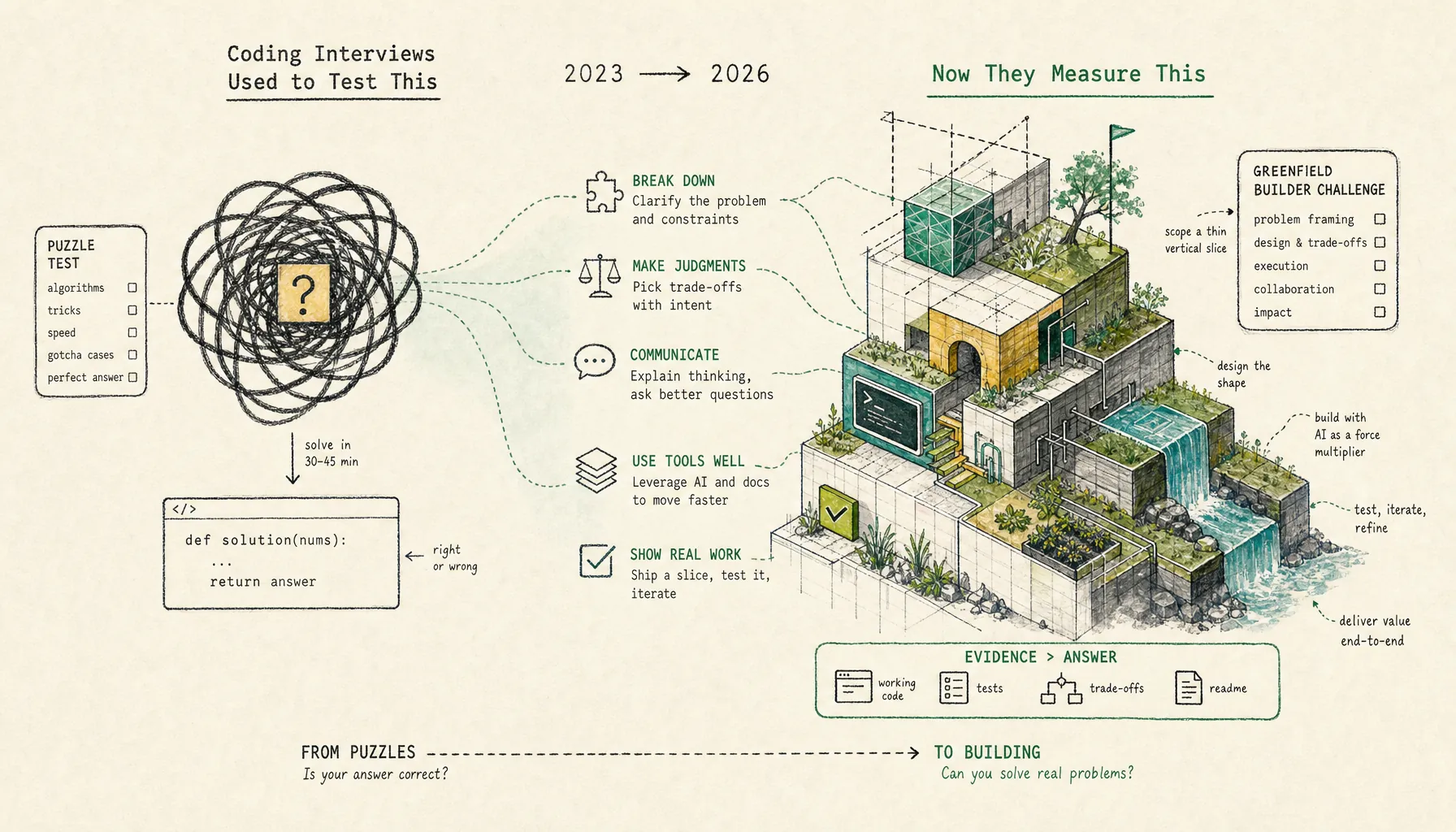
Coding interviews are shifting away from puzzle-style tests and toward greenfield builder challenges because AI changed what technical screens need to measure: how builders break down problems, use judgment, communicate clearly, and show real work.
Microsoft and LinkedIn reported in the 2024 Work Trend Index that 75% of knowledge workers were already using AI at work.
That alone explains why coding interviews look different in 2026. A timed algorithm screen can still tell you who stays calm under pressure and who knows their way around syntax. What it cannot tell you, at least not reliably, is whether a builder can take a fuzzy problem, break it into parts, use AI with discipline, ship something that works, and explain why they made the calls they made.
Key Takeaways
- Traditional coding interviews still test syntax, data structures, and performance under pressure, but they miss decomposition, product judgment, and communication.
- Greenfield builder challenges show how someone starts from ambiguity: scoping, data modeling, tool choice, testing, and trade-off reasoning.
- AI coding tools changed the signal. GitHub research found developers completed a coding task 55.8% faster with Copilot, so hiring screens now need to evaluate judgment around generated work.
- Well-designed builder challenges use synthetic problems, fixed timeboxes, visible rubrics, and no unpaid production work.
- The strongest interviews now look more like a combine: builders show the work, then explain the reads they made under constraint.
Why are coding interviews changing in 2026?
Coding interviews are changing in 2026 because AI made it easier to produce plausible code and harder to tell who actually understands the work. The useful signal moved from solving a familiar puzzle to showing how a builder breaks down a new problem, checks AI output, makes trade-offs, and explains the result.
The old technical screen came from a different bottleneck. Companies hiring builders needed to know whether someone could code at all. A binary tree question, a dynamic programming prompt, or a timed API exercise gave hiring teams a compact test. It was never perfect, but at least it was legible.
Now the bottleneck is different. Companies hiring builders are buried in noise. AI-written resumes can make ten builders look equally polished. AI-assisted code can make weak and strong submissions look similar on first pass. So the question changed. It is no longer, “Can this person produce code?” It is, “Can this person decide what matters, build the right slice, and defend the choices?”
That is why the shift toward proof matters. The pillar article, Get Hired as a Builder in 2026: Proof, Judgment, and Process, covers the full model. This page stays focused on one piece of it: why the technical screen itself is changing.
What do traditional coding interviews still reveal, and where do they fail?
Traditional coding interviews still show baseline programming fluency, but they often fail to show whether a builder can work through real ambiguity. They are useful as a narrow diagnostic, not as the whole hiring signal.
A timed algorithm problem can show command of loops, recursion, edge cases, and Big O reasoning. That still matters for some roles. A backend engineer working on low-latency systems needs to think clearly about complexity. A platform engineer needs to understand failure modes. The problem is treating that narrow slice like it tells you everything worth knowing.
The gap shows up when the work is greenfield. Real product and engineering work almost never arrives as a neat prompt with one expected answer. It shows up as a customer complaint, a messy dataset, a half-documented API, a vague request from leadership, or a workflow nobody has mapped yet. Puzzle tests remove the exact conditions where strong builders separate themselves.
Employment testing also has to connect to the job. The Uniform Guidelines on Employee Selection Procedures, used by federal agencies including the Equal Employment Opportunity Commission, emphasize validation when selection procedures affect employment decisions. In plain terms, serious companies hiring builders need work samples that actually resemble the work.
| Interview type | What it reveals | What it misses |
|---|---|---|
| Timed algorithm screen | Syntax, data structures, pressure performance | Scoping, product sense, communication, AI judgment |
| Whiteboard interview | Verbal reasoning and abstract problem solving | Tool use, testing habits, real implementation quality |
| Take-home assignment | Implementation depth and persistence | Time boundaries, authorship clarity, unpaid work risk |
| Greenfield builder challenge | Decomposition, judgment, shipping, explanation | Requires a stronger rubric from the company |
This is also why the resume screen is getting weaker as a technical filter. AI Resume vs Proof of Work in 2026: Screening and Signals goes deeper on that problem.
Why are greenfield, hands-on builder challenges replacing puzzle tests?
Greenfield, hands-on builder challenges are replacing puzzle tests because they show how a builder works when the answer is not already shaped for them. You get to see the path from problem framing to working artifact.
A good challenge starts with a realistic mess: “Build a lightweight tool that classifies inbound support messages, flags urgent items, and gives a human reviewer a clear reason for each label.” There is no perfect answer sitting in the prompt. The builder has to choose a data structure, decide whether to call a model, write guardrails, handle bad inputs, and produce a demo that makes sense to a non-engineer.
AI makes this format more useful. Not less. GitHub’s Copilot study found a 55.8% faster completion rate on a controlled task for developers using Copilot. Once boilerplate gets faster, the evaluation target shifts. The interview needs to inspect the decisions around that boilerplate.
The NFL draft analogy works here. College stats matter, but teams still run the combine, watch tape, conduct interviews, and test specific movements. Builder hiring needs that same layered signal. Credentials and resumes are the stat line. The hands-on challenge is the tape. For a tighter definition of the proof model, see Proof of Work for Builders: Definition and Examples.
What do builder challenges reveal about decomposition?
Builder challenges reveal decomposition by showing how someone turns a vague request into a series of smaller decisions. Strong builders make the problem manageable before they try to make it impressive.
You can usually see decomposition in the first ten minutes. Does the builder restate the goal? Do they identify the user? Do they split the system into input, processing, output, and feedback? Do they cut scope when time is tight? Do they build the thin version first, or start polishing the hardest part before the basic workflow even exists?
The signal is especially clear in greenfield work because there is no template to hide behind. Two builders can use the same AI tool and end up in completely different places. One asks for a full application, accepts the first structure, and spends the rest of the session patching errors. Another sketches the flow, asks AI for narrow components, writes tests around the risky parts, and leaves a clear note about what is still unfinished.
| Decomposition signal | Strong builder behavior | Weak signal |
|---|---|---|
| Scope control | Ships the smallest useful version first | Builds a broad shell with no reliable core |
| Data thinking | Defines inputs, outputs, and failure cases | Assumes clean data and ignores edge cases |
| System shape | Separates UI, logic, model calls, and persistence | Mixes everything into one fragile file |
| Testing | Tests risky paths and known failure modes | Only tests the happy path |
This is the same signal companies hiring builders look for across product, design, and engineering roles. The related piece Hiring Managers Look for in Builders in 2026: Signals and Requirements covers those patterns from the company side.
What do builder challenges reveal about judgment and AI use?
Builder challenges reveal judgment by making AI use visible. The real question is whether the builder treats AI output like a draft, a collaborator, or an authority.
Good AI-assisted work leaves fingerprints. The builder breaks prompts into smaller tasks. They inspect generated code. They reject code that solves the wrong problem. They say where they are unsure. They add tests where the model is likely to bluff. They can explain what they wrote, what AI drafted, and what they changed.
This matters because AI risk is not theoretical. The National Institute of Standards and Technology AI Risk Management Framework puts reliability, validity, safety, security, accountability, and transparency at the center of responsible AI systems. The OWASP Top 10 for Large Language Model Applications calls out risks like prompt injection, sensitive information disclosure, and insecure output handling.
A builder challenge can surface those habits in a way a resume never will. Give builders a mock dataset with private fields and ask them to build a triage assistant. The strong builder redacts unnecessary fields, limits model context, validates output, and explains where human review belongs. The weak signal is a working demo that dumps sensitive text into every prompt and trusts every response it gets back.
For the specific interview language around these decisions, see Judgment Calls in AI Work in 2026: Trade-Offs and Answers.
What do builder challenges reveal about communication?
Builder challenges reveal communication because the builder has to explain the artifact, not recite a polished biography. The walkthrough shows whether they can make technical decisions legible to people who were not in the room.
This is where a lot of technical screens lose signal. A builder can solve a coding problem silently and still struggle inside a team. A builder can also get tripped up on syntax in a timed screen and still be excellent at framing, shipping, and explaining product-quality work. The walkthrough gives companies hiring builders a second stream of evidence.
A useful walkthrough is short and concrete. It answers five questions: what problem was solved, what was intentionally left out, where the system fails, how AI was used, and what the builder would do next with one more day. That format is hard to fake because it forces the builder to connect implementation details to judgment.
The practical version looks a lot like tape review. The artifact is the play. The explanation is the read. The company sees the result and the thinking behind it. For builders preparing that walkthrough, Builder Interview Demo in 2026: Steps and Script gives a focused structure.
How should companies design builder challenges without creating unpaid work?
Companies should design builder challenges with synthetic problems, short timeboxes, published rubrics, and hard boundaries against production use. The challenge should measure job-related behavior without turning builders into free labor.
The worst version of this trend is a vague take-home assignment that eats a whole weekend and looks suspiciously like real backlog work. That is not a better interview. It is the same broken interview dressed up in new language. The better version is constrained, observable, and scored against the signals the company actually cares about.
- Define the work sample around a real skill, such as decomposing an ambiguous workflow, building a small prototype, or debugging AI-generated code.
- Use synthetic data, fictional customers, and a problem that cannot be shipped directly into the company product.
- Set a visible timebox, usually 90 to 180 minutes for a live or async challenge, and state clearly that unfinished work is acceptable.
- Publish the scoring rubric before the exercise, including decomposition, correctness, testing, AI disclosure, security judgment, and communication.
- Ask for a short walkthrough that explains decisions, trade-offs, known gaps, and next steps.
- Review the same artifact with at least two trained reviewers to reduce one-person bias.
- Compensate builders when the exercise gets long, specialized, or commercially useful to the company.
The rubric is the center of the system. Without it, companies hiring builders end up rewarding polish, speed, or familiarity with a preferred stack. With it, they can compare builders on the work itself. Proof of Work Portfolio for Builders in 2026: Examples and Checklist shows how builders can prepare artifacts that map to those same signals.
How should builders prepare for greenfield coding challenges?
Builders should prepare by practicing small, timeboxed builds and rehearsing how they explain their decisions. The goal is to make the work inspectable, not overly polished.
Pick a common business workflow: invoice review, support triage, lead scoring, content QA, onboarding checklist, internal search. Build the smallest working version in two hours. Use AI where it helps. Track what it generated. Write down what you accepted, changed, and rejected. Then record a five-minute walkthrough.
Preparation should include failure cases too. Break the input. Remove a required field. Add hostile text. Feed the system a contradictory instruction. See what happens. A builder who can explain failure modes sounds far more credible than one who acts like the demo is magically complete.
Role shape matters. A product builder may be evaluated on prioritization, prototype logic, and user impact. A design builder may be evaluated on interaction quality and testable flows. An engineering builder may be evaluated on architecture, tests, and maintainability. The related pages on Builder Roles vs Job Titles in 2026: Product and Engineering Teams and Engineering Builder Portfolio in 2026: Code Demo Checklist go deeper by role.
What is the practical shift for 2026 hiring?
The practical shift is simple: less credential-first screening, more evidence-first evaluation. Coding interviews are changing because the old screen cannot carry the weight companies hiring builders put on it.
This does not mean every company should throw out every algorithm question. It means hiring teams need to stop pretending one puzzle predicts builder performance across AI-assisted work, product ambiguity, team communication, and security judgment. The interview has to look more like the job. Honestly, that is overdue.
Provn’s view is straightforward: performance over pedigree, proof over polish. The best builders rise on what they make, how they think, and how clearly they explain trade-offs. In 2026, that is why the strongest coding interviews are turning into builder challenges.
Frequently Asked Questions
Why are coding interviews changing in 2026?
Coding interviews are changing in 2026 because AI-assisted coding reduced the value of screens that only test whether someone can produce code under pressure. Companies hiring builders now need evidence of decomposition, judgment, testing habits, AI disclosure, and communication.
Are traditional coding interviews still useful?
Traditional coding interviews are still useful for measuring baseline fluency, algorithms, data structures, and performance under pressure. They are much weaker when used as the main signal for builder roles that involve ambiguous problem solving, AI-assisted workflows, and cross-functional communication.
What is a greenfield builder challenge?
A greenfield builder challenge is a hands-on interview exercise where a builder starts from a new, ambiguous problem and produces a working artifact or prototype. The company evaluates how the builder scopes the problem, uses tools, handles edge cases, tests the result, and explains decisions.
How long should a hands-on builder challenge take?
A practical builder challenge usually fits into a 90 to 180 minute timebox when used as an interview screen. Longer assignments need clearer boundaries, compensation, and synthetic problems so the company does not collect unpaid production work.
Do builder challenges vary by location or regulation?
Yes. In the United States, employment tests are shaped by federal guidance such as the Uniform Guidelines on Employee Selection Procedures, plus state and local rules. In the European Union, companies using AI in hiring also need to track obligations under the European Commission framework for the Artificial Intelligence Act. Companies should have counsel review high-volume or AI-assisted assessment processes.