
Builder Roles vs Job Titles: AI Hiring Shift | Provn
AI is collapsing product, design, and engineering handoffs into one shared workspace. Hiring companies are paying less attention to job titles and more attention to clear signs of builder judgment.
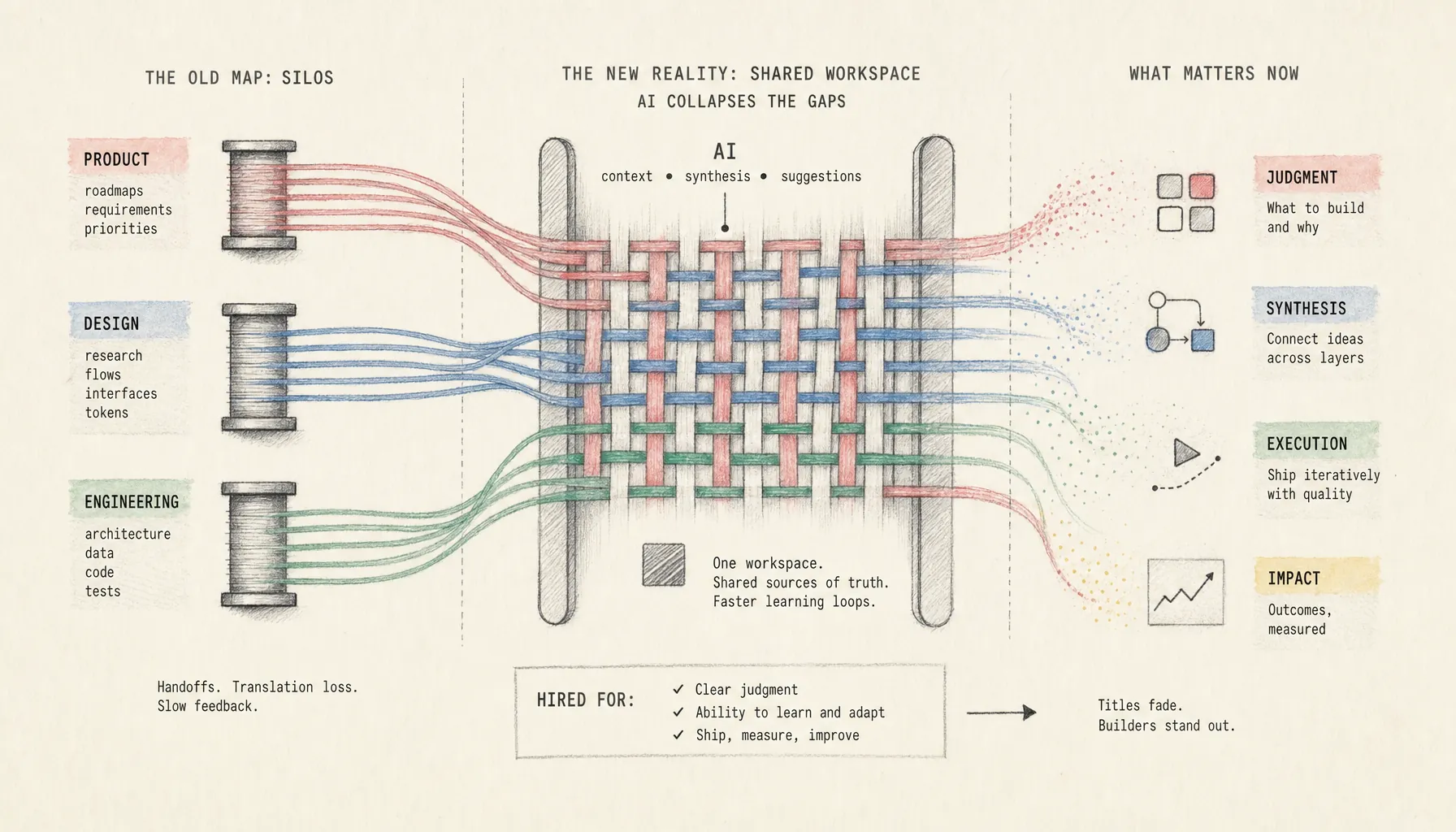
In 2026, builder roles vs job titles stopped being a semantic argument. AI pulled product specs, design mocks, code scaffolds, and research synthesis into the same workspace.
The old hiring map split product managers, designers, and engineers by tools and handoffs. That map is wearing out because the work now favors people who can move from problem to prototype to evidence without waiting for a formal handoff.
Key Takeaways
- AI is flattening narrow job titles because it cuts the cost of moving between product thinking, interface design, code generation, testing, and documentation.
- According to the World Economic Forum Future of Jobs Report 2025, companies expect 39% of workers’ core skills to change by 2030. That makes static title history a weaker signal.
- Product managers, designers, and engineers are not turning into the same role. Their center of gravity is still different, but the people who stand out in each group now show build range.
- Companies hiring builders should evaluate shipped artifacts, judgment calls, iteration records, and working demos instead of relying on title matching alone.
- Builders should describe their work through problem ownership, decisions made, constraints handled, and proof produced, then use the title as context.
What does builder roles vs job titles mean in 2026?
Builder roles vs job titles means hiring is shifting away from functional labels and toward a simpler question: can this person define a problem, build a working answer, and explain the trade-offs behind it?
The old model looked like an assembly line. A PM wrote requirements. A designer shaped the experience. An engineer built the system. Each person stayed in a lane, and the title told the company where that person belonged.
AI changed the workbench. A PM can turn a rough product idea into a clickable prototype. A designer can generate front-end code, inspect analytics, and test flows with synthetic or real user inputs. An engineer can prototype product variants, write user-facing copy, and check whether the feature solves the right problem before a PM writes a ticket.
That does not mean titles vanish from org charts. Titles still matter for compensation bands, reporting lines, compliance, and career ladders. What changes is the hiring signal. When a company looks at two people with the same title, the better question is now: which one can actually build through ambiguity?
That is the frame behind Get Hired as a Builder in 2026: Proof, Judgment, and Process. The title gets a builder into a familiar bucket. The work tells you whether the bucket means much.
Why is AI flattening product, design, and engineering titles?
AI is flattening product, design, and engineering titles because it makes first drafts across functions cheaper while making judgment, taste, and integration more valuable.
The old title system put a premium on tool access. If only a designer could produce credible mocks, the design title mattered more. If only an engineer could scaffold an application, the engineering title carried more gatekeeping power. If only a PM could turn customer noise into structured requirements, the PM title signaled control of the problem frame.
Those barriers are lower now. According to GitHub’s controlled study of Copilot use, developers using Copilot completed a coding task 55% faster than developers who did not. That does not prove every AI-assisted engineer is better. It proves the mechanical cost of producing code has dropped in a measurable way.
The same thing is happening outside code. The 2024 Microsoft and LinkedIn Work Trend Index reported that 75% of surveyed knowledge workers were already using AI at work. The important hiring point is not the adoption number by itself. It is the collapse of first-draft scarcity. When lots of workers can generate a draft spec, wireframe, SQL query, landing page, or test plan, the scarce signal moves to selection and execution.
That is why narrow specialization loses some hiring power. A Figma expert, Jira expert, React expert, or prompt expert still has useful skill. The mistake is treating the tool as the identity. Tools now look more like instruments on the same bench. The builder advantage comes from knowing which instrument to pick, when to stop, and how to prove the result works.
Companies hiring builders are feeling this too. Other platforms are flooding them with polished noise because AI makes polished applications cheap. The useful screen is the one that separates generated polish from demonstrated capability, which is the problem covered in AI Resume vs Proof of Work in 2026: Screening and Signals.
What changes for product managers when builder roles replace narrow titles?
Product managers become more valuable when they can turn strategy into a testable artifact instead of stopping at documents, roadmaps, and meeting choreography.
The PM title used to cover a huge range of actual work. Some PMs owned customer discovery, prioritization, and product economics. Others mostly translated executive requests into tickets. AI makes that split harder to hide because the translation layer is cheaper now.
A builder-style PM works closer to the problem. They can interview users, synthesize patterns, create a thin prototype, write the acceptance logic, test a workflow, and explain why one path was rejected. They do not need to be the strongest engineer in the room. They need enough build range to reduce ambiguity before asking engineering to spend real cycles.
For example, a PM working on onboarding should not stop at a one-page PRD. A stronger proof packet would include:
- A short problem statement tied to a measurable user behavior, such as activation rate or time to first successful action.
- A prototype of the proposed flow with the main decision points visible.
- A simple instrumentation plan showing what events would prove the change worked.
- A trade-off note explaining what was cut from v1 and why.
- A short demo showing the product logic, not a slide deck talking around it.
The title says PM. The proof tells you whether this person can move a problem forward. That difference matters when companies compare people who all know the same product vocabulary. PMs trying to package that evidence well should look at a product manager builder portfolio that emphasizes framing, prototyping, and prioritization.
This also changes what PMs should bring to interviews. They need to show decisions under constraints. The strongest examples explain why the team chose a rough prototype over a polished concept, why the metric changed, or why a customer request was rejected. That overlaps with Judgment Calls in AI Work in 2026: Trade-Offs and Answers, because builder hiring cares less about the perfect answer and more about the reasoning path.
What changes for product designers when design work becomes builder work?
Product designers become more valuable when they connect interface decisions to working behavior, data, accessibility, and implementation constraints.
Designers are not being replaced by people who can generate pretty screens. That is the lazy reading of this shift. AI makes surface production cheaper, so taste, systems thinking, and product judgment become easier to spot. A designer who only shows static screens is easier to confuse with a template. A designer who shows how the interaction behaves under real constraints is much harder to ignore.
You can see the difference in ordinary product work. A checkout redesign is not a set of polished frames. It is a chain of decisions about error states, payment failures, mobile keyboard behavior, accessibility labels, loading states, fraud checks, and support recovery. AI can help draft variations. It does not decide which variant earns trust when something goes wrong.
According to the World Wide Web Consortium Web Accessibility Initiative, accessible design depends on making web content usable for people with auditory, cognitive, neurological, physical, speech, and visual disabilities. That matters in builder hiring because accessibility is not decoration. It is a production constraint. A designer who can show how accessibility changed the prototype has stronger evidence than one who simply says accessibility was considered.
A builder-style designer shows:
- The problem behind the interface, not just the final screen.
- The interaction model, including empty states, edge cases, and failure states.
- The system constraint, such as component reuse, latency, data availability, or accessibility.
- The test evidence, even if it is small, scrappy, and directional.
- The implementation conversation, including what changed after engineering review.
This is where the title flattens in a useful way. A designer does not need to become a full-time engineer. But the designer who can make a prototype behave, inspect the front-end structure, and explain what a developer will inherit is operating as a builder. For builders preparing artifacts, the next practical layer is covered in Proof of Work Portfolio for Builders in 2026: Examples and Checklist. Designers who want role-specific examples can also study a product designer builder portfolio that shows interactive prototypes and shipping decisions.
What changes for engineers and agentic engineers when titles flatten?
Engineers become more valuable when they can own outcomes across product intent, system design, AI-assisted implementation, testing, and operational risk.
The engineering title still matters when depth is required. Distributed systems, security, data infrastructure, model evaluation, and production reliability are not casual skills. AI does not remove the need for technical judgment. If anything, it makes sloppy judgment more expensive.
The visible change is that implementation alone is a weaker hiring signal. If a builder can generate scaffolding quickly, the question becomes whether they know what should exist, how it should fail, and what should be measured. That is where agentic engineering enters the conversation. An agentic engineer is not just an engineer who uses an AI coding tool. It is someone who can direct AI agents through tasks, inspect outputs, set guardrails, and integrate the result into a real system.
According to the Stanford Institute for Human-Centered Artificial Intelligence AI Index Report, AI systems have continued to improve across benchmarks while adoption has moved into everyday business workflows. The practical effect on engineering hiring is straightforward: companies need people who can evaluate AI output, not people who just accept it.
The difference shows up in a simple feature build:
| Engineering signal | Title-based reading | Builder-based reading |
|---|---|---|
| Generated a working feature | Can code with modern tools | Can produce a first pass, but quality is unproven |
| Added tests and failure handling | Shows engineering discipline | Shows awareness of production risk |
| Explained model or agent limits | Shows AI familiarity | Shows judgment about when automation fails |
| Reduced scope after testing | May look less ambitious | Shows ability to protect the user and the system |
| Demoed the trade-offs clearly | Strong communicator | Can connect technical work to product value |
That last row is where a lot of engineers lose signal. They built something real, then describe it as a list of technologies. The builder version explains the constraint, the decision, the evidence, and the remaining risk. For live interview settings, the mechanics are covered in Builder Interview Demo in 2026: Steps and Script. For portfolio packaging, an engineering builder portfolio should make code, architecture choices, and debugging judgment easy to inspect.
How should companies evaluate builder roles instead of job titles?
Companies should evaluate builder roles by looking at artifacts, decisions, constraints, and outcomes before using title history as a filter.
The fastest way to explain this shift is the NFL combine. A college name still gives context. A position still matters. But no serious team drafts only from the media guide. They test speed, strength, decision-making, film, injury history, and fit. Hiring builders needs the same move from label to evidence.
A title-first screen asks: has this person been a PM, designer, or engineer before? A builder screen asks: what did this person make, what constraints shaped the work, what changed after feedback, and what proof shows the result mattered?
That does not mean every hiring process should turn into a long unpaid assignment. It means companies need evidence that maps to the work. A two-hour challenge, a past-work walkthrough, a prototype review, or a structured demo can reveal more than a resume full of AI-polished bullets.
A practical evaluation model looks like this:
| Signal | What to ask for | What strong evidence looks like | Common false positive |
|---|---|---|---|
| Problem ownership | Ask for the original problem and constraints | Clear explanation of user, business, and technical limits | A polished pitch with no constraint history |
| Build range | Ask for a working artifact or demo | Prototype, code, flow, test, or analysis that can be inspected | Screenshots without behavior |
| Judgment | Ask what was rejected | Specific trade-offs and why they mattered | Claiming every choice was obvious |
| Iteration | Ask what changed after feedback | Before-and-after evidence with reasoning | Final output with no process trail |
| AI fluency | Ask how AI was used and checked | Clear disclosure of prompts, edits, tests, and human review | Tool name-dropping without inspection |
The strongest hiring managers are already moving this way because title matching misses cross-role capability. A career product designer may outperform many PMs on a product strategy challenge. A PM may show better prototype judgment than a junior engineer. A self-taught engineer may show stronger production instincts than someone with a cleaner credential line. The person was never the problem. The screen was.
For a hiring-side view of the signal model, see Hiring Managers Look for in Builders in 2026: Signals and Requirements.
How should builders reposition their work when titles matter less?
Builders should reposition their work by leading with proof of problem-solving, then using the title to explain context rather than identity.
The mistake is swapping one label for another. Calling yourself a builder does not prove much on its own. The evidence has to carry the weight.
Use this sequence when rewriting a profile, portfolio page, or interview story:
- State the problem in one sentence using the user, business, or system constraint that made it worth solving.
- Show the artifact that moved the problem forward, such as a prototype, workflow, code demo, analysis, experiment, or shipped feature.
- Explain the role you played across product, design, engineering, research, or operations without inflating ownership.
- Name the AI tools you used only after explaining the human decision they supported.
- Document the judgment calls, including what you rejected, simplified, delayed, or tested.
- Connect the result to evidence, such as usage, speed, conversion, reliability, user feedback, or a clear learning.
- Translate the work into the company’s need, using the job title as a category and the proof as the reason to believe.
Here is the difference in practice:
| Weak title-first version | Stronger builder version |
|---|---|
| Product manager with AI experience and strong cross-functional skills | Built and tested a churn-risk workflow that reduced manual account review time from a weekly spreadsheet pass to a daily surfaced queue |
| Product designer skilled in Figma, research, and prototyping | Redesigned a failed onboarding step after identifying the exact error state where users abandoned setup |
| Full-stack engineer experienced with React, Node, and AI tools | Shipped a support triage prototype with fallback handling, test cases, and a review queue for low-confidence responses |
The second column gives a company hiring builders something to inspect. It also keeps the builder honest. Tools show up only when they explain how the work happened. The proof carries the claim.
What does this shift mean for career paths inside companies?
Builder roles will not erase product, design, and engineering ladders, but they will push companies to reward people who create value across handoffs.
Most companies still need formal job architecture. Compensation systems need levels. Managers need reporting lines. Finance teams need headcount plans. Legal and compliance teams need role clarity. The flattening happens in the work before it shows up in HR systems.
That creates tension. A company may say it wants builders while still promoting people through narrow ladders. A PM who prototypes may be told they are doing design. A designer who writes front-end code may be told they are outside scope. An engineer who challenges product strategy may be told to stay in implementation. The org chart can lag the work by years. Honestly, it often does.
Smart companies handle this by separating role identity from contribution evidence. They keep titles for operating clarity, then add builder signals to hiring, promotion, and project selection. That means performance reviews ask different questions:
- Did this person reduce ambiguity?
- Did they create a useful artifact before asking others to commit time?
- Did they improve the quality of decisions across functions?
- Did they use AI responsibly, with review and correction?
- Did their work shorten the path from problem to evidence?
This is also where pedigree-blind discovery matters. A title from a famous company can still be useful context. It cannot be the proof. A builder from Cal State Chico, Bellevue College, Duke, Meta, a local agency, or no familiar institution at all should be evaluated by the same working evidence. The workbench is the equalizer because it shows what the person can do now.
Where do job titles still matter in builder hiring?
Job titles still matter for scope, accountability, compensation, and specialized depth, but they are weaker as standalone predictors of builder performance.
The flattening argument gets sloppy when people pretend all roles are interchangeable. They are not. A principal infrastructure engineer and a growth PM should not be evaluated with the same rubric. A design systems lead and an agentic engineer face different failure modes. A medical software company has role constraints that a consumer social app does not.
Titles still answer real questions:
- Who owns final technical decisions?
- Who manages product priority?
- Who is accountable for user experience quality?
- Who reviews security, privacy, reliability, and compliance risks?
- How should compensation and leveling be handled?
The problem is title overreach. Titles are useful containers. They are poor proof. A PM title does not prove customer judgment. A designer title does not prove product taste. An engineer title does not prove system thinking. A builder screen asks for evidence before status.
The durable pattern is hybrid: titles for structure, proof for selection. Companies that understand this will still hire PMs, designers, engineers, and agentic engineers. They will look harder at what those builders have built, how they think, and whether their work survives inspection.
Frequently Asked Questions
Are product managers, designers, and engineers becoming the same role?
No. Product managers, designers, and engineers still have different centers of gravity. What changed is that AI lowers the cost of crossing functional boundaries, so the strongest builders in each role show more range than the old title system expected.
What is the difference between a builder role and a job title?
A job title describes a formal category inside a company, such as product manager, product designer, software engineer, or agentic engineer. A builder role describes how someone works: they define problems, create artifacts, test ideas, explain trade-offs, and show proof.
Should builders remove product, design, or engineering titles from their profiles?
No. Builders should keep recognizable titles because hiring systems and hiring managers still use them for context. The stronger move is to put proof next to the title: what was built, what constraints shaped it, what changed after testing, and what result or learning came from the work.
How should companies compare a PM, designer, and engineer for the same builder role?
Companies should compare them on the work required, not on title symmetry. If the role requires rapid product discovery, prototype testing, and technical coordination, the strongest person may come from product, design, or engineering. The evaluation should use the same artifact review, demo, and judgment rubric for all three.
Do agentic engineers replace traditional engineers?
No. Agentic engineers expand the engineering profile by adding AI-agent direction, output review, guardrail design, and workflow orchestration. Traditional engineering depth still matters for architecture, security, reliability, and production systems.