
What Hiring Managers Look For in Builders 2026 | Provn
In 2026, companies hiring builders screen for six signals: curiosity, resilience, problem selection, decomposition, judgment, and communication.
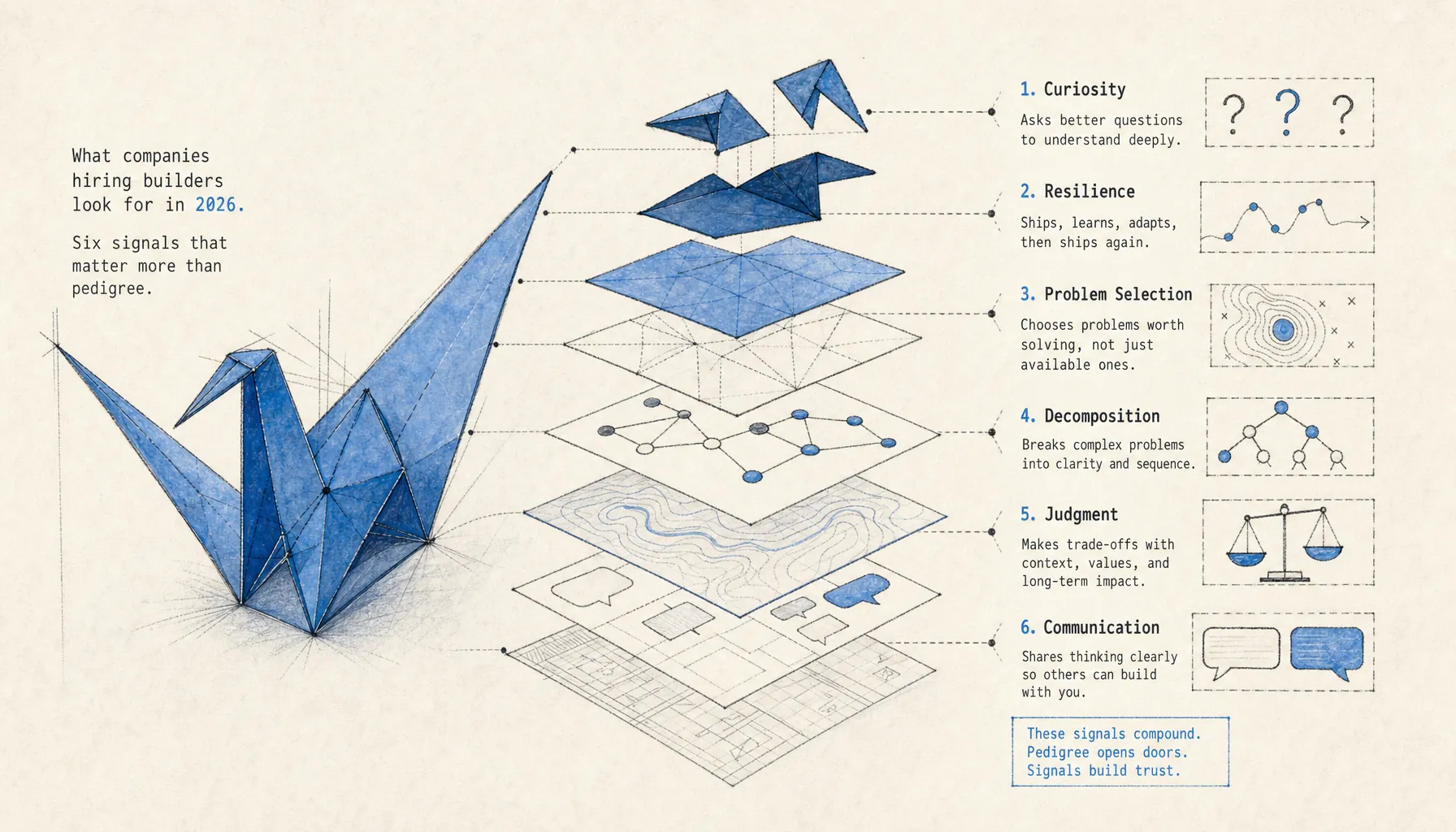
In 2026, the best hiring screens for builders look less like resume review and more like evidence review: what problem did you choose, what did you ship, what broke, and what did you learn?
That is the practical answer to what hiring managers look for in builders in 2026. Most screens now center on six signals: curiosity, resilience, problem selection, decomposition, judgment, and communication. This is not about sounding polished. It is about making your work easy to evaluate.
What are the key takeaways?
- Hiring managers screen builders for evidence of how they think, not just the tools they used.
- The strongest builder proof shows six signals: curiosity, resilience, problem selection, decomposition, judgment, and communication.
- AI fluency is table stakes on many knowledge-work teams. According to Microsoft's 2024 Work Trend Index, 75% of knowledge workers already used AI at work.
- A builder project should show the problem, constraints, trade-offs, failures, shipped artifact, and a short explanation of decisions.
- Pedigree still gets attention, but proof cuts down the guesswork for companies hiring builders.
What do hiring managers look for in builders in 2026?
Hiring managers look for builders who can choose the right problem, break it into workable parts, use AI with judgment, recover from failure, and explain the work clearly enough that a team can trust it.
That 40-word version is the screen. The longer version is more useful. Companies are trying to separate signal from noise in a market where polished applications are cheap to produce. The old screen favored recognizable schools, recognizable employers, and recognizable networks. Those still matter. They do not prove someone can build.
The research lines up pretty cleanly here. According to the World Economic Forum Future of Jobs Report 2025, employers expect 39% of workers' core skills to change by 2030. According to the National Association of Colleges and Employers career readiness competencies, communication, technology, teamwork, and problem solving are core work signals. According to LinkedIn Economic Graph's skills-first research, skills-first evaluation shifts attention away from degree and job-title filters. Microsoft adds the AI reality: 75% of knowledge workers used AI at work in 2024, and 78% brought their own AI tools to work.
Put that together and the hiring problem gets pretty obvious. AI made output easier to manufacture. It did not make good judgment easier to fake. So the question changed: can this person produce useful work when the prompt is messy, the first attempt fails, and the answer has to survive contact with users?
| Source | What it signals | Hiring translation for builders |
|---|---|---|
| World Economic Forum Future of Jobs Report 2025 | Skills change quickly, and analytical thinking remains central. | Show how you learn, test, and adapt under changing constraints. |
| NACE career readiness competencies | Communication, technology use, teamwork, and problem solving matter across roles. | Explain the build in plain language, including decisions and trade-offs. |
| LinkedIn skills-first research | Skill evidence broadens discovery beyond pedigree filters. | Make demonstrated work visible before the interview. |
| Microsoft Work Trend Index | AI use is already common in knowledge work. | Show where AI helped, where it failed, and where you applied judgment. |
This is where Provn's frame matters: performance over pedigree, proof over polish. The best screen is not a prettier resume. It is a clearer signal chain.
For the broader hiring model, the pillar article on how to get hired as a builder in 2026 explains the full proof, judgment, and process loop. This page stays focused on the hiring manager's checklist.
Why does curiosity matter more than tool knowledge?
Curiosity matters because builders deal with problems that do not arrive with a clean spec, a known stack, or one correct answer.
A builder who knows one tool can move fast in one lane. A curious builder can walk into a messy problem, ask why it exists, spot missing context, and test a path forward. Hiring managers look for that habit because AI tools have shortened the distance between question and artifact. The difference now is the quality of the question.
Weak curiosity sounds like tool collecting: “I used Claude, Cursor, v0, and Perplexity.” Strong curiosity sounds like actual investigation: “I noticed onboarding drop-off happened after account creation, interviewed three users, reviewed event logs, and found that the empty state gave no next action.” The second builder did not start with tools. They started with the problem.
In practice, curiosity shows up in the work log. Did you inspect the failure? Did you ask users why they ignored the feature? Did you compare two approaches before shipping? Did you change your mind when the evidence came in? Those sound like small details, but they are usually the difference between real learning and research theater.
There is a trap here. Hiring managers do not reward curiosity as endless wandering. The strong version has direction. It asks better questions so the work gets better.
What curiosity evidence should a builder include?
A builder should include the question that started the project, the evidence gathered, and the decision that changed because of that evidence.
That can be short. Three lines is enough if they are specific: “I assumed users wanted a dashboard. Five interviews showed they wanted alerts before the dashboard. I shipped Slack notifications first and delayed the dashboard.” A hiring manager can actually evaluate that.
If the project is AI-assisted, curiosity also means interrogating the model. What did it get wrong? Which outputs looked plausible but failed? Which assumptions did you verify by hand? For a deeper treatment of the difference between tool fluency and problem sense, see AI tool knowledge vs problem judgment.
How does problem selection reveal builder maturity?
Problem selection shows whether a builder can tell the difference between an impressive artifact and useful work.
Hiring managers do not just ask whether you built something. They ask whether it was worth building. This is where a lot of builder projects lose signal. A polished clone of an existing product proves you can follow a pattern. It rarely proves you can spot a high-value problem inside a company.
Good problem selection usually has four traits. The problem is specific. The user is identifiable. The constraint is real. The outcome can be observed. “Build an AI productivity app” is too broad. “Reduce the time a sales manager spends rewriting messy call notes into CRM updates” is a much stronger problem because the user, pain, workflow, and outcome are all visible.
Hiring managers read problem selection as a proxy for business judgment. Builders who choose small, sharp problems usually ship faster and learn faster. Builders who choose giant abstract problems often disappear into architecture, branding, or demo polish before they prove any value.
| Weak problem choice | Stronger builder problem | Why hiring managers care |
|---|---|---|
| AI personal assistant | Turn unstructured meeting notes into three CRM fields with confidence flags. | Shows workflow specificity and awareness of error risk. |
| Generic marketplace | Match local tutors to last-minute cancellations within a 10-mile radius. | Shows constraint design and operational thinking. |
| Portfolio chatbot | Answer recruiter questions from a verified project archive with citations to artifacts. | Shows trust, source grounding, and use-case discipline. |
The best problems are usually narrower than builders expect. Narrow does not mean low ambition. It means the work can be judged. If you want examples of project scopes that carry hiring signal without getting bloated, the related guide on AI project ideas for builders in 2026 covers that narrower question.
How does decomposition show whether a builder can handle ambiguity?
Decomposition shows whether a builder can turn a vague goal into parts that can be tested, sequenced, delegated, and shipped.
This is one of the most reliable hiring signals because real work rarely arrives as a neat ticket. A head of product says activation is weak. A founder says support volume is too high. A sales lead says demos are inconsistent. The builder has to turn that fog into a path.
Strong decomposition has sequence. It separates the user problem from the technical task. It identifies the riskiest assumption. It creates a first test that can fail quickly. It avoids building the whole system before checking whether the first link in the chain works.
A useful pattern is “map, isolate, test, ship.” Map the workflow. Isolate the bottleneck. Test the riskiest assumption. Ship the smallest useful artifact. That sequence tells a hiring manager you know how to reduce ambiguity without freezing up.
What does strong decomposition look like in a builder project?
Strong decomposition shows the path from messy goal to executable steps, with the riskiest assumption tested before the full build.
Take a support automation project. A weak build starts with “I created an AI support bot.” A stronger build says: “I reviewed 200 support tickets, found that 38% involved billing status, created a retrieval set from billing policy docs, tested answers against 25 historical tickets, and added human review for refunds above $100.” The second version gives a hiring manager a clear view of the reasoning.
The artifact matters. The decomposition matters more. It shows how the builder works when nobody hands them a perfect spec.
Why is judgment the hardest builder signal to fake?
Judgment is the hardest builder signal to fake because it shows up in trade-offs, refusals, risk controls, and decisions made with incomplete information.
AI can produce a first draft. It can generate code. It can summarize user interviews. It can propose a roadmap. It cannot own the consequences of a bad assumption. That is why hiring managers look for builders who know where automation helps and where it needs guardrails.
According to Stanford University's 2025 AI Index Report, AI systems continued to improve across benchmarks, including reasoning and coding-related tasks. The hiring implication is not that human judgment disappears. It is that evaluation moves up a level. If tools can produce more output, the human signal is in choosing, checking, constraining, and explaining that output.
Good judgment often sounds a little unglamorous. “I did not automate refunds because the policy exceptions were too costly.” “I used AI to draft test cases, then manually reviewed edge cases involving account deletion.” “I shipped a rules-based version first because model latency made the AI version worse for the user.” These are not flashy lines. They are trust signals.
Bad judgment usually hides behind output volume. Ten features, no rationale. A working demo, no failure analysis. A slick interface, no explanation of data quality. Hiring managers spot that gap fast because production work punishes missing judgment.
For builders preparing interview explanations, the separate guide on how to explain judgment calls in AI work goes deeper on trade-offs, risk, and answer structure.
How does communication turn proof into hiring signal?
Communication turns proof into hiring signal by making the builder's decisions legible to people who were not there while the work was happening.
This is where strong builders lose opportunities. They ship something real, then explain it like a changelog. Hiring managers do not need every implementation detail upfront. They need the argument: the problem, the user, the constraint, the decision, the result, and the next improvement.
NACE's career readiness framework includes communication as a core competency because work depends on shared understanding, not private brilliance. For builders, that means the demo is part of the work. A good demo does not perform confidence. It transfers context.
The clearest builder explanations usually follow this order:
- State the user problem in one sentence.
- Describe the constraint that made the problem hard.
- Show the artifact doing the job.
- Explain one trade-off you made.
- Name one failure or limitation.
- Describe the next test you would run.
That structure blocks two common mistakes. The first is feature dumping. The second is pretending the project is finished. Hiring managers trust builders who can say what is still unresolved.
If the next step is an interview demo, use the dedicated guide on how to demo something you built in an interview. The key point here is simpler: proof that cannot be understood gets discounted.
Why does resilience mean recovery speed, not inspirational grit?
Resilience means recovery speed: how quickly a builder detects failure, learns from it, and changes course without losing the thread of the work.
Hiring managers do not screen for dramatic stories. They screen for operating behavior. Did the builder notice when the prototype failed? Did they inspect the failure honestly? Did they cut scope instead of abandoning the project? Did they preserve the useful learning?
Resilience is especially visible in AI work because failure often looks uncomfortably close to success. A model returns an answer in a confident tone. A generated component renders correctly but fails accessibility checks. A workflow works on five examples and breaks on the sixth. The resilient builder does not treat the first working demo as the finish line.
The strongest evidence is a failure note. For example: “The first version hallucinated policy details in 4 of 20 test cases. I switched to retrieval from approved documents, added citations, and blocked answers when confidence was low.” That is far more useful than saying “I am resilient.”
Resilience also shows up in scope control. Builders who can cut scope without cutting the learning signal are easier to trust. They can ship a useful wedge, learn from it, and expand from there.
What checklist should builders use before applying or interviewing?
Builders should audit each project for six hiring signals before applying or interviewing: curiosity, problem selection, decomposition, judgment, communication, and resilience.
This checklist is not resume decoration. It is a way to make evidence review easier for companies hiring builders. If a hiring manager has 90 seconds with your work, the signal chain needs to be visible without a guided tour.
Use this before submitting a Provn profile, sending work to a hiring manager, or preparing for an interview.
- Name the business or user problem in one specific sentence.
- Identify the user, buyer, or operator affected by the problem.
- State the constraint that made the work difficult.
- Show the shipped artifact, prototype, analysis, or workflow.
- Explain why you chose this problem instead of an easier or flashier one.
- Break the work into the main decisions, tests, and build steps.
- Describe where AI helped and where human review was required.
- Name one trade-off you made and the option you rejected.
- Document one failure, bug, wrong assumption, or scope cut.
- State what you would test or improve next.
How should builders score their own evidence?
Builders should score their evidence by asking whether a hiring manager can understand the work, trust the reasoning, and see the next decision without extra explanation.
A simple scoring method works well. Give each signal a 0, 1, or 2. Zero means missing. One means mentioned but vague. Two means visible through a concrete artifact, decision, or result. A strong project does not need a perfect 12. It does need enough evidence for a hiring manager to see how you operate.
| Signal | 0: Missing | 1: Vague | 2: Strong |
|---|---|---|---|
| Curiosity | No question or investigation shown. | Mentions research without evidence. | Shows question, evidence, and changed decision. |
| Problem selection | Problem is broad or cosmetic. | User exists but outcome is unclear. | User, pain, constraint, and outcome are specific. |
| Decomposition | No build path shown. | Lists tasks without sequence. | Shows assumptions, tests, and sequence. |
| Judgment | No trade-offs or risk controls. | Mentions decisions without rationale. | Explains trade-offs, rejected options, and checks. |
| Communication | Hard to understand quickly. | Explains features more than decisions. | Clear problem, demo, trade-off, failure, next step. |
| Resilience | No failure or iteration shown. | Mentions iteration without specifics. | Shows failure, diagnosis, change, and learning. |
This is the real difference between polish and proof. Polish asks the hiring manager to believe the presentation. Proof lets the hiring manager inspect the work.
Provn is built around that inspection. Companies hiring builders need a way to find people who can produce useful work, not just people who know how to package themselves. Builders need a way to show work a resume cannot carry. These six signals give both sides a common language.
Frequently Asked Questions
What hiring managers look for in builders 2026?
Hiring managers look for six signals in builders in 2026: curiosity, resilience, problem selection, decomposition, judgment, and communication. The strongest evidence shows a real problem, a shipped artifact or prototype, clear trade-offs, failure analysis, and a concise explanation of how decisions were made.
Do hiring managers still care about pedigree for builder roles?
Pedigree still gets attention because schools, prior employers, and networks are familiar shortcuts. The problem is that those shortcuts do not prove builder capability. Proof of work gives hiring managers a clearer view of how someone thinks, ships, learns, and communicates, whether the familiar names are there or not.
How should a builder show AI-assisted work without looking careless?
A builder should disclose where AI was used, what the tool produced, what was checked manually, and what guardrails were added. Strong AI-assisted work includes source checks, test cases, failure notes, and trade-off explanations. The weak version treats AI output like finished work.
What is the biggest mistake builders make before interviews?
The biggest mistake is showing the artifact without explaining the decision path. Hiring managers need to see why the problem mattered, how the builder broke it down, what trade-offs were made, where the first version failed, and what the builder would test next.
Is a portfolio enough to prove builder ability?
A portfolio is useful when it contains proof, not just screenshots. The strongest builder evidence includes artifacts, demos, work logs, decision notes, failure analysis, and explanation. A polished gallery without reasoning gives hiring managers less signal than a rougher project with clear judgment and learning.