
How to Explain Trade Offs in a Builder Interview
A clear script for explaining product, technical, design, and time trade-offs in builder interviews without slipping into vague process talk.
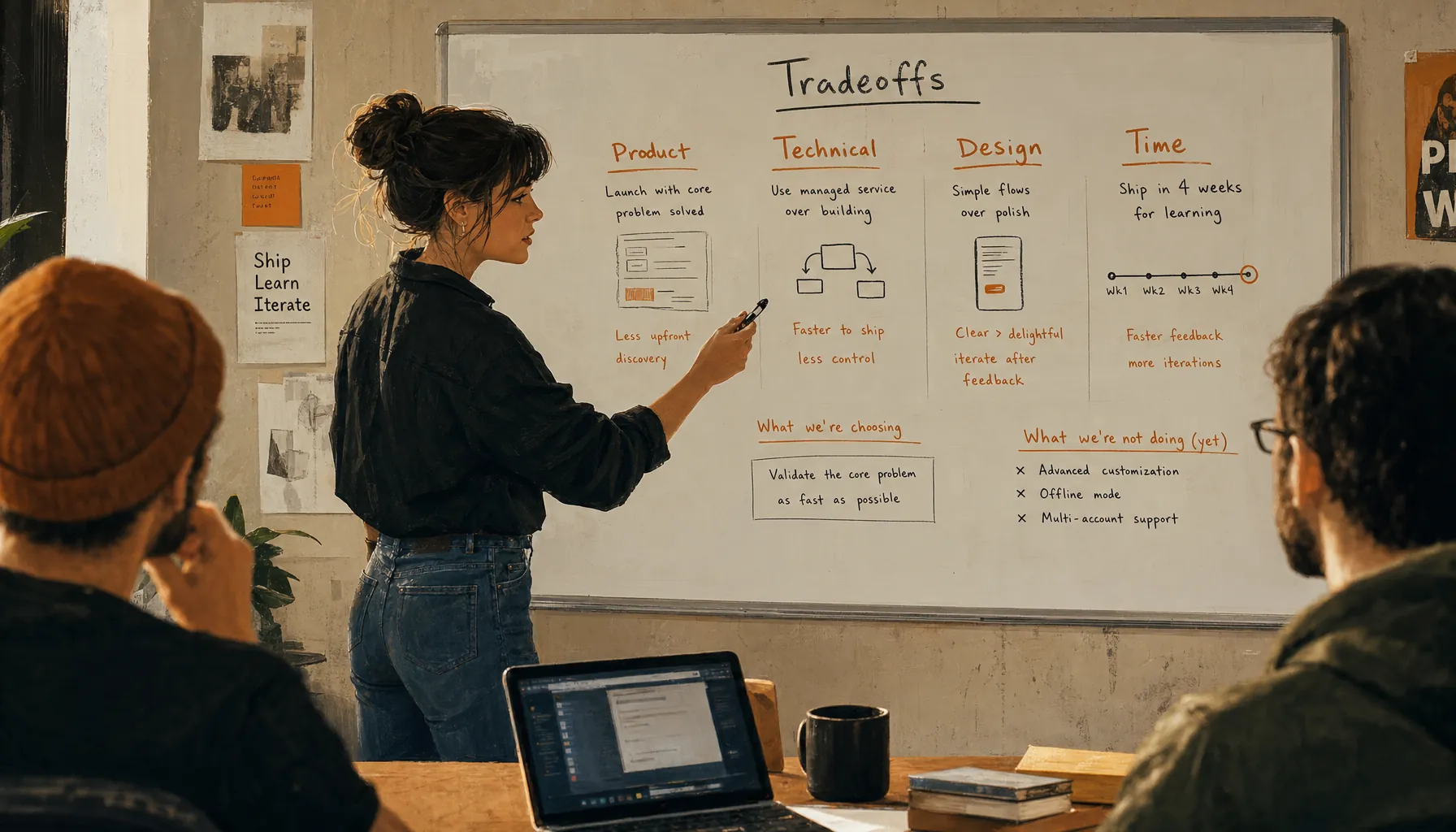
How to Explain Trade Offs in a Builder Interview
The strongest trade-off answers are usually under 90 seconds. They cover four things: the problem, the user, the constraint, and the outcome.
That is the cleanest way to answer this in a builder interview. Companies hiring builders are not checking whether you found some perfect answer. They want to see whether your choice had a reason behind it, a real cost, and a measurable result.
What are the key takeaways for explaining trade-offs in a builder interview?
The best answers make your judgment easy to inspect, not just your final choice.
- Use a four-part answer: problem, user, constraint, outcome.
- Name the option you rejected and the cost you accepted.
- Separate product, technical, design, and time trade-offs. Each one shows a different kind of judgment.
- Use numbers when you have them: latency, conversion, support tickets, build time, error rate, accessibility score, or retention.
- End with what you would revisit if the constraint changed.
How do you explain trade offs in a builder interview?
Explain trade offs by tying the decision to the problem, the user affected, the constraint you faced, and the outcome you measured or expected.
That works because it gives the interviewer a receipt for the decision. It shows what you knew at the time, what you picked, what you gave up, and how you checked whether the choice held up. In 2026, that matters even more. Polished interview answers are cheap now. Clear judgment is still hard to fake.
The bigger hiring pattern is covered in Get Hired as a Builder in 2026: Proof, Judgment, and Process. This page stays narrow on purpose: the exact language to use when an interviewer asks why you chose speed over completeness, simplicity over flexibility, automation over control, or one user segment over another.
What structure keeps a trade-off answer from sounding vague?
A trade-off answer sounds concrete when it follows a fixed sequence: state the goal, name the constraint, compare two real options, justify the choice, and report the result.
Most weak answers fall apart because they skip the rejected option. “We prioritized speed” tells me almost nothing. Speed instead of what? Accuracy? Scope? Security review? Design polish? A builder answer has to show the actual fork in the road.
- Start with the user problem you were solving.
- Name the constraint that forced a choice.
- Compare the two strongest options available at the time.
- State the decision and the cost you accepted.
- Describe the result using evidence, even if it was still early.
- Explain what would make you reverse the decision later.
This structure works well with a live walkthrough. If the interviewer asks to see the work itself, use the companion script in Builder Interview Demo in 2026: Steps and Script instead of trying to make one trade-off answer do the whole job.
How should the core trade-off sentence sound?
The cleanest format is: “For this user, under this constraint, I chose this option because it improved this outcome, while accepting this specific cost.”
Example: “For first-time users trying to finish onboarding in one session, under a two-week launch constraint, I chose a guided setup over a fully customizable setup because completion mattered more than configurability. The cost was that power users had to adjust settings later.”
How do you name the rejected option without sounding defensive?
Treat the rejected option like a real contender, then explain why it lost under the constraint you had.
Bad answer: “The other approach was overbuilt.” Better answer: “A fully configurable workflow would have served advanced users better, but the immediate problem was activation for new users. I deferred configurability until we had evidence that setup friction, not feature depth, was the limiting factor.”
How should builders explain product trade-offs?
Product trade-offs should connect the decision to the user segment, the job to be done, and the behavior you expected to change.
Product answers go sideways when builders talk only about features. Companies hiring builders are listening for priority logic: who mattered most, what pain was most expensive, and why one feature beat another. The screening signals behind that are covered in Hiring Managers Look for in Builders in 2026: Signals and Requirements.
| Trade-off | Weak answer | Builder answer |
|---|---|---|
| New users vs. power users | “We made it simpler.” | “We reduced first-session setup steps from six to three because activation was the bottleneck. The cost was less control for advanced users, which we moved into settings.” |
| Retention vs. acquisition | “We focused on growth.” | “We delayed referral features because existing users were not reaching the habit moment. More acquisition would have poured traffic into a leaky experience.” |
| Depth vs. breadth | “We narrowed scope.” | “We supported one workflow end to end before adding adjacent workflows, because partial support across many use cases created more support load than value.” |
How should builders explain technical trade-offs?
Technical trade-offs should show how you balanced performance, reliability, maintainability, security, and delivery speed.
According to ISO/IEC 25010 software quality models, product quality includes performance efficiency, compatibility, usability, reliability, security, maintainability, and portability. That list is useful in interviews because it gives builders plain labels for trade-offs that might otherwise sound like personal preference.
Example: “I used a managed database instead of running our own because the team needed reliability more than infrastructure control. The cost was vendor dependency and less tuning flexibility. If query volume crossed a sustained threshold, I would revisit that choice with real workload data.”
According to Google’s Site Reliability Engineering chapter on embracing risk, 100 percent reliability is usually the wrong target because reliability has a cost, and users often cannot tell the difference past a certain point. That is a useful line in an interview because it turns “I care about reliability” into something sharper. Reliability is a budget, not a slogan.
Security trade-offs need more care. According to the OWASP Top 10, common web application risks include broken access control, injection, and security misconfiguration. If you skipped a hardening task to ship faster, do not gloss over it. Say what protections stayed in place, what risk remained, and what trigger would force a fix.
This is also where AI-heavy work changes the standard. For builders working across code, systems, and automation, Agentic Engineer Hiring in 2026: CPTO Signals and Requirements goes deeper on the technical judgment companies hiring builders are trying to see.
How should builders explain design trade-offs?
Design trade-offs should explain whose experience improved, whose experience got worse, and why that was acceptable for the problem at hand.
Design choices often get framed as taste. In interviews, taste is not enough. You need to show usability reasoning. According to Nielsen Norman Group research on response time limits, 0.1 second feels instantaneous, 1 second keeps a user’s flow of thought, and 10 seconds usually breaks attention. That gives you concrete language for a design trade-off around animation, loading states, or progressive disclosure.
Accessibility is another place where vague answers weaken builders. According to W3C Web Content Accessibility Guidelines 2.2, normal text generally requires a contrast ratio of at least 4.5:1, while large text generally requires at least 3:1. A strong answer names that directly: “We changed the visual treatment because the original palette looked better in mockups but failed contrast requirements for body text.”
If you need to show evidence of the design decision itself, connect the answer to artifacts. A strong Proof of Work Portfolio for Builders in 2026: Examples and Checklist should include the before state, the rejected direction, the final version, and the result.
How should builders explain time trade-offs?
Time trade-offs should make the deadline visible and show what you cut, deferred, automated, or simplified to protect the outcome that mattered most.
Time pressure exposes builder judgment fast. Anyone can say they worked quickly. The useful answer says what speed cost.
| Deadline pressure | Choice | Accepted cost | Good interview language |
|---|---|---|---|
| Demo in 48 hours | Prototype the core flow only | No edge-case coverage | “I proved the riskiest assumption first and left admin states out of scope.” |
| Launch in two weeks | Manual ops behind the scenes | Higher internal effort | “I kept the user experience clean while delaying automation until volume justified it.” |
| Team bandwidth capped | Reuse existing component patterns | Less visual novelty | “Consistency beat originality because speed and usability mattered more.” |
This matters across roles. Builder Roles vs Job Titles in 2026: Product and Engineering Teams explains why the same person may need to reason across product, design, and implementation instead of staying inside a narrow title.
What mistakes make trade-off answers sound weak?
Weak trade-off answers sound weak because they describe activity instead of judgment.
- Listing tools instead of decisions: “I used Cursor and Figma” does not explain what changed because of your choice.
- Claiming no trade-off existed: Every meaningful decision has a cost. If you cannot name it, the interviewer will assume you missed it.
- Overclaiming certainty: Say what evidence you had, what you lacked, and what you would measure next.
- Hiding AI assistance: If AI helped with code, research, copy, or testing, explain what you delegated and what you verified.
- Confusing credentials with proof: A certificate says you finished a course. A trade-off answer shows how you think under constraint.
The credential-versus-evidence distinction is covered in Certifications vs Portfolio in 2026: Production and Hiring Signals. Same logic here: the screen gets better when the work is visible.
AI has made this more obvious. AI Resume vs Proof of Work in 2026: Screening and Signals explains why polished application materials create more noise for companies hiring builders, while AI-Written Resume in 2026: How Builders Prove Work covers how builders can point back to actual decisions.
What scripts can builders use for product, technical, design, and time trade-offs?
Reusable scripts help when they preserve the decision logic and still leave room for project specifics.
Do not memorize these word for word. Use them as guardrails.
What is a strong product trade-off script?
A product trade-off script should identify the user segment and the behavior the decision was meant to change.
“The main user problem was [problem]. I considered [option A] and [option B]. I chose [option A] because [user segment] needed [outcome] more than [secondary benefit]. The cost was [cost], which I accepted because [reason]. I checked the decision by looking at [metric, feedback, or usage pattern].”
What is a strong technical trade-off script?
A technical trade-off script should name the engineering quality you protected and the one you gave up.
“I optimized for [reliability, speed, maintainability, security, cost] because [constraint]. The alternative was [alternative]. I rejected it because [reason]. The risk was [risk], so I added [guardrail, test, monitoring, review, fallback]. If [trigger] happened, I would change the architecture.”
For AI-specific examples, Judgment Calls in AI Work in 2026: Trade-Offs and Answers gives a tighter set of scripts for model choice, prompt control, verification, and human review.
What is a strong design trade-off script?
A design trade-off script should connect usability evidence to a concrete interface choice.
“The design tension was [simplicity vs. control, speed vs. clarity, density vs. readability]. I chose [direction] for [user type] because [reason]. The cost was [cost for another user or scenario]. I validated it with [test, heuristic, accessibility check, support signal, or usage data].”
What is a strong time trade-off script?
A time trade-off script should say what was deliberately left out and why that omission was the responsible call.
“Given [deadline or resource constraint], I cut [scope] and protected [core outcome]. That meant [accepted cost]. I made that choice because [risk or user need] mattered more at that stage. The next thing I would add is [next step] once [condition] is true.”
If you need a project to practice these scripts, AI Project Ideas for Builders in 2026: Hiring Examples lists examples you can actually build. If the interviewer asks what counts as evidence in the first place, point them to the concept covered in Proof of Work for Builders: Definition and Examples.
Frequently Asked Questions
What is the best way to explain trade-offs in a builder interview?
The best way is to use a four-part structure: problem, user, constraint, and outcome. Name the option you chose, the option you rejected, the cost you accepted, and the evidence you used to judge whether the decision worked.
How long should a trade-off answer be in an interview?
Most trade-off answers should take 60 to 90 seconds before the interviewer asks follow-up questions. A strong answer stays short, but still gives enough detail to show the decision logic.
What is an example of a technical trade-off answer?
A strong technical answer sounds like this: “I used a managed service because reliability and delivery speed mattered more than infrastructure control. The cost was vendor dependency. I accepted that cost because the product had not reached the scale where custom infrastructure would pay for itself.”
Should builders mention AI tools when explaining trade-offs?
Yes. Builders should mention AI tools when those tools changed speed, quality, or scope. The stronger answer explains what AI produced, what the builder verified, and where human judgment changed the output.
What should builders avoid when explaining trade-offs?
Builders should avoid vague lines like “we prioritized users” or “we moved fast.” Those claims only become useful interview evidence when you attach them to a specific user, a real constraint, a rejected alternative, and a result.