
Engineering Builder Portfolio: Code, Demos, Judgment
A hiring-ready engineering builder portfolio shows working code, architecture choices, AI use, and debugging judgment. The goal is to show how the system came together, not just that it works.
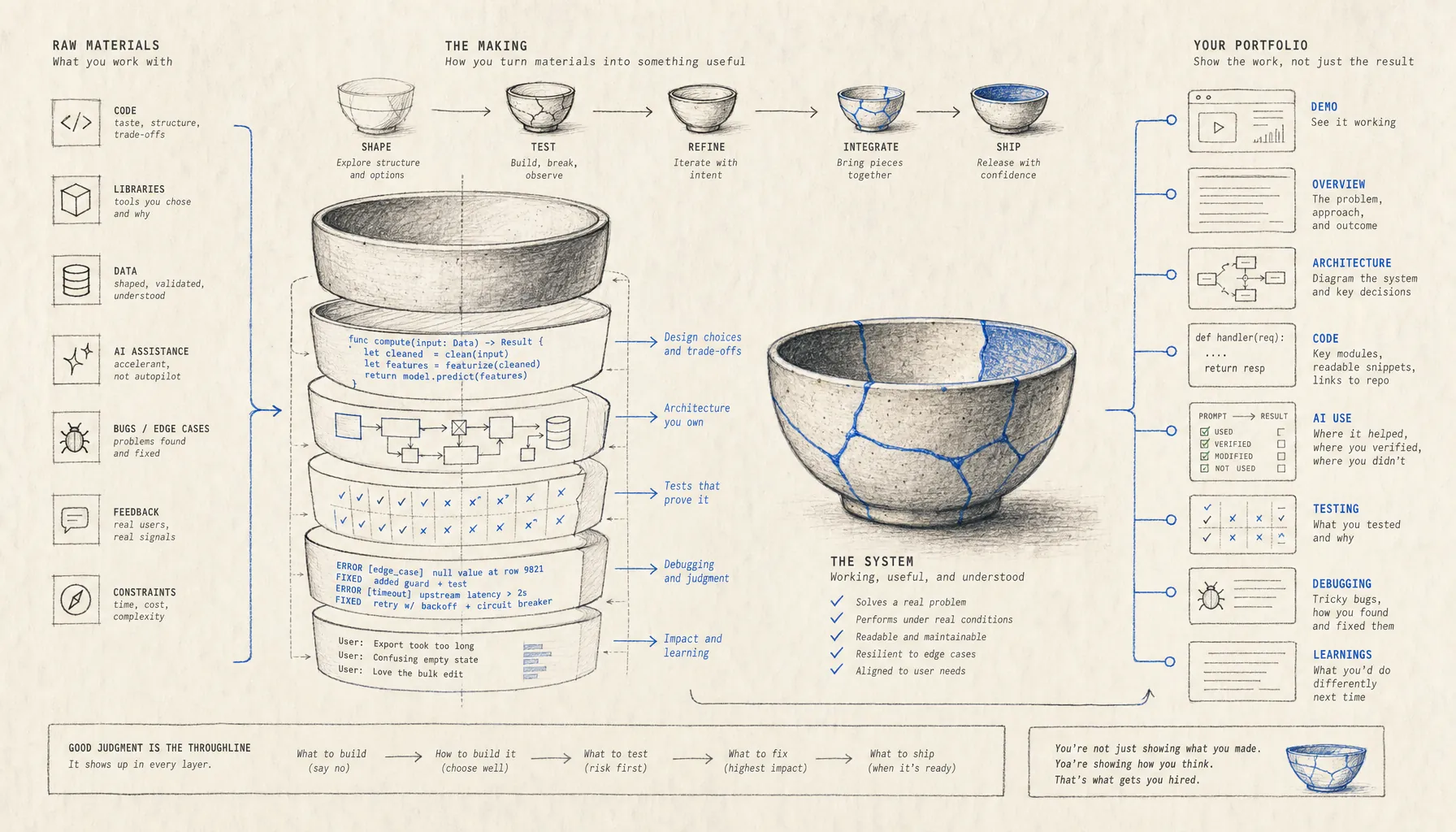
A hiring-ready engineering builder portfolio has five artifacts: runnable code, a demo, architecture notes, AI usage disclosure, and debugging evidence.
In 2026, companies hiring builders are sorting through polished resumes, AI-written summaries, and GitHub links that all blur together. The builders who get remembered show the work behind the work: what they built, why it works, what they tried and rejected, where it broke, and how they decided it was ready.
Key takeaways
- An engineering builder portfolio should contain runnable code, a recorded or live demo, a short architecture memo, AI usage notes, and debugging evidence.
- The strongest portfolios make judgment visible. They show trade-offs, constraints, failure modes, and what changed after testing.
- A public GitHub repository helps only if the README, commit history, test instructions, and deployment notes make the work easy to inspect.
- AI-assisted code needs disclosure: what the tool generated, what the builder reviewed, and what tests or safeguards caught errors.
- A portfolio should read like an engineering lab notebook, not a trophy shelf.
What belongs in an engineering builder portfolio?
An engineering builder portfolio should prove that a builder can take an ambiguous problem and turn it into working software with clear technical judgment.
That proof usually fits on one project page. The page links to the repo, the demo, a short write-up, and the evidence trail. You do not need ten projects. Three finished projects with clear judgment beat fifteen half-explained experiments every time.
Think of the portfolio as a lab notebook. A trophy case says, “Here is the finished thing.” A lab notebook says, “Here was the problem, here was the guess, here is what I built, here is what failed, and here is what changed.” Companies hiring builders can inspect the second one. The first one mostly asks for applause.
A good project page answers five questions:
- What problem did this solve? State the user, workflow, or system pain in one paragraph.
- What did you build? Link the deployed app, repo, API docs, or CLI instructions.
- Why did the solution work? Explain the architecture, data model, failure handling, and trade-offs.
- Where did AI help? Name the tools, tasks, review process, and boundaries.
- What did debugging prove? Show logs, tests, incident notes, performance measurements, or before-and-after fixes.
This is the engineering-specific version of the broader Get Hired as a Builder in 2026: Proof, Judgment, and Process model. The narrow point here is code evidence. The signal is not polish. It is reasoning a reviewer can actually inspect.
How should engineers present code in a hiring-ready portfolio?
Engineers should present code so a reviewer can run it, understand it, and verify the main claim within minutes.
A GitHub link by itself is weak evidence. Most reviewers are not going to reverse-engineer your intent from a folder tree and hope for the best. The README has to pull real weight. According to GitHub’s documentation on repository READMEs, a README is where maintainers explain what a project does, why it is useful, and how users can get started. In a hiring context, that README is your first technical interview.
The repo should include:
- One-command setup: Docker Compose, npm scripts, Makefile, or explicit environment steps.
- Test path: unit tests, integration tests, sample inputs, or a reproducible smoke test.
- Code map: three to five bullets explaining the main directories and why they exist.
- Known limits: unfinished features, scaling constraints, security gaps, or mocked services.
- Decision notes: short comments or docs explaining non-obvious choices.
The common mistake is treating code volume as proof. Companies hiring builders read for compression. They want to know whether you can reduce complexity, choose the right abstraction, and avoid clever code that becomes maintenance debt six months later. For a broader checklist across roles, see Proof of Work Portfolio for Builders in 2026: Examples and Checklist.
How should builders show demos without turning the portfolio into a highlight reel?
A demo should show the core workflow, the boundary conditions, and one real failure path.
Most portfolio demos are too clean. They show the happy path and nothing else. That proves the UI can survive a rehearsed click sequence. It does not prove the builder understands the system underneath it.
A better engineering demo runs for two to four minutes and follows this sequence:
- Start with the user problem. Show the state before the tool exists.
- Run the primary workflow. Use realistic sample data, not lorem ipsum.
- Trigger a failure case. Show empty input, bad auth, rate limits, malformed JSON, duplicate records, or timeout behavior.
- Open the code briefly. Point to the function, service, queue, or model that makes the workflow work.
- Explain the trade-off. Say what you optimized for and what you left unsolved.
The best demos are a little uncomfortable because they show the rough edges. Good. Real software has rough edges. A builder who can name them is easier to trust than one who edits them out. For the interview version of this sequence, use Builder Interview Demo in 2026: Steps and Script.
How do architecture choices prove engineering judgment?
Architecture choices prove judgment when the builder connects constraints to decisions instead of just listing technologies.
“Built with Next.js, Supabase, and OpenAI” tells a company hiring builders almost nothing. It names tools. It does not show judgment. A stronger architecture note explains why the stack fit the problem, what alternatives got rejected, and which constraint mattered most: latency, cost, developer speed, privacy, reliability, or maintainability.
| Weak portfolio note | Hiring-ready architecture note |
|---|---|
| Used PostgreSQL for storage. | Used PostgreSQL because the workflow required relational joins between users, projects, and review events. Rejected document storage because audit queries mattered more than schema flexibility. |
| Added a queue for background jobs. | Moved transcript processing to a queue after API requests exceeded the 30-second hosting timeout during test runs. |
| Used an LLM for classification. | Used an LLM only after rules failed on ambiguous inputs. Added confidence thresholds and manual review for low-confidence cases. |
Security and reliability choices carry extra weight. According to the OWASP Top 10 for Large Language Model Applications, prompt injection, sensitive information disclosure, and excessive agency are real risk categories for LLM applications. If a project uses agents, tools, retrieval, or user-supplied prompts, the portfolio should show the guardrails.
This is where engineering portfolios start to overlap with agentic engineering. Builders working on multi-step AI systems should read Agentic Engineer Hiring in 2026: CPTO Signals and Requirements for the hiring signals tied to agents, tools, and production responsibility.
How should engineers disclose AI usage in portfolio work?
Engineers should disclose AI usage by separating generation, review, testing, and final ownership.
Hiding AI usage is a mistake. Overplaying it is a mistake too. The useful signal is control. A builder needs to show where AI sped up the work and where human judgment stayed in charge.
The National Institute of Standards and Technology frames AI risk management around mapping, measuring, managing, and governing risk in the NIST AI Risk Management Framework. A portfolio can borrow that discipline without turning into a compliance memo. State what the AI system did, where it was allowed to act, how outputs were checked, and what failure modes remained.
A clean disclosure looks like this:
- Tool use: “Used Claude for test-case brainstorming and refactoring suggestions.”
- Human review: “Accepted generated code only after reading each diff and rewriting error handling.”
- Verification: “Added regression tests for three bugs introduced during AI-assisted refactoring.”
- Boundary: “Did not use AI to design auth logic or review secrets handling.”
This matters because companies are separating prompt fluency from engineering judgment. The related screening problem is covered in AI-Written Resume in 2026: How Builders Prove Work. For an engineering portfolio, the answer is simple: show the diff, show the test, show the review.
What debugging evidence should an engineering portfolio include?
Debugging evidence should show how the builder found the cause, tested the fix, and stopped the same failure from coming back.
This is the most underused portfolio signal. Builders often delete the messy parts once the app works. I get the impulse, but it strips out the evidence companies hiring builders actually want.
Good debugging artifacts include:
- A short incident note describing the symptom, cause, fix, and prevention.
- A failing test that became a passing regression test.
- Before-and-after logs for latency, memory use, or API failure rates.
- A screenshot of an error state paired with the code that fixed it.
- A commit sequence that shows diagnosis rather than one giant final commit.
According to Google’s Site Reliability Engineering guidance on postmortem culture, postmortems work best when they focus on learning from incidents rather than assigning blame. A portfolio version can be much shorter. The useful part stays the same: show causality, correction, and learning.
Debugging also exposes trade-offs. A builder who says, “I added caching,” has not said much. A builder who says, “I cached only read-heavy dashboard queries because writes needed fresh state,” has shown system judgment. For more examples of how to talk through those calls, see Builder Interview Trade-Offs in 2026: Answers and Examples.
How do you build the portfolio step by step?
Build the portfolio by picking one serious project, making it reproducible, and documenting the decisions that shaped it.
The order matters. Do not start with visual polish. Start with evidence. A plain page with runnable code and sharp notes beats a beautiful site that hides the engineering.
- Select one project that solved a real workflow, system, or user problem.
- Write a one-paragraph problem statement that names the user, constraint, and outcome.
- Clean the repository so setup, environment variables, tests, and sample data are easy to inspect.
- Record a two-to-four-minute demo that shows the main workflow and one failure path.
- Add an architecture note explaining the stack, rejected alternatives, and main trade-off.
- Document AI usage by naming the tools, generated artifacts, review process, and test coverage.
- Include one debugging artifact that shows diagnosis, fix, and prevention.
- Publish the portfolio page with links to the repo, demo, architecture note, and evidence trail.
One final pass: remove claims that cannot be inspected. “Scalable,” “production-ready,” and “AI-powered” do not mean much unless the portfolio shows load assumptions, deployment details, monitoring, data boundaries, or test coverage. The job of the engineering builder portfolio is to make the reviewer’s job easier and cut down guesswork.
Frequently Asked Questions
How many projects should an engineering builder portfolio include?
Most engineering builder portfolios need two or three strong projects. One flagship project can work if it includes runnable code, a demo, architecture notes, AI usage disclosure, and debugging evidence. Five shallow projects usually create more noise than signal.
Should an engineering builder portfolio include unfinished projects?
An unfinished project can belong in the portfolio if the unfinished state teaches something useful. Label what works, what does not, what you would build next, and why you stopped. Do not present a prototype as a finished system.
Is GitHub enough for an engineering builder portfolio?
GitHub is not enough by itself. It stores the code, but the portfolio still needs to explain the problem, demo the workflow, name the architecture choices, disclose AI usage, and show debugging judgment. A reviewer should not have to piece together the project story from commits alone.
How should engineers show AI-assisted code without weakening the portfolio?
Engineers should show AI-assisted code by documenting the task, generated output, human review, tests, and final changes. The signal is ownership. Companies hiring builders want to see that the builder can use AI without handing judgment over to the tool.
What is the biggest mistake in an engineering builder portfolio?
The biggest mistake is showing that the project runs without explaining why it works. A hiring-ready portfolio connects code, demo, architecture, AI usage, and debugging into one evidence trail. That is what separates proof from polish.