
Product Manager Builder Portfolio: Prove Judgment
A practical guide for PM builders to create a portfolio that shows how you frame problems, prototype, prioritize, surface user insight, and think through product decisions without making up results.
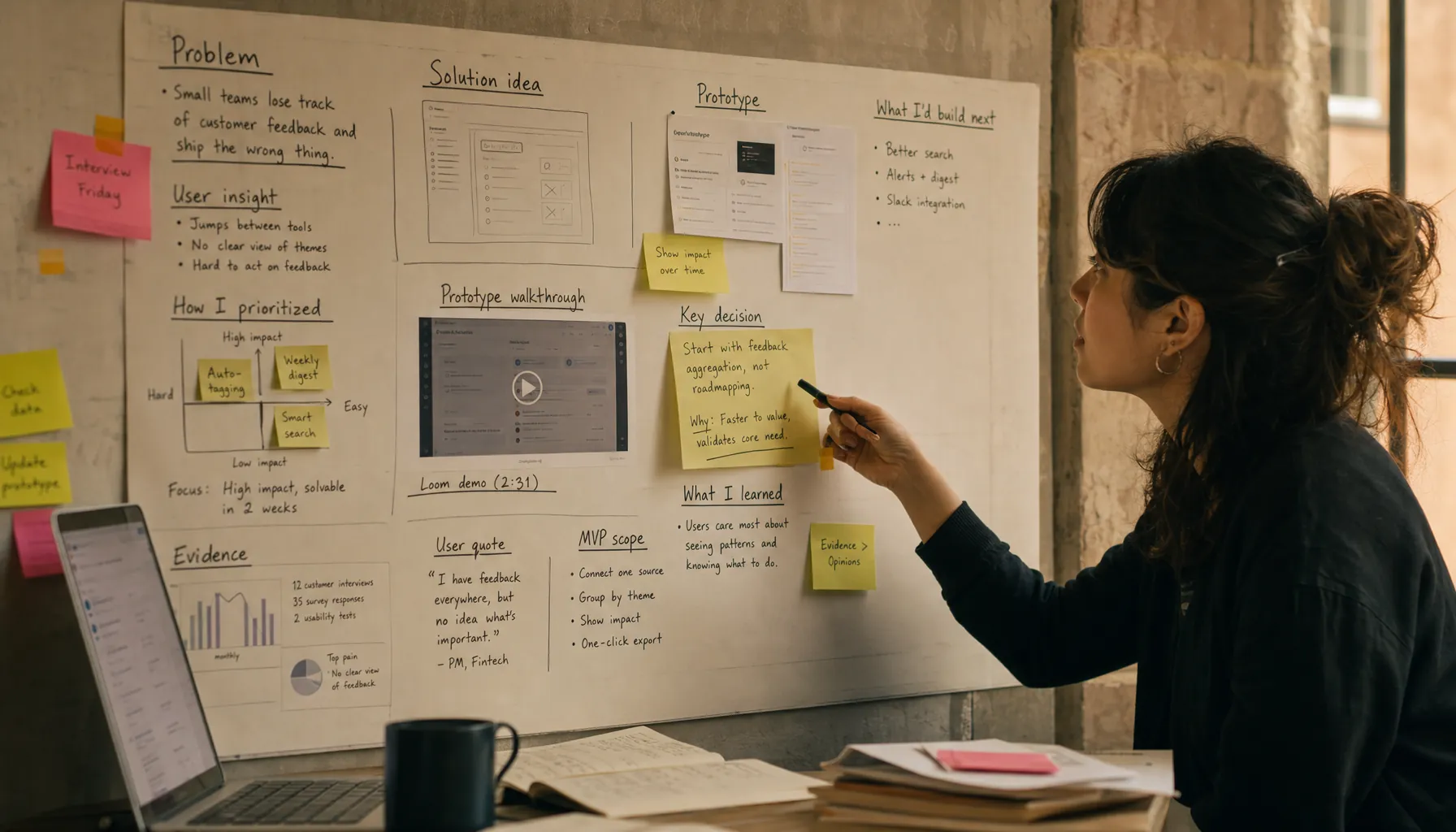
Product Manager Builder Portfolio: Prove Product Judgment
Most product manager portfolios fall apart for the same reason: they read like a roadmap graveyard. Slick slides. Feature names. Launch dates. But none of the actual thinking. A strong product manager builder portfolio shows how a PM frames a problem, builds a prototype, weighs trade-offs, learns from users, and makes calls with imperfect information. It does not fake certainty, and it does not pretend every project ended with a tidy revenue chart.
The hiring screen is noisy in 2026. Companies hiring builders keep seeing polished applications that blur together. A portfolio needs to work more like a flight recorder. It should show the inputs, the constraints, the choices, and the judgment behind the work.
Key Takeaways
- A PM builder portfolio should prove product judgment, not roadmap ownership or title scope.
- Three strong case studies usually beat eight thin project summaries.
- Each case study should include the problem, users, constraints, prototype, prioritization logic, trade-offs, and what changed after feedback.
- Do not invent outcomes. If business metrics are unavailable, use decision quality, evidence quality, prototype behavior, and learning speed.
- If AI helped, say what the tool did, what the PM decided, and where human judgment changed the output.
What is a product manager builder portfolio?
A product manager builder portfolio is a curated proof file that shows how a PM turns messy problems into testable product decisions. It should make judgment visible through artifacts: prototypes, user notes, prioritization matrices, decision logs, and short walkthroughs.
That is different from a standard PM portfolio. A standard portfolio often says, “I owned checkout, activation, or onboarding.” Maybe true. Still thin. Ownership is an org chart fact. It does not tell anyone whether the PM made a good call when the data was incomplete, the team was short on time, or user feedback cut against the first idea.
The closest hiring analogy is the NFL combine. A college program name matters less once the scout can watch the athlete run, throw, lift, and respond under pressure. Provn’s broader hiring model follows that same logic: proof beats pedigree when the work can be inspected. For the larger hiring frame, see Get Hired as a Builder in 2026: Proof, Judgment, and Process.
For PMs, the portfolio should answer one question: would this person make better product decisions with limited information than another PM with a cleaner resume?
What should a product manager builder portfolio prove?
A product manager builder portfolio should prove five things: problem framing, customer insight, prioritization, prototype fluency, and measurable reasoning. Those are the signals companies hiring builders can inspect before handing a PM real scope.
The work should show how the PM thinks before it shows what the PM shipped. According to The Scrum Guide’s definition of the Product Backlog and Product Goal, product work is organized around an ordered set of improvements serving a goal. So a PM portfolio should show the ordering logic, not just a list of features.
| Signal | Weak portfolio evidence | Strong builder evidence |
|---|---|---|
| Problem framing | “Users were confused.” | Three observed user behaviors, one root-cause hypothesis, and the rejected alternate explanations. |
| Prioritization | A roadmap screenshot. | A scored option set with explicit assumptions and constraints. |
| User insight | Persona slides. | Interview notes, patterns, quotes, and what changed after the research. |
| Prototype fluency | Static mockups. | A clickable or working prototype that tests the riskiest assumption. |
| Measurement | Invented uplift claims. | Clear success metrics, proxy metrics, and what evidence would confirm or reject the bet. |
When hiring managers inspect these signals, they are trying to separate polish from capability. The companion piece Hiring Managers Look for in Builders in 2026: Signals and Requirements covers that screen from the hiring side.
How should PMs choose portfolio projects?
Choose projects where the decision process is visible, the problem is specific, and the artifact can be inspected. A small project with sharp reasoning beats a big project where the PM can only talk about meetings, launches, and coordination.
Pick projects with constraint. Constraint is where judgment shows up. A vague case study like “build an AI assistant for sales teams” will read like a prompt exercise. A stronger version sounds like this: “Reduce the time account executives spend rewriting follow-up emails after discovery calls, with a prototype that turns call notes into three editable follow-up options.” Now there is a user, a workflow, a risk, and behavior you can test.
Use this filter before adding a project:
- Choose a problem where one user group has a repeated, observable pain.
- Define the current workflow before proposing a solution.
- Identify the riskiest assumption in the product idea.
- Build the smallest prototype that tests that assumption.
- Collect feedback from at least three relevant users or informed proxies.
- Record what changed after feedback and what stayed the same.
- Write the trade-off you made and the alternative you rejected.
If you want broader examples across builder portfolios, use Proof of Work Portfolio for Builders in 2026: Examples and Checklist as the general checklist, then narrow the evidence here to PM judgment.
How do you show product judgment without inventing outcomes?
You do it by separating claimed impact from demonstrated reasoning. If you do not have access to revenue, retention, activation, or conversion data, say that directly and show the evidence you did have.
This is where a lot of PM portfolios go sideways. A builder should not write “increased retention by 18%” unless that number came from a real measurement system and the PM can explain attribution without squirming. Companies hiring builders will ask. The cleaner move is to state the evidence you actually have: five user sessions, two repeated failure points, one prototype revision, and the metric you would track in production.
According to Nielsen Norman Group’s usability testing guidance, small tests can uncover many usability problems, though they do not replace quantitative validation. That distinction matters. User tests can support product learning. They do not prove business impact.
Use this evidence ladder:
| Evidence level | What it proves | What it does not prove |
|---|---|---|
| Prototype walkthrough | The PM can turn an idea into an inspectable workflow. | Users want it or the business should fund it. |
| User feedback | The PM can learn from real reactions. | The product will scale. |
| Behavioral test | Users completed or failed a task under observed conditions. | Long-term retention or monetization. |
| Production metric | A measured change occurred in the product. | The PM alone caused the change. |
This same discipline matters when AI writes a polished application around thin evidence. The distinction is covered in AI Resume vs Proof of Work in 2026: Screening and Signals and AI-Written Resume in 2026: How Builders Prove Work.
What should each product case study include?
Each PM builder case study should include the context, problem, users, constraints, decision options, prototype, feedback, trade-offs, and measurement plan. The reader should be able to replay the product decision without chasing missing context.
Use one page per case study when possible. The goal is not density. The goal is inspection. A hiring manager should be able to see the fork in the road and understand why you chose one path over another.
What problem framing should a PM portfolio show?
Problem framing should show the difference between symptoms, root causes, and product bets. A useful format is: observed behavior, user cost, business cost, hypothesis, and disconfirming evidence.
Example: “Support managers spend 22 minutes tagging escalation themes after each weekly review. The user cost is manual cleanup. The business cost is delayed pattern detection. The hypothesis is that a review assistant can pre-cluster themes from notes. The risk is false grouping that hides urgent issues.” That is a product problem. “Build an AI tagging feature” is just a solution phrase wearing a product costume.
What prioritization framework belongs in a PM portfolio?
A PM portfolio should show a prioritization framework only when the inputs are visible. Framework names do not prove judgment unless the PM explains the scoring and the trade-off.
RICE is useful because it forces the PM to estimate reach, impact, confidence, and effort. According to Intercom’s original RICE prioritization explanation, confidence is included because estimates vary in evidence quality. That is the part worth showing. A high-impact idea with low confidence should read differently from a moderate-impact idea backed by repeated user behavior.
In interviews, the trade-off explanation usually matters more than the score. See Builder Interview Trade-Offs in 2026: Answers and Examples for the answer pattern, especially if you need a stronger framework for how to explain judgment calls in AI work.
How should PM builders present prototypes and AI-assisted work?
PM builders should present prototypes as decision instruments, not design theater. The prototype should test the riskiest assumption in the product idea and make the PM’s reasoning visible.
A prototype does not need production code. It does need behavior. A Figma click-through can test navigation. A lightweight Lovable, Replit, or Cursor prototype can test workflow logic. A spreadsheet model can test prioritization or pricing assumptions. The artifact should match the risk.
AI-assisted work needs clear disclosure. State what AI helped produce, what prompts or inputs shaped the output, what you changed, and where you overruled the tool. According to Google’s HEART framework paper on user-centered metrics, product teams can evaluate happiness, engagement, adoption, retention, and task success. A PM builder can use that structure to explain which metric matters after launch, even if the portfolio project is still pre-launch.
For demo technique, use Builder Interview Demo in 2026: Steps and Script. If the prototype itself is AI-heavy, use AI Prototype Interview Demo in 2026: Steps and Script to prepare the walkthrough, and review how to explain AI assisted work in an interview so the tool contribution stays clear and credible.
Where does a PM builder portfolio fit with roles, titles, and certifications?
A PM builder portfolio matters most when titles and credentials do not show actual product capability. It gives companies hiring builders a way to inspect work across product, design, analysis, and prototyping.
This matters because builder roles rarely map cleanly to old job titles. A PM may prototype in code. A designer may show stronger product judgment than someone with a PM title. An engineer may frame the customer problem better than both. That does not make titles useless. It just means they are incomplete screens.
For the role boundary question, see Builder Roles vs Job Titles in 2026: Product and Engineering Teams. For the credential question, see Certifications vs Portfolio in 2026: Production and Hiring Signals. For engineering-adjacent PM work, the hiring signal overlaps with Agentic Engineer Hiring in 2026: CPTO Signals and Requirements, especially when the PM can reason through agent behavior, failure modes, and product constraints.
If you need project prompts, use AI Project Ideas for Builders in 2026: Hiring Examples. If you need the base definition of proof in this model, use Proof of Work for Builders: Definition and Examples. If the hardest part is explaining AI judgment, use Judgment Calls in AI Work in 2026: Trade-Offs and Answers.
How do you build the portfolio step by step?
Build the portfolio by selecting three inspectable product decisions and documenting the evidence behind each one. The finished portfolio should read less like a slide deck and more like a decision record.
- Select three projects where you made a visible product decision under constraint.
- Write the user problem in one sentence with the user, pain, frequency, and cost.
- Map the current workflow before showing any solution.
- List three solution options and explain why two were rejected.
- Build a prototype that tests the riskiest assumption.
- Collect user or proxy feedback and record the exact changes it caused.
- Define the production metric, proxy metric, and failure signal for the idea.
- Record where AI assisted the work and where human judgment changed the output.
- Create a five-minute walkthrough that shows the problem, prototype, trade-off, and metric plan.
Provn is where builders get hired. Performance over pedigree. Proof over polish. For PMs, the portfolio has one job: make product judgment inspectable.
Frequently Asked Questions
How many projects should a product manager builder portfolio include?
Most PM builder portfolios should include three strong projects. That is enough range to show problem framing, prioritization, prototypes, and product reasoning without dragging the reader through filler.
Should a PM portfolio include projects that never launched?
Yes, if the project shows real product judgment. A project that never launched can still prove user insight, prototype fluency, prioritization, and measurement thinking. Just label it honestly and do not claim production outcomes.
What if I cannot share company work because it is confidential?
Use sanitized artifacts, recreated workflows, or a fresh project built around a public problem. Remove company names, private metrics, customer data, and internal screenshots. Keep the decision structure: problem, options, trade-off, prototype, and measurement plan.
Do PM builders need to code for the portfolio to be credible?
No. Coding helps when it lets the PM test behavior faster, but the core signal is product judgment. A credible PM builder portfolio can use Figma, spreadsheets, no-code tools, research artifacts, or lightweight code, as long as the artifact tests the right assumption. Teams comparing formats may also look at an engineering builder portfolio or a product designer builder portfolio to see how adjacent builder roles make shipped work and judgment inspectable.
How should PMs disclose AI-assisted portfolio work?
State which parts AI helped produce, including research synthesis, prototype code, copy, analysis, or test data. Then state the human decisions: what you accepted, rejected, changed, and verified. That makes the work stronger because it shows judgment instead of tool dependence.