
AI Tool Knowledge vs Problem Judgment | Provn AI Career Hub
Tool fluency tells you whether a builder can use modern AI software. Judgment tells you whether they can pick the right problem, work within real constraints, and ship work that holds up under scrutiny.
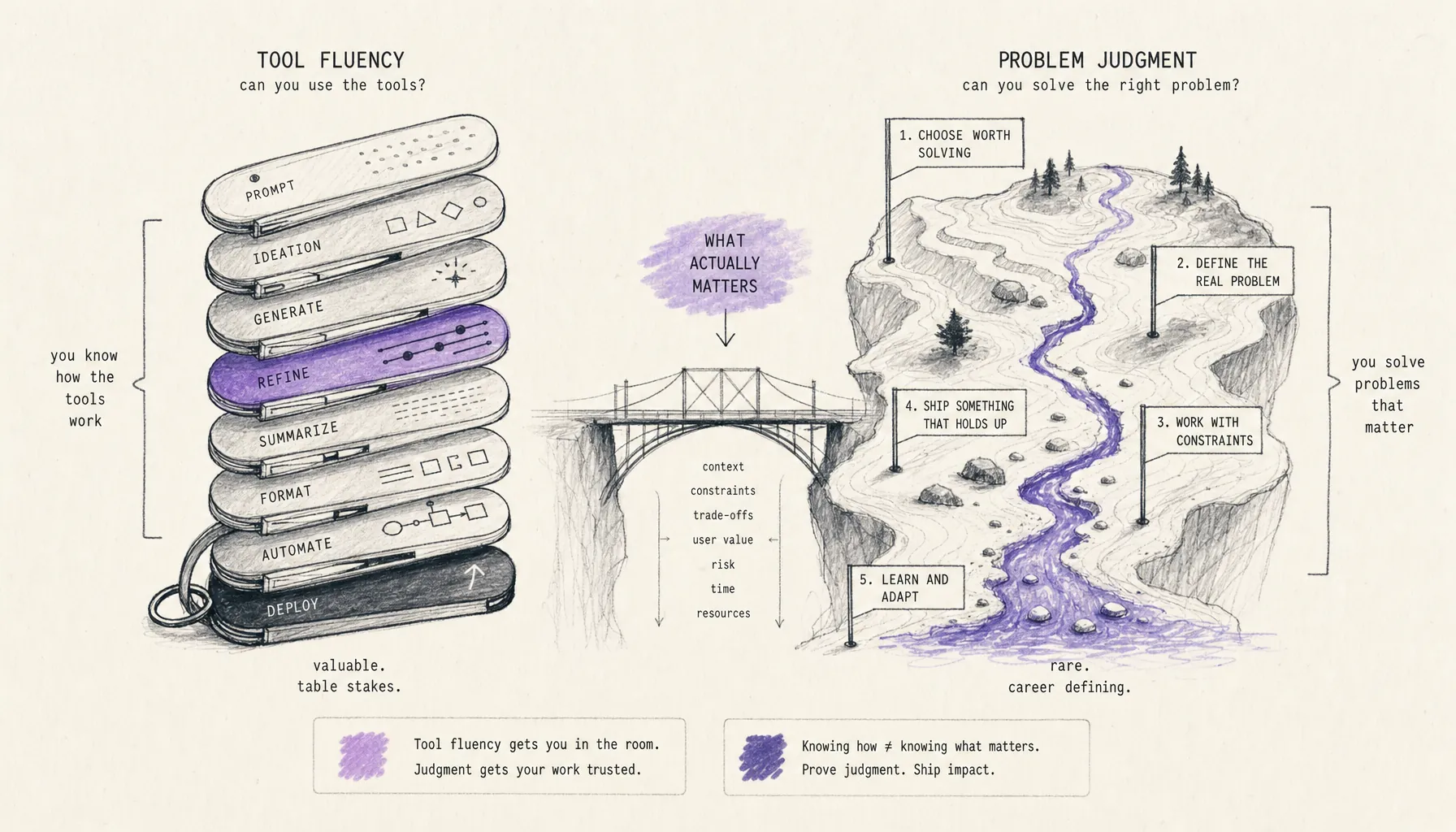
AI Tool Knowledge vs Problem Judgment: What Builders Actually Need to Prove
Stack Overflow’s 2024 Developer Survey found that 76% of developers were already using AI tools or planned to. At that point, tool familiarity stops being rare. The real difference in AI tool knowledge vs problem judgment is whether a builder can tell which problem is worth using the tool for, which trade-offs matter, and how to defend the call.
That is the workshop problem. Knowing every tool on the bench does not mean you know where to cut.
What are the key takeaways about AI tool knowledge vs problem judgment?
AI tool knowledge matters, but problem judgment is the hiring signal that keeps paying off because it travels across tools, teams, and business constraints.
- Tool fluency is becoming common. According to Stack Overflow’s 2024 Developer Survey on AI tools, 76% of developers were already using or planning to use AI tools.
- Problem judgment survives tool churn. The model, interface, or workflow may change every few months. The ability to define the problem, set constraints, and evaluate output sticks.
- Hiring screens are moving toward evidence. Companies hiring builders need to see work, decisions, and trade-offs, not polished claims about tool stacks.
- The strongest proof shows before-and-after thinking. Good builder evidence explains the starting problem, rejected paths, the AI-assisted workflow, the validation method, and the final result.
What does AI tool knowledge vs problem judgment mean?
AI tool knowledge vs problem judgment is the difference between operating an AI system and deciding what work the system should do, under what constraints, by what standard, and for which user or business outcome.
Tool knowledge sounds like this: “I know Cursor, ChatGPT, Claude, Midjourney, Zapier, LangChain, and Perplexity.” That counts. A builder who cannot use current tools will move slower. But tool knowledge mostly answers a narrower question: can this person use the bench?
Problem judgment answers the harder one: can this person decide what should be built in the first place? A builder with judgment asks whether the problem is real, whether the workflow should be automated, what failure looks like, where human review belongs, and what evidence would show the output actually works.
This matters because AI made it cheaper to produce artifacts. Screenshots, landing pages, prototypes, automations, research summaries, and mock dashboards are easier to make now. That creates noise. The signal is the thinking behind the artifact. For the broader hiring frame, Provn’s pillar on Get Hired as a Builder in 2026: Proof, Judgment, and Process explains why proof now beats polish.
Why does AI tool fluency depreciate faster than judgment?
AI tool fluency loses value faster because interfaces, model capabilities, pricing, and working habits change faster than the problems companies hiring builders actually need solved.
In 2024 and 2025, teams watched whole workflows shift when context windows got larger, coding assistants got better, image generation became easier to control, and agent tools moved from demo bait into real production experiments. A tool tutorial can be useful in January and stale by June. Sometimes by March, if we are being honest.
The labor market is moving the same way. According to the World Economic Forum Future of Jobs Report 2025, employers expect 39% of workers’ core skills to change by 2030. That does not mean every builder should chase every new interface the week it drops. It means companies hiring builders should discount static tool claims and pay more attention to how quickly someone learns.
Judgment compounds because it travels well. A builder who can frame an onboarding problem for a sales team can use the same reasoning on support triage, internal knowledge search, or product analytics. The exact tool changes. The diagnostic sequence does not.
| Signal | What it proves | How long it stays useful | Hiring risk |
|---|---|---|---|
| Tool list | Exposure to current software | Short | Easy to inflate or let go stale |
| Prompt examples | Basic workflow fluency | Medium | Can hide weak problem framing |
| Decision log | Trade-off reasoning | Long | Much harder to fake |
| Shipped artifact with validation | Ability to produce and test useful work | Long | Strongest signal when explained clearly |
What does problem judgment look like in real AI work?
Problem judgment shows up when a builder can name the constraint that matters most and explain why a different approach got rejected.
Take a simple example: a company wants an AI agent to answer customer support tickets. Tool-first thinking starts with the agent framework. Judgment-first thinking starts with the queue. Which tickets repeat? Which ones lead to refunds? Which answers require policy interpretation? Which categories should never be automated without review?
That builder may decide the first version should not be an autonomous agent at all. It may be a draft-response tool for five ticket categories with human approval, audit logs, and a weekly error review. According to the National Institute of Standards and Technology AI Risk Management Framework, trustworthy AI systems should be valid, reliable, safe, secure, accountable, transparent, explainable, privacy-enhanced, and fair. Those stop sounding abstract the second a bad support answer creates churn or legal risk.
This is where builders separate themselves. The builder who says “I used an agent” is showing tool awareness. The builder who says “I avoided full automation because 18% of the sample involved billing exceptions” is showing judgment. For a tighter look at how to explain those calls, see how to explain judgment calls in AI work. If you want the hiring-side version of this shift, agentic engineer hiring now centers much more on review habits and production judgment than on agent-tool name-dropping.
How do hiring managers test AI tool knowledge vs problem judgment?
Hiring managers test judgment by asking builders to explain constraints, rejected options, validation methods, and what they would change with more time.
The old screen rewarded polished summaries. The new one has to separate builders from AI-generated sameness. According to Microsoft’s 2024 Work Trend Index, 75% of knowledge workers were already using AI at work. When most people can produce cleaner language and faster mockups, the interview has to move from output inspection to decision inspection.
Strong hiring questions sound like workshop questions:
- What problem did you choose not to solve?
- Where did the AI output fail?
- What data did you trust, and what did you verify manually?
- What would break if this had 10 times more users?
- Which part of the work required human judgment?
Those questions do not punish AI use. They punish vague ownership. They also show cross-role range. A product designer who can frame a pricing experiment, prototype the flow, test the assumptions, and explain the trade-offs may show better product judgment than someone with the expected title history. For hiring-side signal design, see Hiring Managers Look for in Builders in 2026: Signals and Requirements.
How should builders prove problem judgment in their work?
Builders prove problem judgment by showing the work itself and the reasoning trail that produced it.
A portfolio artifact should read less like a gallery and more like a case file. The artifact matters, sure, but the sequence matters more. What was the starting condition? What options were on the table? Why did one path win? Where did AI speed things up? Where did human review catch mistakes?
Use this structure when documenting AI-assisted work:
- Define the user, business problem, and constraint in one paragraph.
- State the first approach you considered and why you rejected it.
- Show the AI-assisted workflow, including tools used and human review points.
- Include one artifact that proves execution, such as a prototype, repo, workflow diagram, analysis, or demo recording.
- Document the validation method, even if the sample size was small.
- Explain the trade-off you would revisit with more users, more data, or production access.
This gives companies hiring builders something a resume cannot: observable reasoning. It also avoids a common AI-work problem, where the output looks impressive right up until someone asks why it exists. For artifact structure, Provn’s proof of work portfolio for builders covers how to package evidence without turning it into design-theater nonsense. If the project was heavily AI-assisted, pair that with how to explain AI assisted work in an interview so the ownership line stays clear.
What mistakes make AI tool fluency look weak?
AI tool fluency looks weak when a builder lists tools without showing judgment, ownership, or validation.
The first mistake is tool stacking. A long list of tools can make the work look thinner, not stronger, when there is no reason each tool was used. The second is prompt theater: showing elaborate prompts without showing whether the output solved the problem. The third is hiding AI involvement. In 2026, the stronger move is to say plainly which parts were AI-assisted and which decisions were human.
According to the OECD AI Principles, AI systems should support transparency, accountability, robustness, security, and human-centered values. In hiring terms, builders should be able to say what the tool did, what they checked, what they changed, and what risk remained.
The cleanest demo format is simple: show the artifact, walk through the decision points, name the failures, then explain the next version. If the live interview is the proving ground, how to demo something you built in an interview gives a practical structure for presenting the work without burying the signal.
Frequently Asked Questions
Is AI tool knowledge enough to get hired as a builder?
No. AI tool knowledge helps builders move faster, but companies hiring builders need proof that the builder can frame the problem, choose constraints, validate output, and explain trade-offs. Tool fluency without judgment gives you more artifacts, not better work.
What is an example of problem judgment in AI work?
A builder shows problem judgment when they decide a support workflow needs human approval instead of full automation because billing, refund, or policy exceptions create unacceptable risk. The judgment is in the constraint, not the tool choice.
How can a builder show judgment if the project was AI-assisted?
A builder can show judgment by documenting what AI generated, what they reviewed manually, what they rejected, and how they tested the final output. Clear disclosure makes ownership easier to evaluate.
Why do hiring managers care less about tool lists in 2026?
Hiring managers discount tool lists because AI adoption is widespread and tool interfaces change quickly. A list of tools proves exposure. A decision trail proves whether the builder can use those tools on work that matters.
Should builders still learn new AI tools?
Yes. Builders should learn new AI tools, but they should treat them as instruments, not identity. The stronger hiring signal is the ability to use the right tool on a well-framed problem and explain the result clearly.