
How to Prove Your Work When AI Writes Your Resume
AI-written resumes flatten builders into the same polished language. The stronger hiring signal is attached work: demos, decision notes, source artifacts, and clear proof of how the work got made.
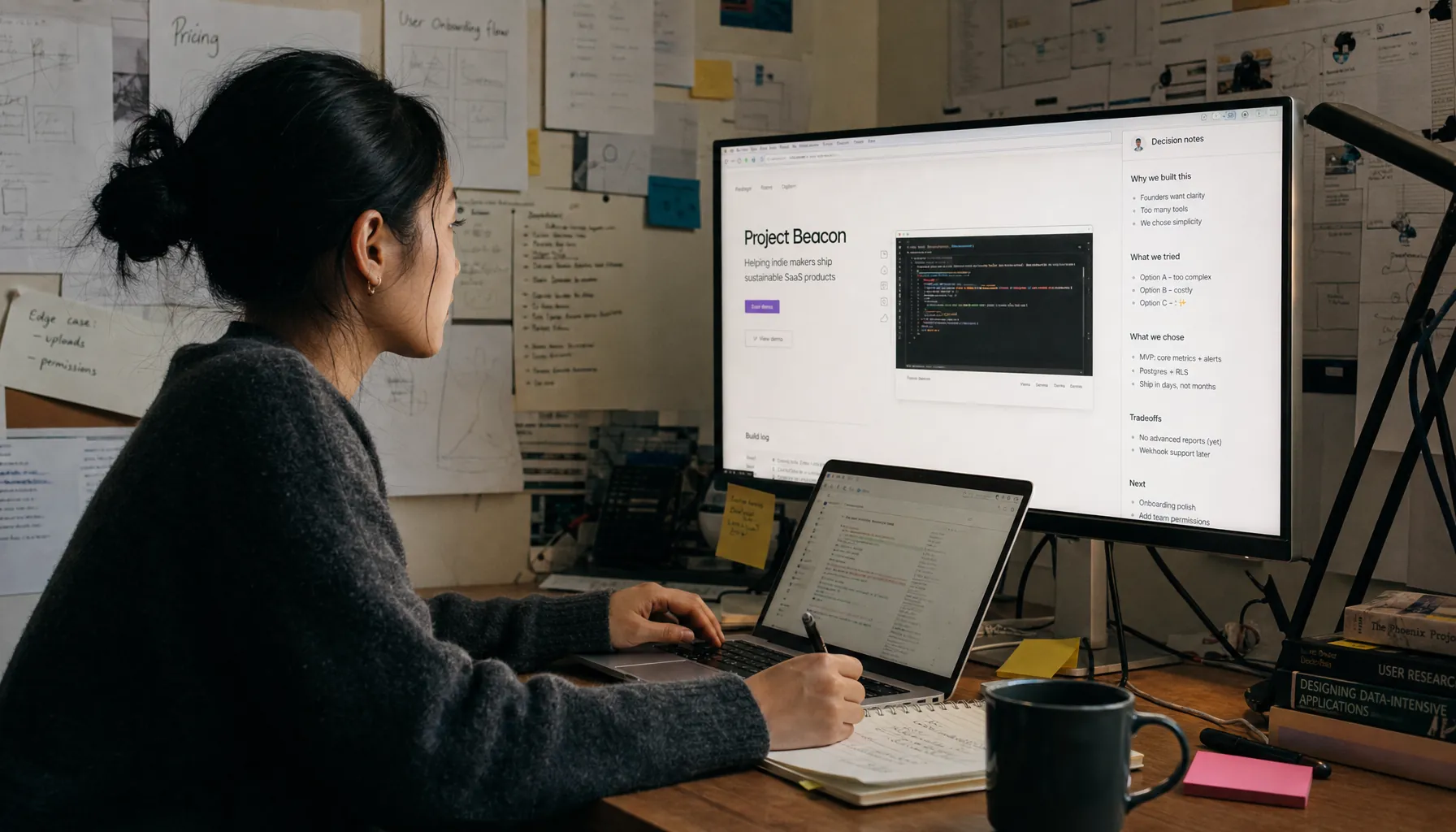
AI made polished resumes cheap. That changed the game. Builders now need proof that holds up after the sentence ends. If AI helped write your resume, back it up with artifacts, demos, decision notes, and timestamps that show what you actually built and how you made the call.
Most hiring screens still act like a metal detector in a room full of belt buckles. It still beeps. It just catches less. Proof gives companies hiring builders something real to inspect.
What should builders know first?
The strongest builder resume in 2026 pairs tight claims with verifiable work. A polished bullet gets attention only if it points to evidence.
- AI-written resumes flatten people into the same shape. Builders need proof that shows output, process, and judgment.
- The best evidence package usually includes a live demo, a short walkthrough, decision notes, source artifacts, and clear constraints.
- Companies hiring builders look for signal density: what got built, what trade-offs you made, and what changed because of the work.
- A resume should work like an index, not the whole case. Every strong claim should point to a specific artifact.
- Do not hide AI assistance. Say where AI sped things up and where your judgment ran the show.
Why does an AI-written resume create a signal problem?
AI-written resumes made it much easier to sound qualified, so companies hiring builders have less reason to trust polished language on its own. AI is not the problem here. The problem is that the old screen depended on polish being scarce.
According to National Bureau of Economic Research research on algorithmic writing assistance, generative AI improved the quality of lower-performing professional writing and narrowed the gap between writers. That matters in hiring. When every builder can describe the same project with clean verbs and tidy metrics, the resume stops doing much sorting.
That is why builder hiring has moved toward observable work. The pillar piece, Get Hired as a Builder in 2026: Proof, Judgment, and Process, covers the bigger shift. For this narrower problem, treat the resume like a cover sheet. The proof should sit one click away.
What counts as proof when AI writes your resume?
Proof is any artifact that lets a hiring manager inspect the work instead of taking your word for it. Strong proof shows output, process, authorship, constraints, and judgment.
You do not need a museum. Three sharp artifacts beat twenty vague links every time. The test is simple: can a reviewer tell what you built, why it mattered, what you tried, what failed, and what you would change with more time?
The most useful proof usually falls into five buckets:
| Proof type | What it proves | Weak version | Strong version |
|---|---|---|---|
| Live demo | The thing works | Static screenshots | Hosted prototype with test credentials or a recorded run |
| Walkthrough video | You understand the system | Feature tour | 5-minute explanation of problem, constraints, architecture, and trade-offs |
| Decision notes | You made judgment calls | Generic postmortem | Specific rejected options, reasons, risks, and evidence |
| Source artifacts | The work has substance | Private claims | GitHub repo, Figma file, Loom, dataset notes, prompt log, PR history |
| Outcome evidence | The work changed something | Unverified impact metric | Before and after metrics, user quotes, benchmark results, adoption notes |
For a wider checklist of portfolio formats, use Proof of Work Portfolio for Builders in 2026: Examples and Checklist. On a resume, keep it tighter: one line, one claim, one artifact.
How should builders attach verifiable work to an AI-written resume?
Put proof right beside the claim it supports. A separate portfolio link helps, but buried evidence gets missed in a fast review.
Use the resume like an annotated index. If a bullet says “built a support triage agent that reduced manual routing,” that same line should point to a demo, a short note, or a repo. The reviewer should not have to hunt for it. They usually will not.
- Add one proof link beside each major project claim.
- Label each link by evidence type, such as demo, walkthrough, decision note, repo, or benchmark.
- Open every artifact with a two-sentence context note explaining the problem and the main constraint.
- Show timestamps, version history, commit history, or exported file metadata when possible.
- Include a short AI-use note explaining what was assisted and which decisions were yours.
- Remove links that require permission requests, broken accounts, or extra context to understand.
Hiring managers are comparing signal, not decoration. The related piece Hiring Managers Look for in Builders in 2026: Signals and Requirements breaks down how companies hiring builders read those signals.
What artifacts create the strongest hiring signal?
The strongest artifacts are hard to fake and easy to inspect. They show work under constraint, not just the polished story afterward.
A demo matters because it exposes reality. A builder who can explain why a prototype is brittle in one area and reliable in another often gives off more signal than someone with a flawless-looking surface and no depth behind it. According to GitHub documentation on repository contribution history, repositories can show contribution activity, commits, and project history. That sequence matters. It lets technical reviewers inspect how the work unfolded, not just where it landed.
For product and design work, the evidence looks different. A Figma file with named frames, discarded variants, and prototype notes can show real thinking. A Notion project log can show scope control. A Loom walkthrough can show how a builder explains constraints when the clock is running. When the next step is a live conversation, use Builder Interview Demo in 2026: Steps and Script to turn the artifact into a structured demo.
How do you prove judgment, not just output?
Judgment shows up in trade-offs, rejected options, and constraint handling. A finished artifact proves less than the decisions that shaped it.
This is where AI-written resumes smooth over the interesting part. They can say “prioritized user needs” or “optimized performance,” but those phrases are basically wallpaper unless the builder shows the decision record behind them.
Use a compact decision note format:
- Constraint: What limited the work, such as time, data quality, latency, cost, permissions, or adoption risk.
- Options considered: List two or three real paths, including the one you rejected.
- Decision: State what you chose and why.
- Risk accepted: Name what got worse because of the choice.
- Evidence: Show the test, user feedback, benchmark, or review that supported the decision.
This matters even more in AI-assisted work, where tool fluency is easy to overstate and harder to verify. The article Judgment Calls in AI Work in 2026: Trade-Offs and Answers goes deeper on how to explain those calls without turning them into a performance.
What should builders avoid when using AI on a resume?
Avoid claims that sound stronger than the evidence behind them. AI makes overclaiming almost frictionless because it can turn partial work into smooth certainty.
According to the U.S. Equal Employment Opportunity Commission guidance on AI and employment selection, employers remain responsible for selection tools that create unlawful adverse impact. That pressure pushes serious companies hiring builders toward clearer evidence and more defensible evaluation. Builders benefit when their materials make the review concrete.
Common mistakes:
- Linking to a portfolio homepage instead of the exact artifact.
- Using inflated metrics without a source, baseline, or measurement method.
- Submitting private repos with no reviewer access.
- Hiding AI assistance when the work clearly used AI tools.
- Showing only the final artifact, with no process or decision trail.
For a direct comparison of resume claims and work evidence, see AI Resume vs Proof of Work in 2026: Screening and Signals. For credential-heavy screens, Certifications vs Portfolio in 2026: Production and Hiring Signals explains where certificates help and where they stop.
How does this change for technical builder roles?
Technical builder roles need proof that separates tool use from system judgment. A working prototype matters, but reviewers also look for architecture, failure handling, and maintainability.
According to the National Institute of Standards and Technology Artificial Intelligence Risk Management Framework, AI systems should be assessed for validity, reliability, safety, security, resilience, accountability, transparency, explainability, privacy, and fairness. You do not need to write a compliance memo for every side project. But the best technical proof does acknowledge these issues in plain terms: what can fail, what data is exposed, where human review exists, and what should not be automated.
For builders aiming at agent-heavy technical roles, Agentic Engineer Hiring in 2026: CPTO Signals and Requirements covers the role-specific bar. If the title itself feels fuzzy, Builder Roles vs Job Titles in 2026: Product and Engineering Teams explains why hiring language often trails the actual work.
What is the minimum proof package for one application?
The minimum proof package is one focused project page with a demo, a walkthrough, a decision note, and source evidence. Anything less sends the reviewer back to trusting the resume, and that is exactly what you want to avoid.
Use this structure when time is tight:
- Resume bullet: One sentence stating the project, constraint, and outcome.
- Demo link: Live or recorded, under five minutes.
- Decision note: One page covering options, trade-offs, and risks.
- Source artifact: Repo, design file, prompt log, benchmark sheet, or project log.
- AI-use note: Three lines explaining what AI did and what you decided.
If the idea of proof is new, start with Proof of Work for Builders: Definition and Examples. The goal is not to make more content. The goal is to make your strongest claim inspectable.
Frequently Asked Questions
Should I say that AI helped write my resume?
Yes, if asked directly or if the process itself is part of the evaluation. But the better move is to make the resume less important by attaching work evidence. A polished AI-assisted resume is fine when the artifacts next to it show real output, process, and judgment.
How many proof links should I include on a resume?
Use three to five strong proof links on a one-page resume. Link only to artifacts that support a specific claim. A hiring manager moving quickly should know exactly what each link opens: demo, repo, walkthrough, decision note, or benchmark.
What if my work is confidential?
Create a sanitized artifact that preserves the decision structure without exposing private data. Replace customer names, remove proprietary data, describe constraints at the category level, and show a recreated workflow or redacted screenshot where your agreement allows it.
Is a GitHub repo enough to prove technical work?
No. A repo helps, but it rarely explains the problem, the constraint, or the decision logic on its own. Pair it with a short walkthrough and a decision note so the reviewer can see both implementation and judgment.
Do builders still need resumes if they have proof of work?
Yes. The resume still helps route the review, summarize scope, and match role requirements. Its job is smaller now: point to proof, not carry the whole case.