
Agentic Engineer Hiring: What CPTOs Test in 2026
Technical hiring leaders are shifting from tool familiarity to sound judgment in production. Hiring agentic engineers now means testing decomposition, control design, review habits, and whether AI-assisted work holds up in real systems.
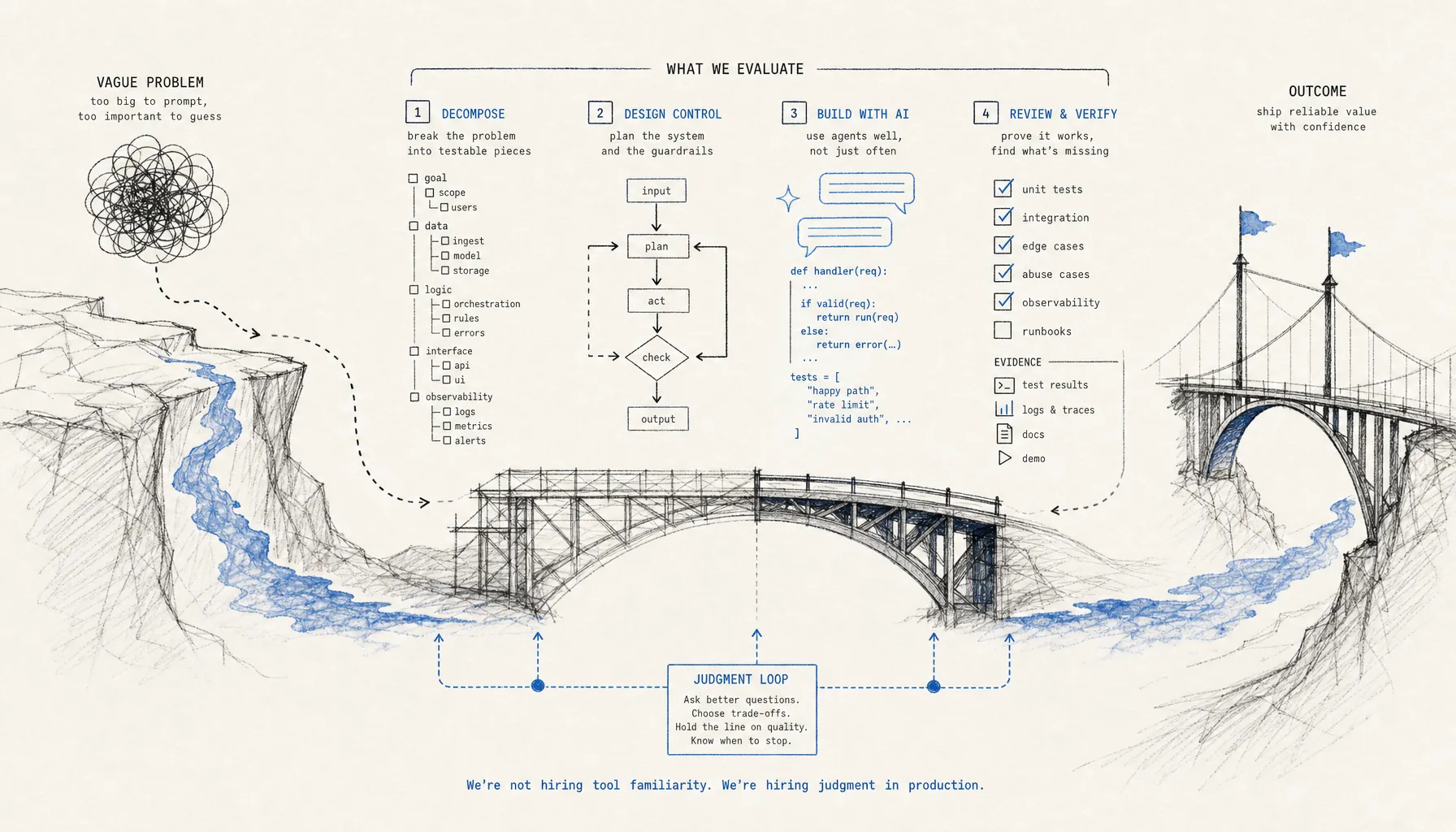
Agentic Engineer Hiring: How CPTOs Evaluate Builders Who Work With AI Agents
By 2026, technical hiring leaders are asking a much sharper question about AI-assisted work: can this builder turn agents into a production workflow people can trust, or can they only put on a slick demo?
That is what agentic engineer hiring actually tests. Can a builder break down a problem, direct automated systems, inspect the output, and step in when human judgment needs to win? Tool fluency alone is weak signal now. What matters is whether the work still holds up when it runs into users, data, latency, security, and maintenance.
What are the key takeaways for agentic engineer hiring?
Agentic engineer hiring rewards builders who can show their decisions, constraints, and production evidence around AI-assisted workflows.
- Technical leaders evaluate agentic builders on problem decomposition, control design, review discipline, and production judgment.
- Tool knowledge on its own is weak signal. A builder who can explain failure modes, rollback plans, and data boundaries is easier to trust.
- Strong agentic work comes with artifacts: task graph, prompt or policy design, evals, logs, test cases, human review points, and a demo of the system under constraint.
- Interview loops are shifting toward work simulations because AI-written resumes and polished claims flatten too many builders into the same generic stack.
- The best evidence shows what the builder handed to agents, what stayed under human control, and why those boundaries made sense.
What does agentic engineer hiring actually test?
Agentic engineer hiring tests whether a builder can turn open-ended work into an AI-assisted system that produces useful, inspectable, maintainable results.
That is the shift. A CPTO is not looking for the person with the longest list of AI tools. They are looking for the person who can take a messy business problem and turn it into a working loop: define the task, give the agent enough context, constrain its behavior, check its work, and ship something another human can use.
According to Stack Overflow's 2024 Developer Survey on AI tools, 76% of developers were using or planning to use AI tools in their development process. That makes tool use a weak filter. When almost everyone can say they use assistants, the hiring question moves up a level. Who knows how to manage the work those assistants produce?
The comparison that usually makes this click is the NFL combine. Every serious prospect has trained. Every highlight reel looks clean. The real evaluation starts when teams test repeatable traits under pressure: timing, reads, recovery, decision speed, and what happens after the first plan breaks. Agentic engineering hiring works the same way. The demo matters. The real signal shows up when the demo stops cooperating.
Provn's broader pillar on Get Hired as a Builder in 2026: Proof, Judgment, and Process covers the full builder hiring model. This page stays focused on one slice of it: how technical leaders assess builders who use agents, automation, and AI-assisted workflows in real production work.
What is the featured answer for agentic engineer hiring?
Agentic engineer hiring is the process of evaluating builders who use AI agents and automation to produce working software, systems, or workflows. Strong evaluation focuses on decomposition, tool direction, output verification, production safety, and the builder's judgment about where automation should stop and human review should begin.
How do CPTOs separate agent use from system judgment?
CPTOs separate agent use from system judgment by asking builders to explain the system around the agent, not the agent itself.
The strongest builders walk through the workflow in layers. First they define the problem in operational terms. Then they show what got delegated. Then they show guardrails, test cases, review points, and the moments where they rejected the agent's output. Weak work skips the middle. It jumps straight from prompt to result.
This matters because agents can be strong at local execution and weak at system responsibility. An agent can draft code, generate test cases, inspect logs, summarize support tickets, or sketch a migration plan. It does not own uptime, user trust, compliance boundaries, or the long-term cost of a brittle architecture. The builder owns that.
According to Anthropic's engineering guidance on building effective agents, many useful agentic systems rely on clear workflows, tool access, and evaluator loops rather than open-ended autonomy. That tracks with how experienced technical leaders hire. They look for builders who understand that reliable agentic work usually comes from structure, not from turning a model loose and hoping for taste.
Here is the practical screen. A technical leader asks a builder to walk through an AI-assisted project. The weak answer names the model, the framework, and the prompt. The stronger answer names the decomposition: ingestion, classification, confidence threshold, escalation path, storage, audit log, and post-release monitoring. Same project. Completely different signal.
What does good problem decomposition look like?
Good problem decomposition turns a vague goal into bounded tasks with clear inputs, outputs, failure conditions, and review points.
Take a support triage agent. The vague goal is simple enough: reduce time spent sorting inbound tickets. A builder with real judgment does not start by slapping a chatbot on the problem. They break the work into smaller decisions:
- Classify the ticket by product area.
- Detect urgency using explicit rules and historical examples.
- Suggest an owner, but avoid auto-routing low-confidence cases.
- Draft a response only when a verified knowledge base article exists.
- Log confidence scores and human overrides for later evaluation.
That decomposition is the hiring signal. It shows the builder understands the business process, the risk surface, and the limits of automation. It also gives the interviewer something real to test. If urgency detection fails, what happens? If the knowledge base is stale, what stops the system from inventing policy? If classifier confidence drops below 0.7, where does the ticket go?
Those are not trick questions. They are the difference between a demo and an operating system.
What are the agentic engineer hiring requirements in 2026?
Agentic engineer hiring requirements in 2026 center on evidence of production judgment, not credentials or generic AI fluency.
Most technical hiring leaders are looking for five signals. They will not always write them this neatly in a role description, but these are the filters that show up in serious interview loops.
| Hiring signal | What strong evidence looks like | What weak evidence looks like |
|---|---|---|
| Problem decomposition | A task graph, data flow, decision tree, or architecture sketch that shows bounded agent responsibilities. | A single prompt and a polished output with no explanation of the intermediate decisions. |
| System judgment | Clear boundaries for automation, human review, permissions, retries, and rollback. | Claims that the agent handles the workflow end to end with no visible controls. |
| Evaluation discipline | Test cases, eval sets, error analysis, logged failures, and examples of rejected outputs. | A demo that shows only the happy path. |
| Production awareness | Attention to latency, cost, observability, data handling, security, and maintenance. | Tool screenshots with no operational context. |
| Communication under scrutiny | A plain explanation of trade-offs, unknowns, and why one design was chosen over another. | Tool jargon that hides the actual decision process. |
According to the National Institute of Standards and Technology AI Risk Management Framework, trustworthy AI systems require attention to validity, reliability, safety, security, resilience, accountability, transparency, explainability, privacy, and fairness. A builder does not need to recite the framework in an interview. They do need habits that line up with it.
This is where pedigree-blind discovery matters. A builder from Bellevue College who can explain a failed agent rollout with logs, evals, and revised constraints gives a CPTO stronger hiring signal than a builder with a famous employer and a vague story about using agents to move faster. The screen should surface the work. If it only surfaces logos, it misses the point.
For a broader view of the signals companies hiring builders use across roles, see Hiring Managers Look for in Builders in 2026: Signals and Requirements. Agentic work is one branch of that larger shift.
Which skills matter more than tool familiarity?
The skills that matter most are task framing, constraint design, verification, debugging, and judgment under ambiguity.
Tool familiarity expires fast. A builder who only knows the menu of current agent frameworks ages with the tooling cycle. A builder who knows how to build a reliable control loop can carry that skill across models, frameworks, and teams.
Technical leaders usually listen for four concrete habits:
- They start from the user's actual workflow, not from the tool they want to use.
- They define what the agent can do and what it must never do.
- They inspect outputs with tests, logs, examples, and human review.
- They can explain what changed after the system failed.
The fourth habit is often the strongest one. A builder who says the agent worked perfectly probably did not test enough. A builder who can show five failure classes and the design changes that followed is much easier to trust.
How should technical leaders design an agentic engineering interview?
A strong agentic engineering interview gives builders a constrained problem, asks them to design the workflow, and evaluates the reasoning behind the automation boundaries.
The old interview pattern was built around solo code production under artificial time pressure. That still has value for some roles, but it misses how strong builders actually work now. On real teams, builders use agents to generate options, speed up execution, and inspect unfamiliar areas. The interview has to test whether the builder controls that workflow or just rides it.
A good interview prompt is specific enough to prevent theater and open enough to reveal judgment. For example: “Design an agent-assisted workflow that reviews failed payments, classifies root causes, drafts customer-safe explanations, and escalates uncertain cases to finance or support.” That prompt forces trade-offs. It touches data handling, customer communication, permissions, confidence thresholds, and operational failure.
According to GitHub's research on Copilot productivity, developers in a controlled study completed a coding task 55% faster when using Copilot. Speed is real. Hiring still has to answer the harder question: did the builder use that saved time to improve quality, or did they just ship the first plausible output?
The interview should measure that directly. The builder can use AI during the exercise, but the artifacts need to expose their decisions. The hiring manager should ask for a walkthrough of the work, including prompts, rejected paths, tests, assumptions, and failure handling. For builders preparing for that format, Builder Interview Demo in 2026: Steps and Script covers how to present the build without turning the interview into a tour of whatever tool was hot that week.
What should the interview scorecard measure?
The interview scorecard should measure the builder's control over the system, not the surface quality of the AI-generated output.
Here is a practical scorecard technical leaders can use.
| Scorecard area | High signal question | Strong answer pattern |
|---|---|---|
| Task framing | What exactly should the agent decide, suggest, or refuse to do? | The builder separates classification, recommendation, execution, and escalation. |
| Data boundaries | What data does the agent need, and what data should it never see? | The builder names privacy, permission, retention, and access-control limits. |
| Evaluation | How will you know whether the workflow is improving? | The builder defines test examples, metrics, human review, and error categories. |
| Failure handling | What happens when confidence is low or the tool returns a bad output? | The builder has fallbacks, escalation paths, and rollback logic. |
| Maintenance | Who owns updates when the product, data, or policy changes? | The builder connects ownership, monitoring, and update cadence. |
The common scoring mistake is overvaluing the final artifact. A clean prototype can hide weak judgment. A rough prototype with excellent decomposition, evaluation, and failure handling can reveal a much stronger builder. CPTOs know production rewards the second pattern more often than the first.
What production risks matter when agents ship real work?
The production risks that matter most are wrong actions, hidden data exposure, brittle dependencies, unbounded cost, and failures that look plausible until users catch them.
Agentic systems create a different risk profile than ordinary software because they combine probabilistic outputs with tool use. A script usually fails loudly when it hits an exception. An agent may produce a confident but wrong answer, call the wrong tool, update the wrong record, or pass along private context in a generated response. That is why observability and permission design belong in hiring evaluation.
According to the OWASP Top 10 for Large Language Model Applications, major LLM application risks include prompt injection, sensitive information disclosure, insecure output handling, excessive agency, and supply chain exposure. Those categories should come up in hiring conversations because they map directly to how agentic workflows fail in practice.
A builder does not need to sound like a security specialist to show maturity. They need practical habits. Limit tool permissions. Keep audit logs. Require human approval before irreversible actions. Treat external content as untrusted input. Test against adversarial examples. Do not give an agent write access to production systems unless the rollback path is real and tested.
The current hiring system often rewards the most polished claim, which is exactly the problem. Proof matters more here. A resume line that says “built AI agent for customer operations” tells you almost nothing. The evidence should show what the agent could access, what it could change, how outputs were reviewed, and what happened when it failed. For more on why polished application materials are weak signal in this market, see AI Resume vs Proof of Work in 2026: Screening and Signals.
What are the hidden edge cases in agentic work?
The hidden edge cases usually show up at the boundary between generated reasoning and real-world authority.
Four come up again and again in technical review:
- Silent policy drift: The knowledge base changes, but the agent keeps using old examples or cached assumptions.
- Overbroad tool access: The agent can read or write more than the task requires, which widens the blast radius fast.
- False confidence: The output sounds right, so reviewers stop checking the underlying source.
- Evaluation mismatch: The team measures speed while users get lower accuracy or higher escalation cost.
The operator-level answer is not “use more AI.” It is tighter design. A builder should be able to say: this step is automated, this step is suggested, this step is human-approved, this step is logged, and this step triggers a rollback. That tells a CPTO more than any model leaderboard ever will.
How should builders prepare proof for agentic engineer hiring?
Builders should prepare proof that shows the work behind the workflow: decomposition, prompts or policies, evals, logs, failure analysis, and production decisions.
The best proof does not require a giant portfolio. It requires the right artifacts. A technical leader should be able to inspect the build the way a coach watches practice film. What was the original problem? What did the builder delegate? What did the builder reject? What changed after testing? What would they do differently with more users, more data, or stricter compliance requirements?
Use this preparation sequence before an agentic engineering interview:
- Define the business problem in one sentence with the user, workflow, and measurable outcome.
- Map the workflow into bounded steps, including which steps are automated, suggested, or human-reviewed.
- Document the agent's tools, permissions, data sources, and refusal conditions.
- Build a small eval set with normal cases, edge cases, and adversarial cases.
- Record failures and explain what changed in the design after each failure class.
- Prepare a short demo that shows one successful path and one controlled failure path.
- Explain the production risks, including cost, latency, privacy, monitoring, and rollback.
This evidence should stay compact. A two-page project note plus a five-minute demo can carry more signal than a big site full of generic AI projects. The artifact should make the builder's judgment visible.
If the work lives inside a broader proof package, Proof of Work Portfolio for Builders in 2026: Examples and Checklist covers how to structure the portfolio without burying the signal. For agentic hiring, the most valuable section is usually the failure analysis. That is where tool use becomes judgment.
What should builders avoid showing?
Builders should avoid presenting agentic work as a tool montage with no evidence of decision-making.
Three patterns weaken the signal fast. First, hiding AI use as if the work was done manually. Companies hiring builders already know AI-assisted work is normal. The real question is whether it was controlled. Second, showing only the best run. Production systems are judged by variance, not by one clean output. Third, describing agents as autonomous when the real system still depends on human approval, auditability, and constrained permissions.
A stronger statement sounds like this: “I used an agent to classify inbound requests and draft suggested actions. It could not update records directly. Low-confidence cases went to a human queue. I tested 40 examples, found three failure classes, and changed the escalation rule after the agent mishandled ambiguous billing cases.”
That gives a CPTO something to trust. Scope, control, evidence, and revision. That is the signal.
What does Provn change about agentic engineer hiring?
Provn changes agentic engineer hiring by making demonstrated work easier to inspect than polished claims.
The hiring stack is full of sameness. AI-assisted resumes read clean. Profiles list the same tools. Credentials still push familiar schools and employers to the top before they show the actual work. That creates a bad screen for agentic builders because the strongest signal is process, not polish.
Provn is where builders get hired. Performance over pedigree. Proof over polish. For agentic work, that means surfacing the artifacts technical leaders actually need: how the builder framed the problem, where automation entered the system, how outputs were checked, and what production judgment shaped the final result.
The system should reveal a product designer who performs like a standout product manager on a PM challenge. It should reveal an engineer from Cal State Chico whose agentic workflow survives technical scrutiny. It should also reveal when a famous logo is doing more work than the work itself. Agentic engineer hiring gets better when the screen shows proof.
Frequently Asked Questions
What is agentic engineer hiring?
Agentic engineer hiring is the evaluation of builders who use AI agents, automation, and AI-assisted workflows to produce working systems. Strong hiring screens test decomposition, control design, output verification, production awareness, and judgment about where automation should stop.
What do CPTOs look for in builders who use AI agents?
CPTOs look for builders who can explain the system around the agent. That includes task boundaries, data access, tool permissions, evals, logs, human review points, failure handling, and maintenance ownership. The strongest builders show how they changed the workflow after testing exposed errors.
Should builders disclose AI-assisted work in technical interviews?
Builders should disclose AI-assisted work clearly because the disclosure itself creates hiring signal. A strong explanation names what the agent did, what the builder reviewed, what outputs were rejected, and which production risks were controlled. Hiding AI use removes the interviewer's ability to evaluate judgment.
How is agentic engineer hiring different in San Francisco, New York, and remote teams?
San Francisco and New York technical teams often evaluate agentic work through live product or engineering simulations because the local market has dense competition for AI-native builders. Remote teams tend to rely more on asynchronous proof, recorded demos, written project notes, and structured review artifacts because the hiring loop has fewer in-person calibration moments.
What is the biggest mistake builders make when showing agentic AI work?
The biggest mistake is showing only the polished output. Technical leaders need to see the control system: decomposition, constraints, evals, logs, edge cases, rejected outputs, and rollback plans. A perfect demo with no failure analysis is weaker than an imperfect build with clear production judgment.