
AI Resume vs Proof of Work: Stronger Hiring Signals
AI makes it easier to turn out polished resumes, and a lot harder to trust what you're reading. Work samples, challenges, and demos give companies hiring builders better evidence because they show how someone thinks, decides, and delivers under real constraints.
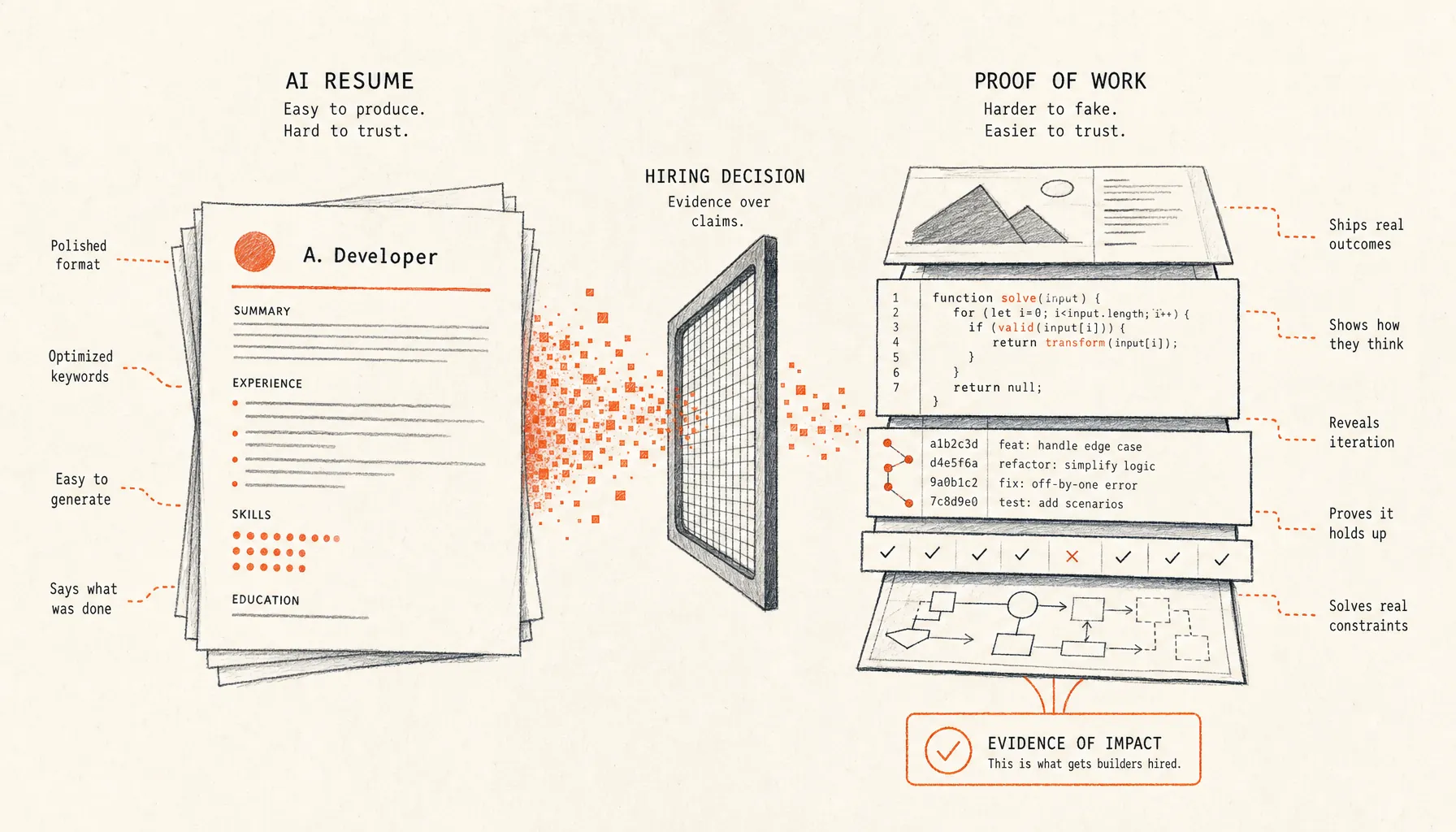
AI Resume vs Proof of Work: Why Hiring Evidence Changed
By June 2025, 34% of U.S. adults had used ChatGPT, about double the 2023 figure, according to Pew Research Center’s ChatGPT usage analysis. That changed the AI resume vs proof of work argument in a pretty obvious way: resume polish got cheap, while real work stayed hard to fake.
The resume still matters. It gives context. The problem starts when companies hiring builders treat context like proof. In 2026, better evidence comes from work samples, challenges, demos, and a builder’s explanation of the decisions behind the work.
Key Takeaways
- AI-written resumes are weaker signals because a lot of builders can now produce polished, keyword-matched summaries with the same tools.
- Work samples are stronger evidence because they show output, constraints, trade-offs, iteration, and judgment.
- The best hiring systems use the resume as a cover sheet, then test the claims with a challenge, demo, or reviewed artifact.
- Research on selection methods has long found work sample tests and structured interviews to be among the better predictors of job performance.
- For builders, the strongest proof includes the artifact, the problem framing, the tools used, the prompts or workflow, the trade-offs, and a short walkthrough.
Why has the AI resume become a weaker hiring signal?
An AI resume gets weaker when the writing improves faster than the evidence behind it.
The old resume screen relied on a simple assumption: polish told you something useful. Clean bullets suggested communication skill. Keyword fit suggested relevant experience. A concise summary suggested judgment. That logic falls apart when the same model can generate competent phrasing for almost anyone with a prompt and a job description.
This is not an argument against AI. AI is a normal work tool now. Microsoft and LinkedIn reported in their 2024 Work Trend Index that 75% of global knowledge workers were using AI at work. The hiring problem is more specific than that: when builders use AI to write resumes and companies hiring builders use software to scan them, the middle of the market fills up with documents that sound equally qualified.
At that point, the resume starts acting like the cover sheet in an audit file. It lists the project, the company, the dates, and the claimed result. It does not show the source material. It does not show whether the builder understood the problem, worked within constraints, caught failure modes, or shipped something that actually held up.
That gap shows up fastest in builder hiring because builder work crosses tool boundaries. A product designer may prototype a workflow. An engineer may use agents to compress a week of setup into one afternoon. A product manager may turn a messy customer problem into a working internal tool. A resume flattens all of that into bullets. Proof of work keeps the shape of the work intact.
That is the real failure mode here. AI makes the surface more uniform while the meaningful differences move into process. Companies hiring builders still need to know who can actually build. A resume cannot answer that on its own anymore.
What does proof of work show that a resume cannot?
Proof of work shows whether a builder can turn a real problem into a working artifact under real constraints.
A resume says, “Built onboarding automation that reduced support tickets.” Proof of work shows the intake form, the routing logic, the edge cases, the before-and-after support flow, the failed first version, and the builder’s explanation of why the final version won. One is a claim. The other is an evidence file.
Selection research points in the same direction. In the classic personnel selection meta-analysis by Frank Schmidt and John Hunter, work sample tests showed high predictive validity for job performance, especially compared with weaker screens that rely on indirect signals. Structured interviews also held up well because they ask the same job-relevant questions across people instead of letting charm or pedigree do all the work.
In practice, proof of work gives companies hiring builders four kinds of evidence:
- Output evidence: the thing produced, such as a prototype, analysis, workflow, dashboard, code repo, product spec, or demo.
- Process evidence: how the builder framed the problem, chose tools, sequenced the work, and tested assumptions.
- Judgment evidence: what the builder chose not to do, where they accepted risk, and where they avoided an easier but weaker path.
- Communication evidence: whether the builder can explain the work clearly enough for another person to trust it.
This is where a lot of hiring systems still lag. They ask for proof late, after screening on school, company names, job titles, and keyword density. That is backwards. A better approach starts with the evidence file: show the work, then use the resume to interpret it.
For a broader view of the builder hiring process, the pillar article Get Hired as a Builder in 2026: Proof, Judgment, and Process explains how proof, judgment, and process fit together across the full hiring loop.
How should hiring teams compare an AI resume vs proof of work?
Companies hiring builders should compare an AI resume vs proof of work by asking a blunt question: which signal is harder to fake, closer to the actual job, and easier to evaluate consistently?
The clean comparison is not resume versus no resume. It is context versus evidence. The resume gives a hiring manager a quick map. Proof of work shows the ground they are standing on.
| Hiring evidence | What it shows | Where it fails | Best use in 2026 hiring |
|---|---|---|---|
| AI-written resume | Experience summary, keywords, role history, claimed outcomes | Polish is easy to generate; claims are hard to verify at scale | Use as context after reviewing stronger evidence |
| Work sample | Real output from prior work or a self-directed project | It can lack context if the builder does not explain constraints or authorship | Use to assess actual work quality and fit for the problem |
| Challenge | How the builder performs on a role-relevant task under shared conditions | Poorly designed challenges turn into unpaid labor or trivia tests | Use short, scoped, job-relevant exercises with evaluation rubrics |
| Demo | How the builder explains decisions, failure modes, and trade-offs | Strong presenters can look better than the artifact unless the interviewer probes the work | Use to test reasoning, ownership, and communication |
| Credential or pedigree | Prior selection by a school, company, or network | Measures access and old filters more than current capability | Use only as background, never as the main proof |
The legal and operational side matters too. The Uniform Guidelines on Employee Selection Procedures, published at 29 C.F.R. Part 1607, frame selection procedures around job-relatedness and consistent evaluation. A builder challenge should map to actual work, use a documented rubric, and avoid arbitrary hurdles that reward free time or insider familiarity.
The same goes for AI screening. The Equal Employment Opportunity Commission states in its technical assistance on software, algorithms, and artificial intelligence in employment selection that companies hiring builders still carry responsibility when selection tools create discriminatory effects. A proof-first system still needs structure. “Show us something cool” is not a system. The evidence has to be comparable.
A useful hiring rule is simple: the closer the evidence is to the work, the more weight it should get. The resume is several steps away. A demo is one step away. A live or take-home challenge is closer. A shipped artifact with a clear walkthrough is often the strongest mix because it shows both execution and explanation.
Why do challenges and demos expose builder judgment?
Challenges and demos expose builder judgment because they force builders to explain choices, trade-offs, and failure handling instead of just presenting outcomes.
AI changed the hiring question. It used to be, “Can this person produce the artifact?” Now it is often, “Can this person direct the system toward the right artifact?” That is a different test. A builder who knows how to prompt, scaffold, inspect, revise, and reject bad output is stronger than someone who can only generate a polished first draft.
A strong challenge does not need to be long. Honestly, long challenges usually measure free time. A better builder challenge is narrow and realistic: improve a broken onboarding flow, build a lightweight support triage prototype, refactor an agent workflow, write a product brief from messy notes, or turn customer complaints into a prioritized set of fixes. The artifact matters. The explanation matters even more.
The most revealing demo questions are concrete:
- What did you try first, and why did you move away from it?
- Where did the AI output mislead you?
- What constraint shaped the final version?
- What would fail at 10 times the volume?
- Which part would you rebuild if this moved into production?
Those questions separate tool fluency from problem judgment. The builder who can point to the weak seam in their own work is usually easier to trust than the one who acts like every decision was obvious from the start.
The National Institute of Standards and Technology makes a similar point in governance language. The NIST Artificial Intelligence Risk Management Framework emphasizes measurement, documentation, and human oversight in AI systems, according to NIST’s AI Risk Management Framework 1.0. Companies hiring builders do not need to turn every interview into a compliance workshop. They do need to ask how the builder checked the work.
For hiring managers who want a fuller map of these signals, Hiring Managers Look for in Builders in 2026: Signals and Requirements goes deeper on the evaluation side.
Where does the resume still belong in builder hiring?
The resume still belongs in builder hiring as context, sequencing, and orientation. It just should not carry the main burden of proof.
A good resume answers the basic questions fast. What domains has this builder worked in? What kinds of teams have they joined? What constraints have they dealt with? What vocabulary will help the interviewer make sense of the work sample? Those questions matter. They just do not settle the decision.
The audit-file analogy still holds up. The resume is the cover sheet. It gives dates, names, and labels. Proof of work is the invoice, the receipt, the correspondence, the artifact, and the notes in the margin. No auditor would accept a cover sheet as the whole file. Companies hiring builders should not either.
This reframing also cuts pedigree bias. A school name or company brand can pull attention toward someone who already passed a famous filter. It can also bury a builder from Cal State Chico, Bellevue College, a small agency, a family business, or a role title that does not match the work they actually did. The builder is not the issue. The screen is too narrow.
The same thing happens across roles. A product designer might outperform as a product manager on a challenge because they can frame the problem, build the prototype, and reason through trade-offs. A resume screen built around prior PM titles misses that. Proof of work catches cross-role capability because it starts with the work itself.
There are still cases where resumes deserve more weight. Highly regulated roles may require licenses, security clearances, or specific domain exposure. Senior roles may need evidence of operating at scale. Even then, the resume should point toward verification. It should tell the hiring team what to inspect next.
How should builders replace resume claims with proof?
Builders should replace resume claims with proof by attaching a concrete artifact, a short context note, and a walkthrough that explains decisions.
The goal is not a glossy portfolio. Gloss creates the same problem as the AI-written resume, just in a prettier wrapper. The goal is to give companies hiring builders enough source material to inspect the work.
- Choose one role-relevant problem that matches the kind of work you want to do.
- Build or select an artifact that shows a finished or testable version of the work.
- Write a short context note with the problem, users, constraints, tools, and timeline.
- Document the AI-assisted workflow, including prompts, model outputs, edits, and verification steps where relevant.
- Explain three judgment calls: what you prioritized, what you rejected, and what risk you accepted.
- Record a three-to-five-minute walkthrough that shows the artifact and explains the decisions behind it.
- Connect the proof back to the resume with one plain bullet that points to the artifact.
A strong proof packet should be small enough for a busy hiring manager to review in a few minutes. It also needs to survive a deeper interview. If the walkthrough is the only impressive part, the proof is thin. If the artifact is strong but the explanation is vague, the hiring team still has to guess how much of the work belongs to the builder.
The most common mistake is hiding AI use. That sets up the wrong conversation. Companies hiring builders do not need a performance of hand-built purity. They need to know what the builder controlled, what the tool generated, how the builder checked it, and where human judgment changed the result.
Builders who want a tighter artifact checklist should use a dedicated proof of work portfolio for builders instead of treating a resume as the main evidence file.
What does strong proof look like for different builder roles?
Strong proof looks different by role, but every good proof packet shows the artifact, the constraint, and the builder’s decision process.
A builder is not defined by one tool. The work might be product, engineering, design, research, automation, operations, or some mix of all of that. The common thread is simple: the builder ships something that makes the problem clearer or the system better.
| Builder type | Strong proof artifact | What the hiring team should inspect | Weak substitute |
|---|---|---|---|
| Product builder | PRD, prototype, user flow, prioritization memo, launch notes | Problem framing, trade-offs, sequencing, feedback loops | A resume bullet claiming “owned roadmap” |
| Engineering builder | Repo, architecture note, test plan, demo app, agent workflow | Code quality, maintainability, failure handling, production judgment | A list of languages and frameworks |
| Design builder | Clickable prototype, before-and-after flow, research synthesis, design rationale | Interaction logic, user constraint, clarity, speed of iteration | A polished visual mockup without reasoning |
| Operations builder | Automation workflow, dashboard, SOP, exception handling map | Reliability, handoffs, monitoring, cost of failure | A claim about improving efficiency with no artifact |
| AI workflow builder | Prompt chain, evaluation notes, tool orchestration, output review system | Model limits, verification, escalation paths, human review | A tool list with no evidence of judgment |
The table matters because companies hiring builders often confuse artifact type with role fit. A product manager who can build a working prototype may show better product judgment than someone with a cleaner product title history. An engineer who can explain why an AI agent should not be used in a workflow may show better production judgment than someone showing off a flashy automation.
That is the real advantage of proof of work. It lets teams compare builders by the substance of what they can do, not by how familiar their path looks on paper.
What mistakes make proof of work weaker?
Proof of work gets weaker when it turns performative, unscoped, unverifiable, or disconnected from the job.
The first mistake is overproduction. A cinematic demo with no inspectable artifact just recreates resume polish in another format. Companies hiring builders should ask for links, screenshots, commits, notes, diagrams, prompts, or source material that makes the work reviewable.
The second mistake is unfair challenge design. A take-home task that takes ten hours of unpaid labor will favor builders with more discretionary time. A better challenge is scoped to 60 to 120 minutes, uses a realistic but bounded problem, and includes an evaluation rubric before the work starts. The Society for Human Resource Management describes structured evaluation as a way to improve consistency in interviews, and its structured interview guidance recommends asking the same job-related questions and rating answers against defined criteria.
The third mistake is asking for confidentiality violations. Prior work samples should not expose private customer data, proprietary code, unreleased strategy, or internal metrics. Builders can redact, reconstruct, or create an analogous public version. Companies hiring builders should reward that judgment, not punish it.
The fourth mistake is mistaking tool knowledge for capability. A builder who can name five AI tools has not proved they can make good calls under ambiguity. The useful evidence is how they used the tools, where they checked the output, and what they changed after review. For a deeper treatment of that distinction, see AI tool knowledge vs problem judgment.
The final mistake is weighting pedigree after proof contradicts it. If a builder performs well on a job-relevant challenge and explains the work clearly, the evidence file is already telling you something. Going back to school names or company logos at that point usually means the hiring system does not trust its own process.
Frequently Asked Questions
AI resume vs proof of work questions usually come down to evidence quality, fairness, and how much weight each signal should carry.
Is an AI-written resume bad for hiring?
An AI-written resume is not bad by itself. It becomes weak evidence when the decision depends on polished wording instead of verified work. Builders should treat the resume as context and link it to artifacts, demos, or challenges that show actual capability.
Why is proof of work stronger than a resume?
Proof of work is stronger because it is closer to the job. It shows the artifact, the constraints, the process, and the judgment calls behind the output. A resume summarizes claims. Proof gives companies hiring builders something they can inspect.
Should hiring teams stop using resumes?
Companies hiring builders should not stop using resumes. They should reduce the weight resumes carry. The resume should orient the reviewer, then the main evaluation should come from role-relevant work samples, structured challenges, demos, and consistent rubrics.
How long should a builder challenge take?
A builder challenge should usually take 60 to 120 minutes when used early in hiring. Longer exercises should be paid, tightly scoped, or saved for later stages. The task should match real work and include the evaluation criteria before the builder starts.
What should builders include with proof of work?
Builders should include the artifact, the problem context, the tools used, AI-assisted workflow notes where relevant, three judgment calls, known limitations, and a short walkthrough. The strongest proof lets a hiring team inspect both the output and the thinking behind it.