
Campus Hiring AI Native Builders: 2026 New-Grad Guide
Campus hiring now leans on work samples, challenge reviews, and mentorship fit because polished applications no longer separate strong builders from people who simply write well.
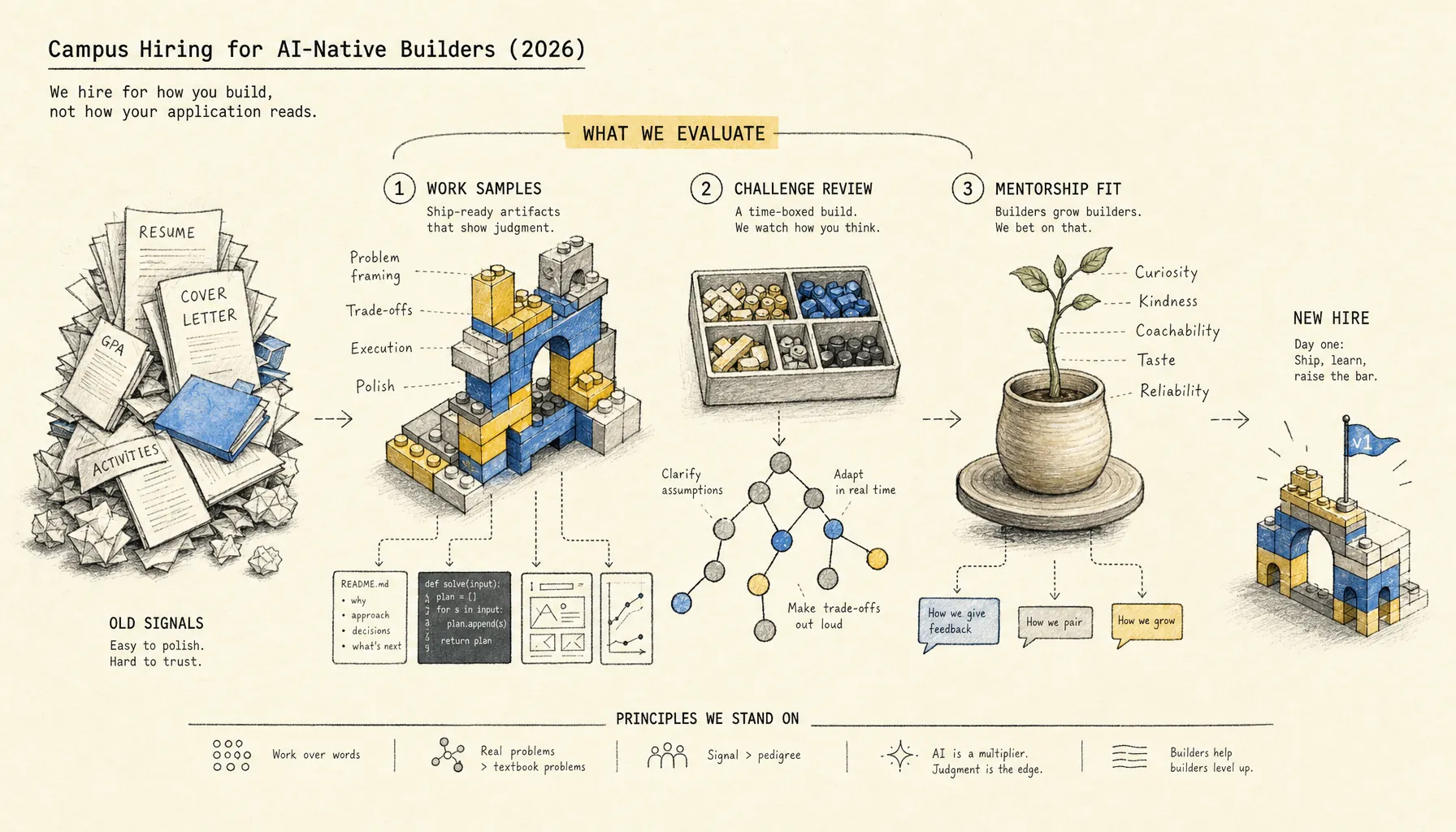
Campus Hiring AI Native Builders: What New Grads Need to Prove in 2026
Companies planned to hire 7.3% more Class of 2025 graduates than the Class of 2024, according to NACE’s Job Outlook 2025 Spring Update. But campus hiring changed faster than hiring volume did. For AI-native builders, the process now looks less like resume sorting and more like a lab practical. Companies hiring builders want to see what a new grad can actually make with AI, how they think through messy problems, and whether they improve under real mentorship.
The reason is simple. AI-forward teams get polished applications by the truckload. Pretty language is cheap now. What still matters is proof: shipped work, decision logs, prompt history, tradeoff notes, and a plain account of what the builder did versus what the tool did.
Key Takeaways
- Campus hiring for AI-native builders now favors visible output over polished application materials.
- The strongest proof shows output, process, judgment, and limits, not just a finished demo.
- Mentorship fit shows up in coachability, follow-through, debugging habits, and how quickly feedback changes the work.
- AI-forward campus loops increasingly look like work-sample reviews because AI-generated resumes made old screening methods less useful.
- Builders should bring one focused project, a concise walkthrough, and a record of decisions into new-grad hiring loops.
Why is campus hiring AI native builders different in 2026?
Because the first screen moved from credentials to evidence of production. A transcript, internship title, or club leadership line still adds context, but none of that tells a company hiring builders whether someone can use AI to ship useful work.
The old campus process was built around scarcity. Companies hiring builders went to a small set of schools, collected resumes, ran behavioral screens, and used GPA, brand names, referrals, and internships as shortcuts. Those shortcuts were always rough. In 2026, they are even weaker because generative AI can make the surface layer of almost every application look competent.
That does not make AI the problem. The problem is a hiring system that mistakes polished writing for signal. An AI-native builder can use tools to move faster, but a company still has to know who made the judgment calls. Which constraints mattered? Which answer got rejected? Where did the model hallucinate? What changed after user feedback?
The closest comparison really is a lab practical. A biology student does not prove competence by talking about pipettes. They prove it by running the experiment, recording what happened, controlling variables, and explaining the result. For a broader view of the full early-career path, see How to Get Hired as an Early-Career Builder in 2026: Proof, Requirements, Timeline, and Process.
What do AI-forward companies evaluate in new-grad builders?
Most AI-forward companies look for four things in new-grad builders: production, proof, curiosity, and mentorship fit. Early-career hiring is a bet on learning rate, not a bet that someone already has the whole job figured out.
Production means the builder can make something useful. Useful does not have to mean enterprise-grade. It means the work solves a defined problem for a real user or a realistic workflow. A campus project that automates a club’s onboarding, improves a research workflow, or turns messy notes into structured output tells a hiring manager more than another chatbot clone.
Proof means the work holds up under inspection. A GitHub repo by itself is thin. A stronger package includes a short demo, a README with constraints, screenshots of test cases, known failure modes, and a walkthrough of decisions. Builders who want examples can use Proof of Work for Early-Career Builders: Examples, Checklist, and Steps as a practical checklist.
Curiosity shows up in how the builder investigates. According to NACE’s career readiness competencies, employers define career readiness through behaviors like critical thinking, communication, technology use, teamwork, leadership, and professionalism. In an AI-native loop, you can actually see those behaviors when a builder tests assumptions instead of accepting the first output and moving on.
Mentorship fit is the last screen, and it matters more than people think. Companies hiring builders know a new grad will need context. They want someone who can absorb feedback without going passive. The builder should ask precise questions, change the work after feedback, and explain what they learned without putting on a fake humble act. Most hiring managers can spot that performance from a mile away.
How should new graduates prepare for AI-native campus hiring loops?
New graduates should prepare by building one inspectable project and getting very good at explaining it. The goal is to make the review concrete enough that pedigree matters less.
The lab practical model helps here. A company is not asking whether the builder memorized every AI tool released in the last six months. Nobody sane expects that. It is asking whether the builder can point tools at a useful outcome, catch errors, and explain what happened.
- Choose one real workflow where the user, input, output, and success condition are specific.
- Build a working version that a reviewer can open, watch, test, or inspect in under five minutes.
- Document the AI tools used, the prompts or agent instructions that mattered, and the human decisions that changed the result.
- Record three failure cases, including one model error, one product assumption that failed, and one user experience issue.
- Write a 300-word project brief that explains the problem, the constraints, the tradeoffs, and the next improvement.
- Practice a five-minute walkthrough that separates what the AI generated from what the builder designed, verified, or rejected.
This also keeps interviews from drifting into vague self-description. Without proof, a builder gets stuck making abstract claims: fast learner, strong communicator, interested in AI. With proof, the conversation moves to decisions. That is where strong new grads pull ahead. For a narrower skills lens, use AI-Native New Graduate Skills: Signals, Examples, and Hiring Criteria.
What proof works best in campus hiring for AI native builders?
The best proof shows the finished work and the reasoning trail behind it. A clean artifact with no process notes is weaker than a messier artifact with clear judgment. That may feel unfair if you like polishing, but it is true.
| Proof type | What it shows | Common weakness |
|---|---|---|
| Working demo | Can produce something testable | No evidence of why choices were made |
| Decision log | Can reason through ambiguity | Too much diary, not enough judgment |
| Prompt or agent trace | Can direct AI systems deliberately | Shows prompting, but not verification |
| User feedback notes | Can learn from reality | Feedback is collected but not acted on |
| Failure case review | Can inspect limits and risk | Failures are framed as excuses |
The strongest proof package is small. One project. One sharp demo. One explanation of the constraints. One page of decisions. Builders without a formal internship can still show this kind of evidence through a class project, a campus operations problem, a research assistant workflow, or personal automation. The separate playbooks for Early-Career Builder Portfolio: Evidence, Judgment, and Review Criteria, AI Builder Portfolio Examples: Projects, Proof, and Checklist, and AI Portfolio With No Experience: Steps, Proof, and Examples go deeper on those formats.
One edge case matters here. A beautiful project can actually hurt the builder’s case if the explanation hides the AI contribution. Companies hiring builders do not need a purity test. They need attribution. If the model generated the first draft, say so. If the builder changed the architecture, tested edge cases, rewrote the interface, or rejected bad outputs, show that work clearly.
How do companies judge mentorship fit in new-grad AI hiring?
Companies judge mentorship fit by watching how a new graduate responds to feedback, ambiguity, and correction. The strongest signal is not confidence. It is how fast and how well the work improves once new information shows up.
This is one of the clearest differences between campus loops and senior hiring. A senior hire is judged more on pattern recognition from prior work. A new graduate is judged on learning rate. AI changes the surface of the work because a builder can produce more attempts in less time, but companies hiring builders still need to know whether those attempts get better or just pile up.
A practical mentorship screen usually includes a challenge, a review, and a revision. The first submission shows baseline production. The feedback conversation shows listening and judgment. The revised version shows whether the builder can turn critique into better work. For the mentorship-specific version of this screen, see AI Mentorship for Early-Career Builders: Process, Expectations, and Fit.
There are also legal and process constraints around hiring tools. According to the U.S. Equal Employment Opportunity Commission’s guidance on software, algorithms, and artificial intelligence in employment selection, employers can be responsible if selection tools create adverse impact under Title VII. New York City also regulates automated employment decision tools under Local Law 144, which requires bias audits and notices for covered tools. The practical takeaway is straightforward: serious companies need hiring evidence that relates to the work, can be reviewed by humans, and can be applied consistently.
What does this mean for pedigree-blind campus discovery?
Pedigree-blind campus discovery means companies can find strong builders without using school brand, prior company brand, or network access as the first filter. This is not about pretending context does not matter. It is about not confusing context with proof.
Campus hiring has always had a sorting problem. A Duke or Meta name gets noticed fast. A builder from Cal State Chico or Bellevue College who has stronger production is easier for the system to miss. That is not a builder problem. That is a screening problem, and honestly, it has been one for years.
AI makes this more obvious because cross-role capability is easier to show. A product designer might perform like an excellent product manager in a challenge. A writing-heavy graduate might build a useful internal agent. A CS graduate might show product judgment that never appears on a transcript. The supporting pages on AI-Native Builder vs Junior Developer: Skills, Evidence, and Hiring Fit, Fresh Graduates vs Mid-Career Hires in AI Teams: Hiring Edge, and Barbell Hiring Strategy in AI Teams: Fresh Graduates, Veterans, and Mid-Career Pullback explain why some AI teams are opening the door again for high-learning-rate graduates.
Provn’s position is straightforward: performance over pedigree, proof over polish. Campus hiring for AI-native builders works best when the review starts with the work, then asks whether the builder can keep improving inside a team.
Where should new graduates go next in the early-career builder hiring cluster?
New graduates should pick the next resource based on the hiring gap they actually need to close. The common mistake is reading everything when one missing proof point is what is really blocking the loop.
The pattern is simple: pick one gap, produce proof against it, then enter the loop with evidence. Campus hiring for AI-native builders is not a personality contest. It is a review of whether the work, the reasoning, and the learning curve hold up when someone actually looks closely.
Frequently Asked Questions
What does campus hiring AI native builders mean?
Campus hiring AI native builders means evaluating recent graduates through evidence of what they can build with AI, how they make decisions, and how they respond to feedback. It puts more weight on work samples, challenge submissions, demos, and walkthroughs than on school brand alone.
What should a new graduate bring to an AI-native campus interview?
A new graduate should bring one inspectable project, a short demo, a decision log, failure cases, and a clear explanation of which parts came from AI and which parts the builder designed, tested, revised, or rejected.
Do AI-forward companies still care about GPA or school name?
Some do, especially in structured campus programs. But AI-forward teams increasingly treat GPA, school name, and internships as context, not proof, because those signals do not show production, judgment, curiosity, or mentorship fit.
How is campus hiring different in major tech hubs versus smaller markets?
In major tech hubs like San Francisco, New York, Seattle, and Austin, new-grad AI hiring often includes more challenge-based review because teams see higher application volume and more AI-polished resumes. In smaller markets, school relationships and referrals can still carry more weight, but builders can reduce that dependency by showing concrete proof of work.
How does Provn fit into campus hiring for AI native builders?
Provn is where builders get hired. It helps companies hiring builders evaluate demonstrated capability instead of leaning mostly on resumes, credentials, and networks. The idea is simple: performance over pedigree and proof over polish.