
Fresh Graduates vs Mid Career Hires AI Teams
Some AI-forward teams ramp new grads faster because their habits are still forming, they learn in tighter cycles, and companies hiring builders can judge them by the work they actually ship.
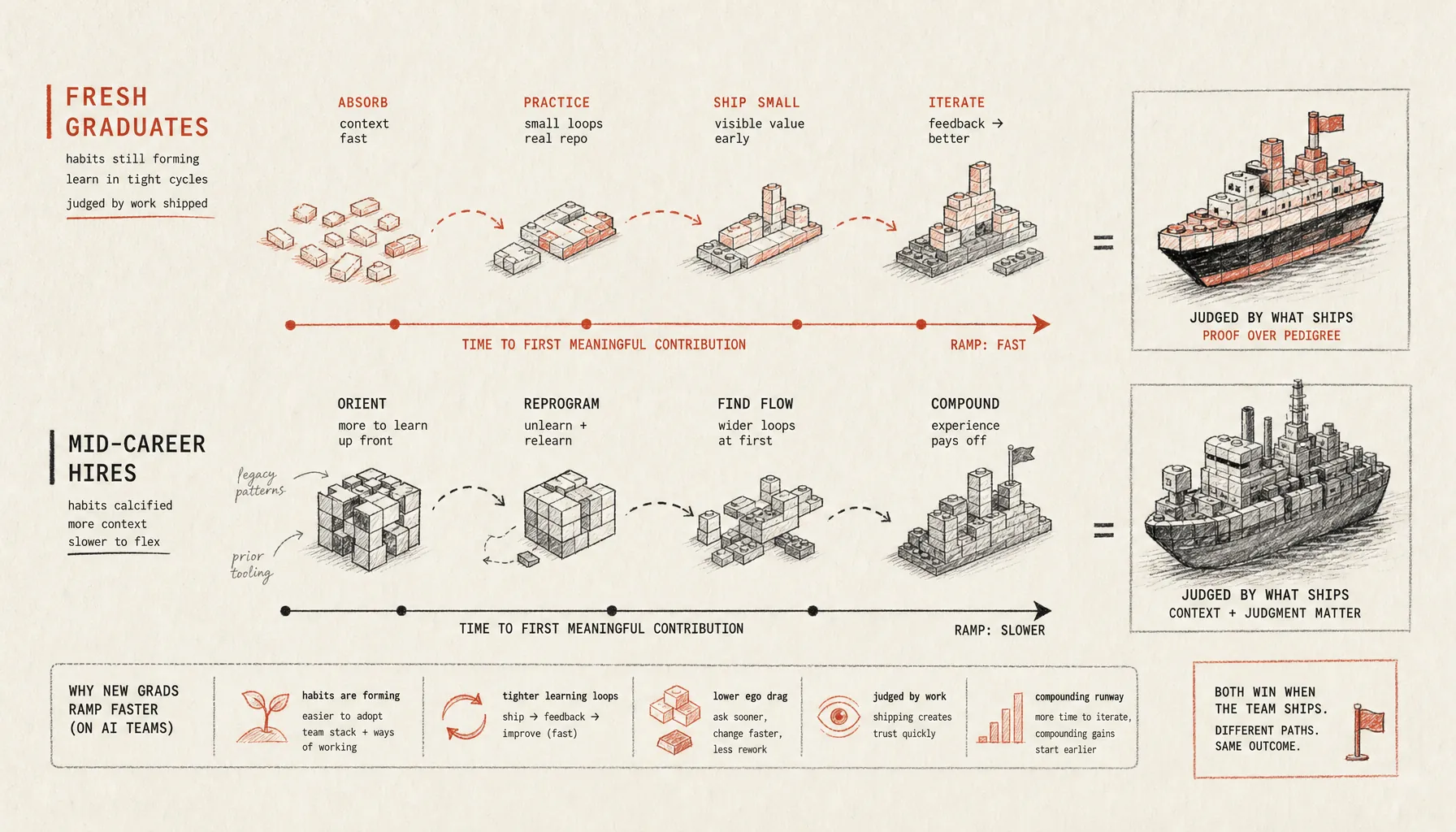
Fresh Graduates vs Mid Career Hires AI Teams: Onboarding Speed and Tradeoffs
Microsoft’s 2024 Work Trend Index found that 75% of knowledge workers were already using AI at work, and 78% were bringing their own tools. That helps explain why so many companies hiring builders keep asking about fresh graduates vs mid career hires AI teams. They want to know who gets productive fastest when the work itself is changing.
The answer has very little to do with age. It has a lot to do with habits. Some fresh graduates show up with fewer fixed routines, switch tools quickly, and work in tight feedback loops. Some mid career hires bring judgment, domain memory, and the kind of organizational range fresh graduates usually have not built yet. The real hiring question is simpler: which advantage matters more for the work right in front of the team?
Key takeaways
- Fresh graduates can ramp faster in AI-native workflows when the job rewards quick iteration, prompt testing, tool switching, and visible output.
- Mid career hires still have the edge when the work depends on domain judgment, customer history, compliance knowledge, or cross-functional trust.
- The World Economic Forum’s Future of Jobs Report 2025 found that companies expect 39% of workers’ core skills to change by 2030. Learning speed is now a hiring signal, not a nice extra.
- The strongest screen is proof of work: what the builder shipped, how they used AI, what broke, and how they fixed it.
- The best AI teams pair fresh graduates with experienced operators instead of pretending one group can replace the other.
Why do some AI teams onboard fresh graduates faster than mid career hires on AI teams?
Some fresh graduates ramp faster because they have less old process to unlearn. They are also often more comfortable using AI as part of the workflow, not as an optional add-on. That advantage is behavioral, not demographic.
AI-native work feels less like learning a single software tool and more like learning a new tempo. A builder asks a model for a first pass, checks the output, catches the hallucination, rewrites the instruction, connects another tool, ships a version, and notes what failed. That loop can run five times before lunch. Someone trained in slower approval chains usually needs time to trust that pace without dropping the judgment part.
That is where some fresh graduates move fast. A lot of them already learned in public, built with messy tools, and stitched together code, design, writing, and research just to get a project over the line. According to Stanford University’s 2025 AI Index Report, AI systems keep improving across benchmark tasks while still falling short on reliability, reasoning, and factual consistency. That mix favors builders who test tools aggressively but do not treat the output as gospel.
The NFL combine analogy works here. College production matters, but teams still want to see speed, decision-making, and what happens under pressure. For AI teams, the combine is a work sample. A fresh graduate who can show a shipped agent, a product prototype, or a research workflow with clear failure notes gives companies hiring builders far more signal than a resume bullet claiming they are “AI fluent.” For the broader hiring path, see How to Get Hired as an Early-Career Builder in 2026: Proof, Requirements, Timeline, and Process.
Where do mid career hires still beat fresh graduates on AI teams?
Mid career hires win when the bottleneck is judgment, context, or trust, not tool adoption. AI makes production faster. It does not tell you which problem is worth solving in the first place.
Experienced operators usually know the hidden constraints: why a customer request is politically loaded, why a data field cannot be trusted, why legal will push back, or why a slick prototype will fall apart in a sales call. You do not learn that from tutorials. You learn it the hard way.
The best mid career hire on an AI team is not the person clinging to the old process. It is the person who can shrink that process without losing the judgment inside it. A product lead who used to spend three weeks gathering customer notes can now use AI to cluster calls in a day. The value is knowing which clusters are noise. A finance operator can generate scenario models much faster with AI. The value is knowing which assumption quietly blows up the forecast.
That matters because adoption by itself is a weak signal. McKinsey’s State of AI research has tracked broad generative AI adoption inside organizations, but the harder part is changing process, governance, and accountability around it. Mid career hires with real operating range often help teams avoid the classic trap: shipping fast artifacts that do not change the business at all.
How should hiring managers compare fresh graduates vs mid career hires for AI teams?
Hiring managers should compare fresh graduates and mid career hires based on the work loop the role actually demands, not just years of experience. The useful question is whether the job is constrained mainly by learning speed, quality of judgment, or organizational execution.
| Role constraint | Fresh graduate advantage | Mid career hire advantage | Best screen |
|---|---|---|---|
| Rapid prototyping | Fast tool testing, low attachment to legacy workflows | Better scoping if they have shipped similar products | Build a working prototype in 48 hours with a written failure log |
| Customer-facing decisions | Can synthesize research quickly with AI | Stronger pattern recognition from prior customers | Review five messy customer notes and recommend next action |
| Agent management | Comfort directing tools across tasks | Better risk judgment when agents touch live systems | Design an agent workflow with approval gates and rollback points |
| Regulated or high-risk work | Useful for research, documentation, and testing | Usually stronger on policy, audit trails, and escalation | Explain what must stay human-reviewed and why |
The mistake is treating “AI-native” like a personality trait. It is a work pattern. A builder can define the task, direct the model, inspect the output, revise the system, and explain the decision trail. That is why proof beats claims. Provn’s related piece on AI-Native New Graduate Skills: Signals, Examples, and Hiring Criteria goes deeper on the signals without turning this comparison into another bloated checklist.
What is the practical decision framework?
Hire for the bottleneck. Fresh graduates make sense when the team needs iteration speed. Mid career hires make sense when the team needs judgment under constraint. You need both when the work mixes new workflows with real operating risk.
- Define the work loop the role will repeat every week.
- Identify the main bottleneck: speed, judgment, domain context, or coordination.
- Design a work sample that recreates that bottleneck instead of rewarding interview polish.
- Score the builder’s process notes, not just the final artifact.
- Pair fast learners with experienced reviewers when the work touches customers, money, or live systems.
What proof separates strong fresh graduates from polished AI users?
Strong fresh graduates show decisions, not just outputs. A polished AI user can make a clean demo. A real builder can tell you what failed, what changed, and why the final version works.
Companies hiring builders are seeing more AI-generated resumes, cover letters, portfolios, and take-home submissions. The documents look smoother than they used to. The signal is worse. That is why the review has to move away from presentation quality and toward process evidence.
A useful proof packet has four parts: the artifact, the prompt trail or system design, the failure log, and the judgment note. The judgment note is where the builder earns trust. Why use retrieval instead of a longer prompt? Why keep a human approval step? Why reject the model’s first recommendation? Why ship a smaller version instead of the flashy one? Those answers tell you a lot.
This is also where pedigree-blind discovery matters. A builder from Bellevue College who ships a clean agent workflow with strong reasoning should not lose to a better-known school name with weaker proof. A career product designer who performs like a strong product manager on an AI challenge should not get filtered out because the title history looks different. For examples of evidence companies hiring builders can actually review, see Proof of Work for Early-Career Builders: Examples, Checklist, and Steps.
What onboarding model works best for mixed AI teams?
The best onboarding model combines the fast learning loops of fresh graduates with mid career judgment and clear review gates. AI teams get into trouble when they confuse speed with autonomy too early.
A solid 30-day ramp gives fresh graduates real work quickly, but not unlimited authority. Week one should cover the toolchain, data rules, examples of good work, and common failure modes. Week two should assign a contained build with a reviewer. Week three should add some ambiguity. Week four should move the builder into a live workflow with clear escalation rules.
Governance is not paperwork. It is how a team keeps trust intact while moving fast. The National Institute of Standards and Technology AI Risk Management Framework breaks AI risk into govern, map, measure, and manage functions. In practice, companies hiring builders can turn that into a few plain onboarding questions: What can this builder automate? What must be reviewed? What data is off limits? What happens when the model gets it wrong?
The strongest teams do not waste time arguing about whether fresh graduates or mid career hires are universally better for AI teams. They build a barbell. Fast builders stay close to new tools. Senior operators stay close to judgment. Proof-based screens connect the two. For the broader hiring model, read Barbell Hiring Strategy in AI Teams: Fresh Graduates, Veterans, and Mid-Career Pullback.
Frequently Asked Questions
Are fresh graduates better than mid career hires for AI teams?
Fresh graduates are better for some AI team roles, especially when the work rewards fast iteration, tool switching, and visible proof of learning. Mid career hires are better when the work depends on domain judgment, customer history, compliance awareness, or internal trust.
Why do AI-forward teams sometimes prefer fresh graduates?
AI-forward teams sometimes prefer fresh graduates because they have fewer fixed workflows to replace and often adapt quickly to prompt-based, agentic, and prototype-heavy work. The stronger signal is not graduation year. It is whether the builder can use AI to ship useful work and explain how they did it.
What is the biggest risk of hiring fresh graduates into AI-native roles?
The biggest risk is giving autonomy before judgment is proven. Fresh graduates can move fast, but AI work that touches customers, revenue, private data, or production systems needs review gates, escalation rules, and clear limits on what can be automated.
What is the biggest risk of hiring mid career talent for AI teams?
The biggest risk is importing old workflows and layering AI on top without changing the work loop. A strong mid career hire compresses the process while keeping the judgment. A weak one uses AI as a faster drafting tool and leaves the operating model basically untouched.
How should a builder prove fit for an AI team without a long resume?
A builder should show a shipped artifact, the prompt or system design, a failure log, and a short explanation of tradeoffs. An Early-Career Builder Portfolio: Evidence, Judgment, and Review Criteria should make the work easy to inspect instead of asking the hiring manager to guess from credentials.