
Directing AI vs Learning AI Tools | Provn AI Career Hub
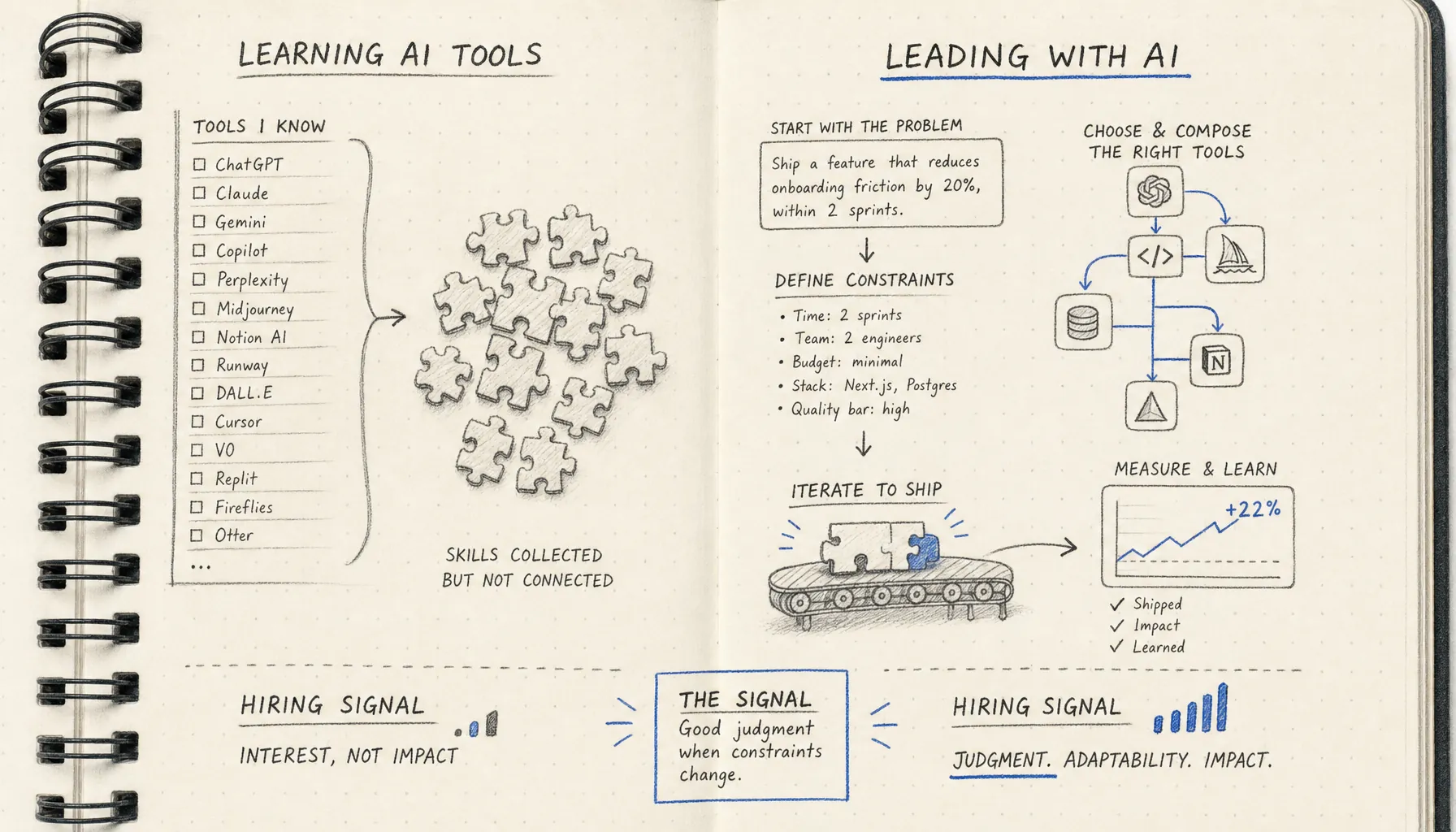
Companies hiring builders reward people who use AI to ship real work, not people who just list tools. The clearest signal is good judgment when the constraints change.
Directing AI vs Learning AI Tools: What Hiring Managers Reward
Microsoft’s 2024 Work Trend Index found that 75% of knowledge workers already use AI on the job. That changed the hiring signal fast. Saying you’ve used ChatGPT or Claude does not tell companies hiring builders much anymore. What matters now is whether you can aim the tool at a real problem, set constraints, test the output, and ship something useful.
That is the gap between directing AI vs learning AI tools. Tool familiarity might get a builder into the conversation. Direction is what makes a company trust them with messy work.
Key takeaways
- Tool knowledge expires quickly. Direction carries across models, workflows, and company problems.
- Hiring managers can evaluate AI direction through artifacts: problem framing, prompt traces, revision history, acceptance criteria, failure analysis, and shipped outcomes.
- According to Microsoft’s 2024 Work Trend Index, 75% of knowledge workers used AI at work, so “I use AI” is not much of a signal on its own.
- The strongest early-career builders show taste, judgment, debugging habits, and the ability to make AI output hold up with a real user.
What is the difference between directing AI vs learning AI tools?
Directing AI means using models, agents, and tools to produce a defined outcome under constraints; learning AI tools means getting familiar with specific interfaces, features, and workflows. The first is a working skill. The second is where most people start.
The tool learner says: “I know ChatGPT, Claude, Cursor, Perplexity, Midjourney, and Zapier.” The AI director says: “I used Claude to group user complaints into five recurring failure modes, tested those categories against 200 support tickets, built a triage prototype, and cut manual review time in the demo from 45 minutes to 11.”
That difference matters because tools change constantly. The judgment layer changes more slowly. OpenAI’s own prompt engineering guidance tells you to break complex tasks into smaller steps, provide reference material, and test changes systematically. Anthropic’s Claude prompt engineering documentation says much the same thing: define the task, provide context, set constraints, and evaluate the output.
That is the real work. The interface is the least interesting part.
Why does directing AI vs learning AI tools matter to hiring managers?
Hiring managers care about directing AI vs learning AI tools because AI made polished work cheap and reliable signal harder to find. The problem is not a shortage of formatted documents. It is a shortage of proof.
Companies hiring builders are buried in noise. A builder can now generate a resume, cover note, portfolio copy, mock case answer, and take-home writeup in one afternoon. The surface looks better. The underlying work often does not. That is why smart teams are looking for evidence that survives inspection.
The World Economic Forum Future of Jobs Report 2025 lists analytical thinking, AI and big data, curiosity, and resilience among major workforce skills. Those are not tool names. They are judgment signals. You see the same pattern in the National Association of Colleges and Employers career readiness competencies, which define readiness through communication, technology, teamwork, leadership, professionalism, and problem solving.
The market is not paying extra for memorizing buttons. It rewards people who can take unstable inputs and turn them into something usable.
For the broader hiring process, see How to Get Hired as an Early-Career Builder in 2026: Proof, Requirements, Timeline, and Process.
How can hiring managers compare tool knowledge and outcome direction?
Hiring managers can compare tool knowledge and outcome direction by asking one simple question: did the builder control the work, or just operate the software? A good review follows the chain from problem to shipped artifact.
| Hiring signal | Tool learner signal | AI director signal | What to evaluate |
|---|---|---|---|
| Problem framing | Starts with the tool | Starts with the user, constraint, and success metric | Does the builder define the job before choosing the model? |
| Prompting | Uses generic prompts | Iterates prompts based on failures and examples | Can the builder explain why the prompt changed? |
| Output review | Accepts fluent answers | Checks facts, edge cases, and user fit | Does the builder catch plausible errors? |
| Workflow design | Copies a demo | Builds a repeatable process | Can the work be run again by someone else? |
| Shipping judgment | Shows screenshots | Shows what changed after use | Did the artifact survive feedback? |
The NFL draft analogy works here. A fast 40-yard dash matters. It does not prove a receiver can read coverage, adjust a route, and catch the ball under pressure. Tool fluency is the 40-yard dash. Directed building is game tape.
Builders who want to make that game tape easy to review should study Proof of Work for Early-Career Builders: Examples, Checklist, and Steps.
Which signals show that a builder can direct AI toward outcomes?
The best signals of AI direction are artifacts that show judgment before, during, and after the model produces output. Hiring managers should look for the decision trail, not just the finished asset.
What does good problem framing look like?
Good problem framing names the user, constraint, input, expected output, and acceptance criteria before any tool gets picked. A builder who writes “build a better onboarding flow” has not framed the problem. A builder who writes “reduce first-session confusion for self-serve users by replacing three setup screens with one guided checklist, measured by completion rate and support-ticket themes” has.
What does strong AI iteration look like?
Strong AI iteration shows the model getting corrected, constrained, and tested against reality. The useful artifact is not a perfect transcript. It is a record of what broke. Bad retrieval. Hallucinated citations. Overbroad copy. Code that passed the happy path and failed on empty states. Builders who can name those failures are much easier to trust.
What does evaluation discipline look like?
Evaluation discipline means the builder defines what “good” means before polishing anything. In software, that might be tests, logs, or completed user tasks. In product work, it might be a decision memo, a prototype review, or a before-and-after workflow. In growth work, it might be conversion, response quality, or time saved.
This is also where cross-role builders stand out. A product designer who does strong work on a product-management challenge may never look obvious from job history alone. The work can show the capability that the screen misses. Related signals are covered in AI-Native New Graduate Skills: Signals, Examples, and Hiring Criteria.
How should builders prove AI direction without tool theater?
Builders prove AI direction by showing a small shipped outcome, the reasoning behind it, and the evidence that it worked or failed in a useful way. A tool list is weak. A traceable build is strong.
- Choose a real problem with a visible user, workflow, or measurable pain point.
- Define the outcome before choosing the AI tool, including success criteria and constraints.
- Document the first prompt, the failed outputs, and the revisions that improved the result.
- Test the artifact against real examples, edge cases, or user review.
- Publish the final artifact with a short walkthrough explaining tradeoffs and what changed after feedback.
One simple example: build an AI assistant that drafts outbound LinkedIn messages for a student club. The tool matters less than the operating logic. What data does it use? How does it avoid generic copy? How does it handle missing context? What does the builder do when the model invents a shared interest? That is where judgment shows up.
For builders starting with limited formal work history, AI Portfolio With No Experience: Steps, Proof, and Examples is a much cleaner path than stacking tool badges.
How does this fit into the early-career AI builder hiring cluster?
Directing AI ties together early-career builder hiring because it explains why proof, portfolios, interviews, mentorship, and role design all come back to demonstrated work. The same evidence can do a lot of jobs if it is organized well.
A builder portfolio should not read like a gallery. It should read like a record of decisions. See Early-Career Builder Portfolio: Evidence, Judgment, and Review Criteria and AI Builder Portfolio Examples: Projects, Proof, and Checklist for examples of what belongs in that record.
Companies are changing team design too. Some are pairing senior operators with fresh builders who move quickly across AI-assisted workflows. That pattern shows up in Barbell Hiring Strategy in AI Teams: Fresh Graduates, Veterans, and Mid-Career Pullback and Fresh Graduates vs Mid-Career Hires in AI Teams: Hiring Edge.
The adjacent skills matter too. Builders who direct AI well often get better at coordinating agents, asking sharper interview questions, and using mentorship as a feedback loop. Those topics are covered in Managing AI Agents at Work: Skills, Examples, and Career Path, AI-Native Interview Questions: Answers and Builder Examples, and AI Mentorship for Early-Career Builders: Process, Expectations, and Fit.
The definition pages help set the vocabulary without repeating this comparison: Early-Career Builder: Definition, Examples, and Hiring Signals, AI-Native New Graduate: Definition, Skills, and Signals, and AI-Native Builder vs Junior Developer: Skills, Evidence, and Hiring Fit.
For narrower situations, the cluster also covers Thin Resume as an Early-Career Builder: Evidence and Interview Story, AI Agent Project for LinkedIn: Steps and Proof for New Graduates, Curious and Resilient Builder: Interview Signals and Examples, Early-Career Builder Mentor: How to Find One and Work Well, and Hiring Manager Expectations for Early-Career AI Builders: Signals and Evidence.
Provn’s view is simple: performance over pedigree, proof over polish. Builders who can direct AI toward an outcome give hiring managers something better than a claim. They give them work to inspect.
Frequently Asked Questions
Is learning AI tools still useful for early-career builders?
Yes. Tool familiarity still helps, but it is an entry-level signal. Hiring managers care more about whether a builder can choose the right tool, define the outcome, check the output, and explain tradeoffs. A builder who knows fewer tools but ships stronger work usually sends the clearer signal.
What is the clearest example of directing AI instead of learning AI tools?
A clear example is building a customer-support triage workflow with defined categories, test tickets, error review, and a measurable drop in manual sorting time. Listing “used ChatGPT and Zapier” names tools. Showing the workflow, failures, revisions, and final result proves direction.
How can hiring managers test AI direction in an interview?
Hiring managers can give builders a small ambiguous task, require a short work log, and ask for a walkthrough of decisions. The best interview prompts ask builders to explain what they ignored, where the model failed, how they tested the output, and what they would change with another hour.
Does directing AI matter more in San Francisco, New York, or remote roles?
The signal matters in every market, but the review context changes. San Francisco AI teams often inspect prototypes and agent workflows. New York teams may care more about business judgment, client-facing analysis, or workflow automation. Remote teams need artifacts that can be reviewed asynchronously, such as Loom walkthroughs, repos, decision memos, and test logs.