
How to Build an AI Portfolio With No Experience | Provn
A builder with no formal experience can still give companies hiring builders real proof by shipping small AI projects, posting working demos, and sharing build notes that show judgment, constraints, and how the work changed over time.
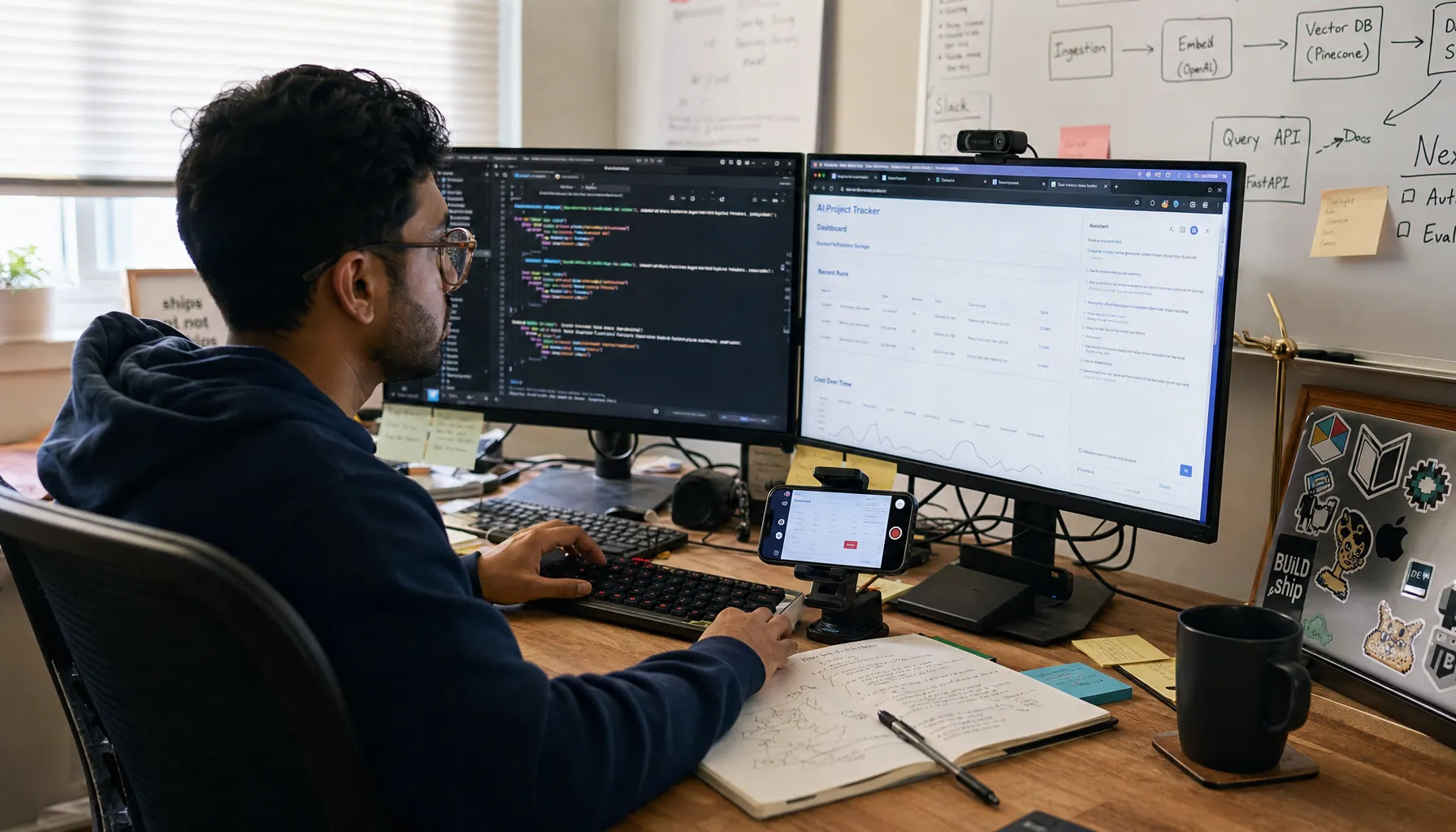
You do not need a formal AI job to show real hiring signal. You need working projects, public demos, and build notes that make your decisions easy to inspect.
This page covers how to build an AI portfolio with no experience so it holds up when companies hiring builders put it in front of a hiring manager, a recruiter, or an engineer. The idea is simple: do not ask anyone to imagine what you can do. Put the work in front of them.
Key Takeaways
- Build three small AI projects instead of one giant unfinished one: one workflow automation, one user-facing product, and one evaluation or debugging project.
- Every project should include a live demo, source repository, short video walkthrough, README, and build notes that explain tradeoffs.
- Use real constraints: latency, cost, hallucination risk, accessibility, data privacy, and failure handling.
- Reviewers look for judgment under ambiguity, not tool name-dropping or glossy screenshots.
- Update a no-experience portfolio like a product log, with dated changes and visible iteration.
Why can a no-experience AI portfolio still be credible?
A no-experience AI portfolio is credible when it shows that a builder can take a fuzzy problem, turn it into something that works, and explain the choices along the way.
Professional experience is just a proxy. It tells a reviewer that somebody else trusted you with real work before. If you do not have that proxy yet, you need a different kind of proof. Not a certificate. Not a prompt library. Not a tutorial clone. Actual work that shows how you scope, build, test, revise, and communicate.
The hiring system still leans hard on school names, company names, and networks. That falls apart pretty fast with AI work, because some of the clearest signal lives outside the resume. A builder might have already built an agent workflow, a research assistant, a data-cleaning tool, or a support prototype long before landing an official AI title.
According to the Stack Overflow 2024 Developer Survey on AI tools, 76% of respondents said they were using or planning to use AI tools in their development process. That changes the bar. Access to tools is common now. Good judgment is not. Your portfolio needs to prove the second part.
For the broader hiring path, see How to Get Hired as an Early-Career Builder in 2026: Proof, Requirements, Timeline, and Process. This page stays focused on one thing: how to create believable proof when your resume is still thin.
What should your first AI portfolio project prove?
Your first AI portfolio project should prove that you can solve a narrow real problem, check whether the output is any good, and explain what you changed after version one fell short.
Do not start with a giant assistant that supposedly does everything. Those projects almost always turn into vague demos with no clear standard for success. Pick a tight use case where success and failure are obvious.
| Project type | Good no-experience example | What it proves | Weak version to avoid |
|---|---|---|---|
| Workflow automation | Turns messy meeting notes into tagged action items with owner, deadline, and uncertainty flag | Structured outputs, error handling, workflow thinking | Generic summarizer with no test cases |
| User-facing AI product | Helps renters compare lease clauses and highlights terms that need human review | Product judgment, interface design, risk boundaries | Chatbot wrapper with no target user |
| Evaluation project | Compares three prompts on 50 sample inputs and logs accuracy, refusal quality, and failure modes | Measurement discipline and debugging | Claims the model “works well” without evidence |
The best first project usually looks a little boring on the surface and solid underneath. A receipt parser. A grant-search assistant. A job description analyzer for companies hiring builders. A customer email triage tool. That is good news, honestly. These projects force you to make real decisions about data shape, reliability, and edge cases.
GitHub reported in its Octoverse 2024 report that Python became the most used language on GitHub, a shift GitHub tied in part to AI, data science, and automation work. That does not mean every portfolio project needs to be in Python. It means reviewers expect builders to connect AI work to real systems, scripts, and workflows, not just screenshots and claims.
If you need a broader checklist for evidence, use Proof of Work for Early-Career Builders: Examples, Checklist, and Steps as the companion piece. This page is about how to create that proof from zero.
How do you build an AI portfolio with no experience step by step?
Build an AI portfolio the same way you build a small product: choose a narrow problem, ship something that works, test it on real examples, and publish notes that show your judgment.
Treat the portfolio like a mini product line. Three finished projects beat twelve half-finished experiments every time. Each one should take one to three weeks, depending on scope. The goal is not fake complexity. The goal is evidence a busy reviewer can actually evaluate.
- Pick a narrow problem with a visible before-and-after, such as turning unstructured notes into a clean task list.
- Define the user, input, output, and failure cases before you pick tools.
- Build the smallest working version using a model API, open-source model, no-code workflow, or local script.
- Create a test set of at least 20 realistic examples and record where the system fails.
- Add one improvement based on the failure log, such as schema validation, retrieval, better instructions, or human review flags.
- Publish a live demo or recorded walkthrough that shows the product working on real inputs.
- Write build notes that explain your decisions, constraints, tradeoffs, and next changes.
The step most builders skip is the test set. It is also the step companies hiring builders remember. A demo shows that something runs. A test set shows that you understand the difference between running and working.
Use official guidance when the project touches real risk. The National Institute of Standards and Technology AI Risk Management Framework describes AI risk management in terms of validity, reliability, safety, security, transparency, and accountability, according to NIST’s AI Risk Management Framework page. A beginner project does not need enterprise process. It does need boundaries. If your tool touches legal, medical, financial, or personal data, say clearly what it should not be used for.
What should public demos and build notes include?
Public demos and build notes should show the project, the reasoning behind it, the constraints you worked under, and proof that you improved it after testing.
A strong demo is short. Two to four minutes is plenty. Start with the problem, show the input, run the product, show the output, then explain one design decision that mattered. Do not spend half the video introducing yourself. The reviewer clicked because they want to see the work.
Build notes matter because AI projects can look weirdly similar from the outside. Two builders can both publish a lease analyzer. One copied a tutorial and changed the colors. The other designed clause categories, tested false positives, added disclaimers, and tightened the prompt after repeated failures. The notes make that difference obvious.
| Portfolio artifact | Minimum standard | Stronger signal |
|---|---|---|
| README | Problem, setup, tools, demo link | Architecture, test cases, known failures, next iteration |
| Demo | Screen recording or live link | Walkthrough using realistic messy inputs |
| Build notes | What you built | Why you made each tradeoff |
| Evaluation | A few examples | Scorecard with pass, fail, partial, and notes |
GitHub’s documentation on repository READMEs recommends using README files to explain what a project does, why it is useful, and how users can get started. For hiring review, add two more sections: “What failed” and “What I changed.” Those sections tell a reviewer you know how to think, not just ship.
If your project has a web interface, follow basic accessibility discipline. The World Wide Web Consortium publishes Web Content Accessibility Guidelines for making web content more usable for people with disabilities. Your portfolio project does not need to be perfect. It should have labeled controls, readable contrast, and keyboard-friendly flows. That shows you built for users, not for a screenshot carousel.
For review criteria beyond this page, see Early-Career Builder Portfolio: Evidence, Judgment, and Review Criteria.
What mistakes make a beginner AI portfolio look weak?
A beginner AI portfolio looks weak when the projects are too broad, the demos feel staged, and the failure modes are hidden.
The most common mistake is wrapping a model and calling it a product. Sometimes that wrapper is useful. Usually it is not enough on its own. The builder still needs to define the user, the workflow, the constraints, and how success gets measured. Without that, the project does not say much.
The second mistake is using only clean examples. Real inputs are messy. A recruiter note is full of abbreviations. A customer email is angry and missing context. A PDF has broken formatting. A credible AI project shows what happens when the input is annoying, inconsistent, or incomplete.
The third mistake is confusing AI fluency with tool collecting. Listing ten tools does not show judgment. A hiring manager wants to know why you chose retrieval instead of a longer prompt, why you used a schema, why you added a human approval step, or why you decided an agent loop was not worth the complexity.
This is where AI-native skill actually shows up. Strong builders direct systems, inspect outputs, and design feedback loops. For a narrower skill breakdown, read AI-Native New Graduate Skills: Signals, Examples, and Hiring Criteria.
How should builders package the portfolio for hiring review?
Builders should package the portfolio as a clear review path: a one-page index, three project cards, demo links, source links, and short notes that surface the strongest proof in under five minutes.
Assume the first reviewer is busy, because they are. They should not have to dig. Put the strongest project first. For each project, use the same structure: problem, user, demo, tools, evaluation, tradeoffs, next iteration.
The homepage can be plain. A simple Notion page, GitHub Pages site, personal site, or well-organized README is enough. Polish matters after the proof is clear, not before. A beautiful page with vague projects loses to a plain page with working demos and honest evaluation. Every time.
Use this five-minute review test before you share it:
- Can a reviewer understand what you built in 20 seconds?
- Can they run or watch the demo in one click?
- Can they see the project’s limits without asking?
- Can they tell what you did versus what the model did?
- Can they see evidence of iteration?
That last question is the real filter. AI made first drafts cheaper. Hiring signal now lives in the second and third draft. The builder who shows revision, testing, and judgment stands out because the work feels handled by a person, not just generated and posted.
Provn’s view is simple: performance over pedigree, proof over polish. A no-experience AI portfolio works when it gives companies hiring builders something better than a guess.
Frequently Asked Questions
How many projects should an AI portfolio have with no experience?
Three finished projects are enough for a no-experience AI portfolio if each one includes a working demo, source or build notes, realistic test examples, and a clear explanation of tradeoffs. One project should show automation, one should show a user-facing workflow, and one should show evaluation or debugging discipline.
Do I need professional AI experience before publishing an AI portfolio?
No. The whole point of the portfolio is to replace missing professional proof with visible work. Do not pretend self-directed projects were client work or employment. Label them honestly, publish the artifact, and show the decisions behind it.
What is the best first AI project for someone with no experience?
The best first AI project is a narrow workflow with measurable output, such as converting messy notes into structured tasks, classifying support emails, extracting fields from invoices, or comparing policy documents. The project should have clear inputs, outputs, and failure cases.
Should my AI portfolio use OpenAI, Claude, open-source models, or no-code tools?
The tool choice matters less than the reasoning behind it. A strong portfolio explains why the builder chose a specific model, workflow, or platform for the problem. If cost, privacy, latency, or deployment limits affected the choice, say that in the build notes.
Where should I host an AI portfolio?
Builders commonly host AI portfolios on GitHub Pages, a personal website, Notion, Framer, or a public GitHub profile. Pick the option that makes demos, READMEs, build notes, and source links easy to review. A plain page with working proof is stronger than a polished page with fuzzy evidence.