
Proof of Work for Early-Career Builders | Provn
Early-career builders can make up for thin credentials with real proof of work: inspectable projects, build logs, demos, decision notes, and failure write-ups that companies hiring builders can review before the interview.
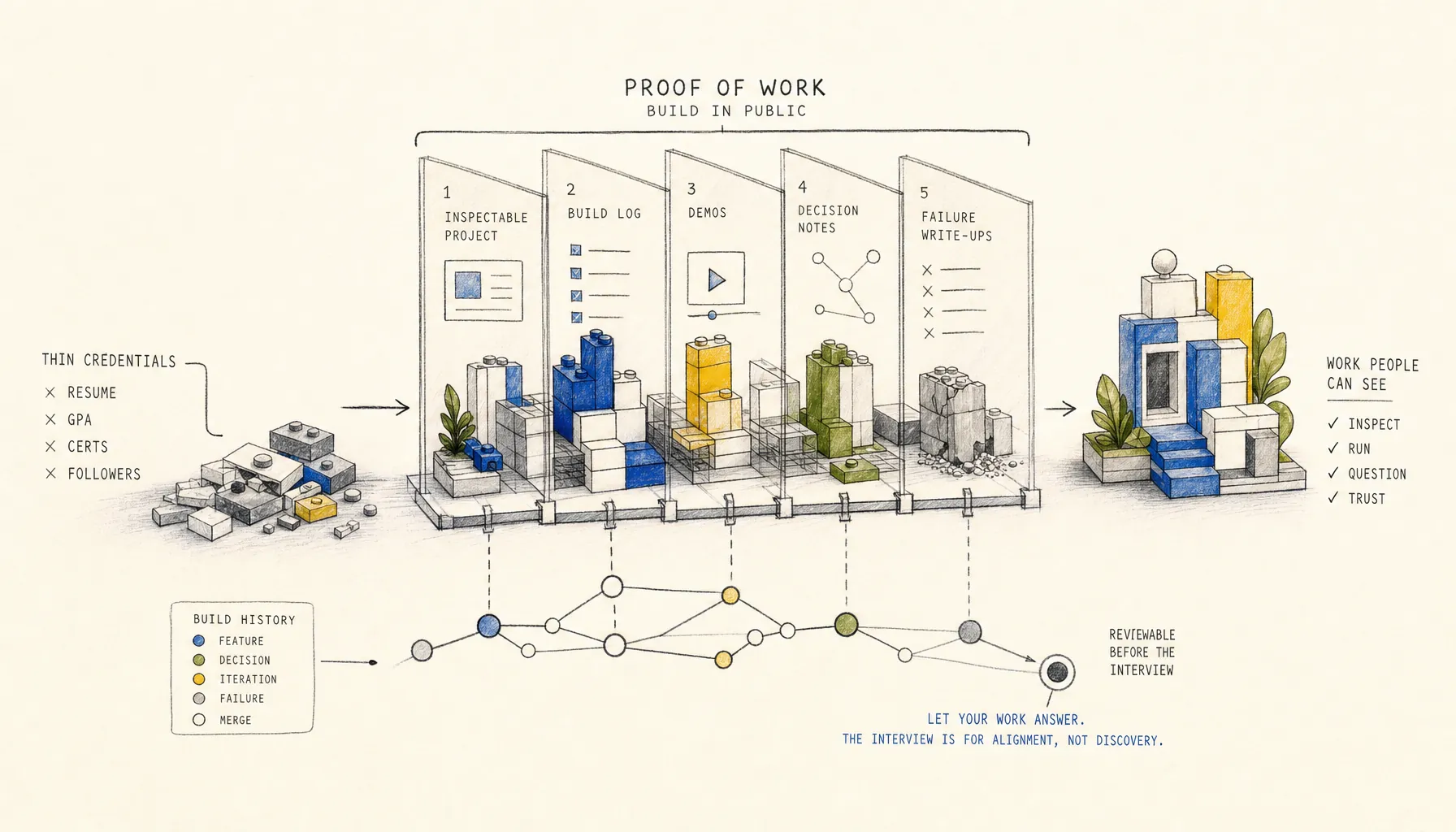
Proof of work matters most early in a builder’s career because it lets a hiring manager inspect the artifact, the decisions, the tradeoffs, and the builder’s judgment before anyone schedules an interview.
That matters for a simple reason. Early-career builders usually have thinner credentials through no fault of their own: fewer formal roles, fewer recognizable company names, and less time to stack the kinds of signals old hiring systems know how to sort. This guide is about replacing those thin credentials with visible work: project formats, build logs, demos, decision notes, and the evidence companies hiring builders actually use when they want to see capability before experience.
Key Takeaways
- Proof of work is strongest when it includes four inspectable layers: artifact, demo, build log, and decision notes.
- Hiring managers look for judgment, ownership, product sense, technical reasoning, communication, and the ability to improve after feedback.
- A polished project without decision history is weaker than a rougher project with clear tradeoffs, constraints, tests, and iteration.
- The best early proof projects are small enough to finish in 7 to 14 days and real enough to show user pain, data handling, edge cases, or workflow impact.
- A proof packet should let a reviewer understand the problem, run or view the demo, inspect the repository or artifact, and see what changed between versions.
What does proof of work for early-career builders actually mean?
Proof of work for early-career builders is visible evidence that a builder can define a problem, make something useful, explain decisions, handle constraints, and improve the work after reality pushes back.
A resume makes claims. Proof of work lets someone check them. For an early-career builder, the strongest signal usually is not one flashy artifact. It is the trail around it: why this problem, what got tried, what failed, what changed, what shipped, and what the builder would do next.
The cleanest way to think about this is the combine model. In the NFL draft, scouts still care about a player’s college history. They also want timed drills, film, position tests, interviews, medicals, and references. One signal does not cut it. Hiring builders works the same way. A degree, internship, or title gives context. Visible work lets a hiring manager watch the builder perform.
For the broader hiring path, the cluster pillar covers how to get hired as an early-career builder in 2026. This page is narrower. It focuses on the evidence layer: how to make work inspectable enough that a company can see capability before it sees years of experience.
The short version: proof of work for early-career builders is a public or shareable package of artifacts, demos, logs, and decision notes that shows capability through finished work, not school names, employer brands, or keyword-stuffed resumes.
Why do thin credentials fail early-career builders?
Thin credentials fail early-career builders because traditional hiring systems sort proxies before they look at work.
The screen usually runs on three familiar inputs: resumes, credentials, and networks. Those are easy to sort. They are also incomplete. A resume can say “built an AI agent,” but it cannot show whether the builder scoped the workflow well, caught hallucinations, handled edge cases, or made sane product decisions under time pressure.
This is where early-career builders get misread. The builder from Duke or Meta gets surfaced because the proxy is familiar. The builder from Cal State Chico, Bellevue College, a bootcamp, a community college, or a self-directed path may have equal or stronger ability, but the screen sees less familiar packaging. The builder is not the problem. The screen is missing the evidence.
Companies hiring builders say they want skills that resumes rarely prove cleanly. According to the National Association of Colleges and Employers analysis of attributes employers seek on student resumes, companies consistently look for communication, teamwork, problem-solving, analytical ability, and work ethic. Those are performance traits. They show up in work history, decisions, documentation, and collaboration patterns, not in a tool list.
AI has widened the gap. Companies now get stacks of AI-polished resumes that sound smooth and say roughly the same thing. People reviewing them are buried in noise. That is where proof helps. A hiring manager can skip the adjectives and inspect the work itself.
What evidence do hiring managers actually inspect?
Hiring managers inspect proof that the builder can make decisions under constraints, not proof that the builder can present a tidy finished object.
A polished demo matters. It just is not the whole signal. The deeper evidence sits around the demo. Hiring managers want to know whether the builder picked a real problem, cut scope intelligently, tested assumptions, handled failure modes, and explained tradeoffs without pretending the messy parts never happened.
For a more hiring-side view, see the related cluster page on what hiring managers want from early-career AI builders. The short version is that strong reviewers read artifacts like operators, not fans. They want proof that maps to real work.
| Evidence type | What it shows | What weak evidence looks like | What strong evidence looks like |
|---|---|---|---|
| Live demo or recorded walkthrough | Can the builder make the thing work in context? | A scripted tour with no edge cases. | A 3 to 5 minute walkthrough showing input, output, failure handling, and next improvement. |
| Build log | Can the builder work through uncertainty? | A final writeup that skips what changed. | Date-stamped notes showing decisions, blockers, tests, and revisions. |
| Decision notes | Can the builder explain judgment? | “I used this tool because it is popular.” | “I chose a rules-based fallback because model output was unstable on short inputs.” |
| Repository or artifact history | Can the builder ship in increments? | One giant upload with no meaningful history. | Readable commits, issues, release notes, or version history. |
| Evaluation notes | Can the builder measure whether the work improved? | “It works pretty well.” | A test set, before and after examples, user feedback, or error categories. |
The practical takeaway is simple. Do not make reviewers guess at your judgment. Put the judgment next to the work. A hiring manager reviewing 40 profiles will spend more time on the builder whose project explains itself.
Which project formats create the strongest proof of work?
The strongest proof-of-work projects are small, inspectable, useful, and constrained enough that a reviewer can understand the builder’s decisions in one sitting.
Early-career builders often make the same mistake: they overbuild. They try to launch a full SaaS product, a sprawling agent system, or a portfolio site with eight different sections nobody will read. That usually weakens the signal. Big projects hide decision quality. Smaller projects expose it.
The best format depends on the role path. A product-leaning builder should show problem framing, prioritization, and user workflow. A technical builder should show architecture, testing, reliability, and implementation quality. A design-leaning builder should show interaction decisions, user constraints, and tradeoffs. Cross-role builders should make those boundaries obvious.
| Project format | Best for showing | Example scope | Evidence to include |
|---|---|---|---|
| Workflow automation | Operational thinking and practical AI use | Turn messy meeting notes into prioritized follow-up tasks. | Before and after workflow, error cases, prompt or logic choices, demo video. |
| AI agent with bounded task | Planning, tool use, guardrails, reliability | Research five vendors and produce a sourced comparison table. | Task definition, allowed tools, failure modes, test cases, human review points. |
| Data product | Analytical judgment and communication | Analyze public job postings for skills frequency in entry-level roles. | Data source, cleaning decisions, chart, limitations, interpretation. |
| Product teardown plus prototype | Product sense and design judgment | Improve onboarding for an existing tool and prototype the first-run flow. | Problem diagnosis, user assumption, wireframes, tradeoff notes, prototype link. |
| Open-source contribution or issue fix | Collaboration and codebase reading | Fix documentation, reproduce a bug, or submit a small patch. | Issue link, pull request, test notes, maintainer feedback if available. |
A strong project has a real constraint. Time is a constraint. Messy input is a constraint. A nontechnical user is a constraint. A model with inconsistent output is a constraint. Constraints create judgment, and judgment is what hiring managers are trying to see.
For examples of how different proof artifacts can fit inside a broader body of work, the related page on early-career builder portfolio evidence goes deeper on portfolio structure. This article stays focused on what each proof unit should contain.
How should builders document the work so it survives review?
Builders should document proof of work with enough context that a reviewer can understand the problem, inspect the artifact, and judge the reasoning without needing follow-up questions.
Documentation is not decoration. It is part of the evidence. A hiring manager cannot evaluate a project if the link opens to a blank repo, a vague README, or a demo with no explanation of what problem it solves.
According to GitHub Docs on repository READMEs, a README explains what a project does, why it is useful, how users can get started, and where to find help. That same structure works for hiring proof. It gives a reviewer a clean way into the work.
What should a build log include?
A build log should record dated decisions, blockers, tests, changes, and the reason each meaningful change happened.
Think of the build log as game film. It lets the reviewer see how the builder responded over time. The artifact shows the final score. The log shows how it got there.
- Day and time spent: “Day 2, 90 minutes, narrowed the agent task after bad outputs on broad prompts.”
- Decision made: “Moved from freeform answer to structured JSON output because downstream parsing failed.”
- Evidence used: “Tested 20 sample inputs. Six failed because the input had missing company names.”
- Tradeoff accepted: “Kept manual review before send because autonomous sending created too much risk.”
- Next step: “Add confidence labels and source citations before expanding the workflow.”
What should decision notes explain?
Decision notes should explain why the builder chose one approach over another and what risk came with that choice.
This is where proof gets stronger than a portfolio screenshot. A decision note makes the builder’s judgment visible. It also keeps the reviewer from assuming choices were accidental.
For AI-heavy work, decision notes should include model choice, prompting approach, data handling, evaluation method, human review points, and known limitations. According to the National Institute of Standards and Technology AI Risk Management Framework, trustworthy AI work requires attention to validity, reliability, safety, security, privacy, explainability, and accountability. An early-career builder does not need enterprise governance language. They do need to show they noticed the failure modes.
What should a demo show?
A demo should show the project solving the target problem, handling at least one imperfect input, and explaining what the builder would improve next.
A good demo is short. Three to five minutes is enough for most proof projects. Start with the user problem. Show the input. Show the output. Show one failure or edge case. End with the next version.
Do not overproduce the video. Hiring managers do not need cinematic editing. They need to see whether the builder can make the thing work and talk about it clearly.
What belongs in a proof packet?
A proof packet should contain one artifact, one demo, one build log, one decision note, and one short summary that tells the reviewer why the work matters.
The packet is the unit that replaces thin credentials. It should be compact enough to review in 10 minutes and deep enough to support a real interview. If a reviewer likes it, the proof packet often becomes the interview agenda. That is exactly what you want.
Use this structure:
- Write a one-sentence problem statement. Name the user, the pain, and the outcome the project tries to improve.
- Publish the artifact. Share the repository, prototype, notebook, live demo, document, or recorded output.
- Record a 3 to 5 minute walkthrough. Show the project working, then show one edge case or limitation.
- Add a build log. Include dated notes on what changed, what failed, and what evidence caused the change.
- Write a decision note. Explain the main tradeoffs, rejected alternatives, risk controls, and next version.
- Include review instructions. Tell the hiring manager exactly what to inspect first and how long it should take.
- Attach a role-fit note. Map the proof to the kind of work you want to do without stuffing it with keywords.
For public code, include a README, setup instructions, and a license if others might reuse the work. For prototypes, include the prototype link, the intended flow, and screenshots in case the tool link breaks. For AI agents, include sample inputs and outputs because agents are hard to judge from a static description.
According to GitHub Docs on releases, releases package specific project versions with release notes and linked assets. Builders can borrow that idea even outside software: version the work, explain what changed, and make the current state easy to inspect.
How do hiring managers read proof of work before experience?
Hiring managers read proof of work by asking one question: does this evidence reduce uncertainty about how this builder will perform on the job?
Experience helps because it reduces uncertainty. A builder who has done similar work inside a company has already dealt with deadlines, ambiguity, code reviews, user complaints, data issues, and team communication. Early-career builders have less of that formal evidence. Proof of work narrows the uncertainty a different way.
The reviewer is usually asking five practical questions:
- Can this builder define a real problem? The project should not feel like a tutorial wearing a fake mustache.
- Can this builder make something usable? The artifact should produce an output, decision, workflow, or insight.
- Can this builder explain judgment? The notes should make tradeoffs visible.
- Can this builder handle imperfect conditions? The work should show errors, constraints, or edge cases.
- Can this builder improve? The build log should show iteration, not just completion.
This is where visible work beats polish. Polish often hides the real signal. Hiring managers know that clean language, attractive slides, and confident summaries are cheap now. A coherent trail of decisions is much harder to fake.
There is also a risk lens. For AI projects, reviewers increasingly look for whether the builder understands basic safety and misuse issues. The OWASP Top 10 for Large Language Model Applications lists common risk categories such as prompt injection, sensitive information disclosure, insecure output handling, and excessive agency. Early proof projects do not need enterprise-grade controls, but a builder who names the relevant risk and adds a simple guardrail sends a much better signal than one who ignores it.
What mistakes make proof of work look weaker than it is?
Proof of work looks weak when reviewers cannot tell what the builder did, why it mattered, or how the builder made decisions.
Most of the common mistakes are fixable. They usually come from treating proof like a showcase instead of an inspection file. A showcase tries to impress. An inspection file lets the reviewer verify.
| Mistake | Why it hurts | Fix |
|---|---|---|
| Only showing the final output | The reviewer cannot see judgment or iteration. | Add build notes, rejected options, and the main tradeoff. |
| Choosing a toy problem | The work does not map to job conditions. | Use a real workflow, real user pain, public data, or a real constraint. |
| Overclaiming impact | Unsupported claims reduce trust. | State what you measured and what you did not measure. |
| Hiding AI assistance | The reviewer cannot separate direction from execution. | Explain where AI helped, where human judgment directed the work, and what you verified. |
| No failure analysis | Real work fails in specific ways. | Include at least three error cases or limitations. |
| Broken links or missing access | The proof cannot be reviewed. | Test every link in an incognito browser and include screenshots or backup files. |
Failure analysis deserves extra attention. According to Google’s Site Reliability Engineering book chapter on postmortem culture, useful postmortems focus on learning from incidents without blame. Builders can use the same pattern in proof projects. Name what failed. Explain why. Show what changed. That is much stronger than acting like version one worked perfectly.
One of the highest-signal lines in a proof packet is also one of the simplest: “Here is what I would change in version two.” That tells a hiring manager the builder can inspect their own work. That trait travels across roles.
How should a builder create proof of work in 14 days?
A builder can create credible proof of work in 14 days by choosing one narrow problem, shipping a small artifact, documenting decisions daily, and packaging the evidence for review.
Two weeks is enough time to show judgment and not enough time to hide behind endless scope. That is a good thing. The goal is not to build a company. The goal is to produce inspectable evidence that maps to the work you want to do.
If the builder has no formal experience, the related cluster page on how to build an AI portfolio with no experience covers the broader starting point. The sequence below is the proof-packet version.
- Choose one role-shaped problem that a real team would recognize.
- Write a one-sentence user, pain, and outcome statement before building.
- Define the smallest artifact that proves progress on the problem.
- Create a public or shareable workspace for the artifact, notes, and demo.
- Build the first working version within three days, even if it is rough.
- Test the first version on at least 10 realistic inputs, tasks, or user scenarios.
- Record every major failure, confusing result, or scope cut in a dated build log.
- Revise the project based on the evidence from testing rather than personal taste.
- Write a decision note explaining the main tradeoff, risk, and rejected alternative.
- Record a 3 to 5 minute demo showing the normal path and one edge case.
- Package the artifact, demo, build log, decision note, and review instructions in one link.
- Ask one technical and one nontechnical reviewer to inspect the packet for clarity.
- Fix access issues, unclear claims, missing context, and unsupported impact statements.
- Attach the proof packet to outreach, interview materials, and Provn-style work evidence.
The 14-day version has one big advantage: it forces tradeoffs. Hiring managers learn more from a narrow finished project than from a broad unfinished one. Scope discipline is a work skill, not just a project-management slogan.
How does proof over pedigree change the hiring conversation?
Proof over pedigree changes the hiring conversation by moving attention from where a builder has been to what the builder can show.
This cuts both ways. A pedigree signal can surface someone who still has to prove they can build. A less familiar background can bury someone whose work is already strong. A better screen assumes neither. It inspects performance.
That is why visible work matters inside Provn’s model. Provn is where builders get hired. Performance over pedigree. Proof over polish. The hiring system is crowded with polished claims. The builder who can show the work gives companies hiring builders something better to inspect.
Proof of work is not a way around standards. It raises the standard. The builder has to make something real enough to examine. The company has to evaluate capability instead of leaning only on school names, employer brands, or networks. That is a better test for both sides.
Frequently Asked Questions
What is proof of work for early-career builders?
Proof of work for early-career builders is visible evidence of capability through projects, demos, build logs, decision notes, and artifacts. It gives hiring managers a way to inspect how a builder thinks and ships before leaning on years of experience or brand-name credentials.
How many proof-of-work projects should an early-career builder have?
Two or three strong proof packets usually beat a big pile of shallow projects. Each packet should show a different angle of capability, such as product judgment, technical execution, AI workflow design, data analysis, or communication. One strong project with excellent documentation is better than five half-finished demos.
Should proof of work be public?
Public proof is useful because it is easy to review, but shareable private proof also works when the project includes sensitive data, client material, or personal information. Use public data, anonymized examples, screenshots, and recorded demos when full access does not make sense.
What should a builder include if the project used AI tools heavily?
The builder should explain where AI contributed, what human decisions controlled the outcome, how outputs were checked, and what failure modes showed up during testing. Hiring managers are not looking for tool purity. They are looking for direction, judgment, verification, and ownership.
Can proof of work replace a thin resume?
Proof of work can make a thin resume much less limiting because it gives hiring managers evidence that traditional credentials do not show. It does not remove the need for clear communication, role fit, or interview performance. It gives the builder stronger material for each of those steps.