
How to Show Curiosity and Resilience in an Interview
Builders show curiosity and resilience in interviews when they can prove how they learned, tested, bounced back, and shipped under real constraints.
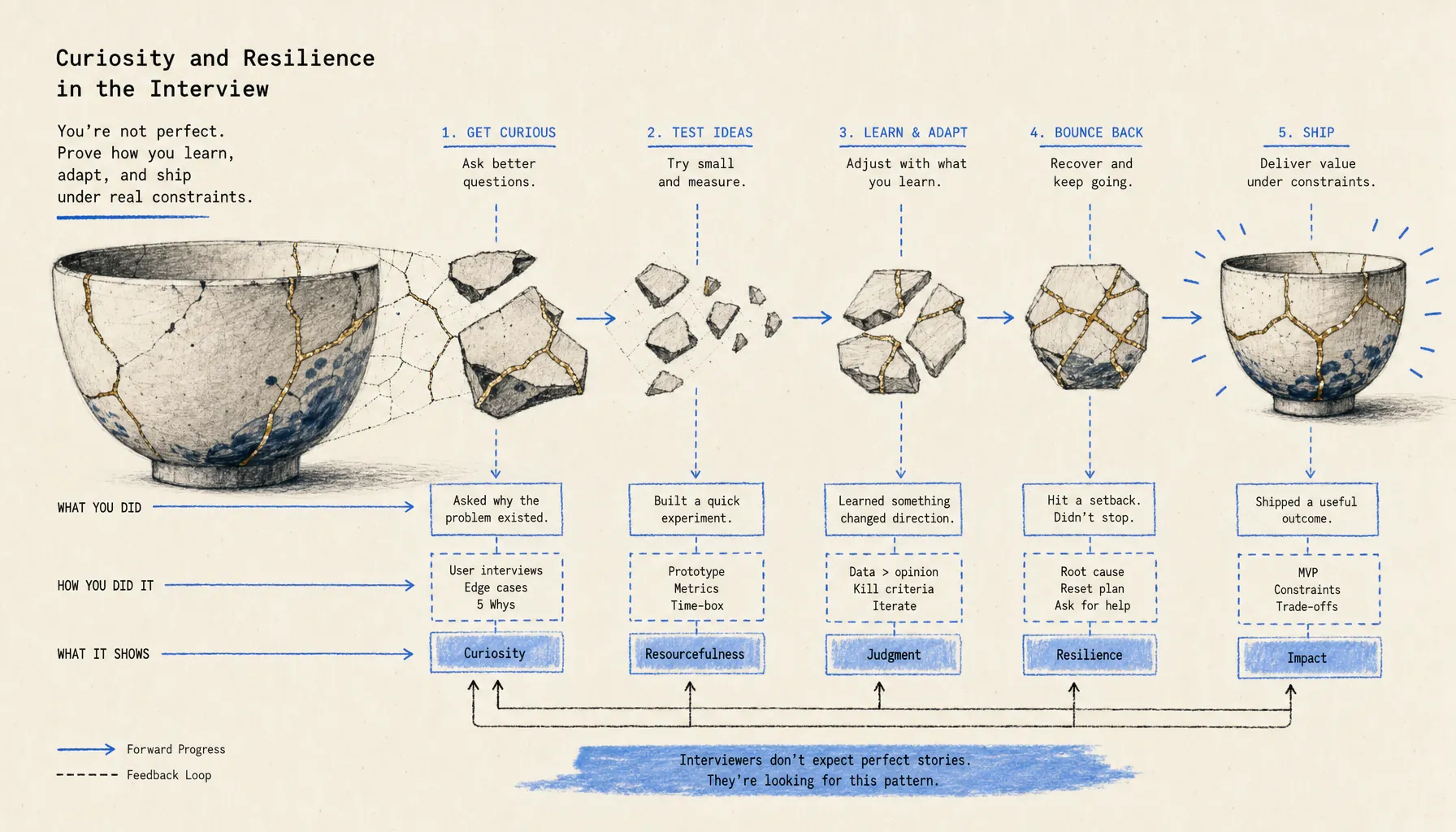
How to Show Curiosity and Resilience in an Interview
Microsoft reported in 2024 that 75% of knowledge workers were already using AI at work. Polished interview answers are cheap now.
That changes how builders should think about how to show curiosity and resilience in an interview. Companies hiring builders still care about those traits, but they trust work more than adjectives. The stronger interview comes from the builder who can explain what they tried, what failed, what they changed, and what finally shipped.
Key Takeaways
- Curiosity comes through best when you show a learning loop: question, test, evidence, revision, result.
- Resilience is clearest when you walk through a constraint, a failed attempt, a changed plan, and a shipped outcome.
- Structured interviews reward specific examples because interviewers score evidence against a rubric, not vibes.
- AI made generic interview answers easier to produce, so companies hiring builders pay more attention to process details that are hard to fake.
- The best answers come from real work: prototypes, commits, customer notes, experiments, walkthroughs, and postmortems.
How do you show curiosity and resilience in an interview?
You show curiosity and resilience in an interview by describing real work where you ran into something you did not know, tested a path, hit resistance, changed your approach, and got to a result.
The answer needs to move through evidence. What did you not understand at the start? What did you do to learn it? What broke? What did you change? What exists now because you kept going?
This gets at Provn’s core idea: performance over pedigree, proof over polish. A builder from Bellevue College who can walk through a shipped AI workflow with sound judgment gives a hiring manager more signal than a famous-school answer full of self-description. For the broader hiring sequence, see How to Get Hired as an Early-Career Builder in 2026: Proof, Requirements, Timeline, and Process.
According to Microsoft and LinkedIn’s 2024 Work Trend Index, 75% of knowledge workers were using AI at work. That changes interviews too. More people can produce clean, plausible answers. Far fewer can explain the messy middle of the work.
Why do leaders value curiosity and resilience in early-career builders?
Companies hiring builders value curiosity and resilience because early-career builders usually start with partial context, shifting tools, and messy problems.
The work does not arrive as a syllabus. In one week, a builder might compare model outputs, prototype a customer support agent, rewrite a landing page, debug a broken API call, and explain the tradeoff to a nontechnical manager. Curiosity gets them into the problem. Resilience keeps them moving when the first version is wrong.
According to the National Association of Colleges and Employers career readiness competencies, companies evaluate skills such as career and self-development, communication, and critical thinking. Fine. But labels are not the point. In an AI-heavy team, the real question is not whether someone says they love learning. It is whether they can learn fast enough to improve the output.
The same pattern shows up in employer research. The World Economic Forum Future of Jobs Report 2025 lists analytical thinking and resilience, flexibility, and agility among core workforce skills. In plain English, companies hiring builders expect people to face unfamiliar problems without waiting around for perfect instructions.
What interview answers prove curiosity instead of claiming it?
Curiosity shows up when a builder can point to a question that changed the work.
Weak answers treat curiosity like a personality trait. Strong answers leave a trail: a question, a source, a test, a changed decision, and a visible result. The interviewer should be able to see how learning moved the project forward.
For early-career builders, the best curiosity examples often come from small projects. Say a builder used an AI agent to sort LinkedIn connection notes, noticed bad categorization, inspected the prompts, created test cases, and improved precision. That is a real answer. The project may be small. The signal is not. For more examples of evidence that holds up under review, see Proof of Work for Early-Career Builders: Examples, Checklist, and Steps.
| Interview prompt | Weak answer | Stronger builder answer |
|---|---|---|
| “Tell me about a time you learned something new.” | “I am naturally curious and like learning new tools.” | “I wanted to understand why my support chatbot gave confident wrong answers. I built 20 test questions from real support docs, compared three prompt formats, and found the issue was missing source constraints. The final version cited the doc section before answering.” |
| “How do you approach unfamiliar problems?” | “I research online and ask questions.” | “I map what I know, list what would change the decision, then run the smallest test. On a pricing-page project, that meant interviewing five users before changing copy. The test showed confusion around usage limits, not price.” |
According to Google’s guidance on structured interviewing, structured interviews compare responses against consistent criteria. That works in favor of builders who bring concrete evidence. A vague answer about curiosity gives the interviewer nothing to score. A work-backed answer gives them behavior they can actually evaluate.
What interview answers prove resilience instead of claiming it?
Resilience shows up when a builder can explain what they did after the first plan failed.
A lot of people get this wrong and turn resilience into endurance theater. “I worked really hard” is not enough. Companies hiring builders want to know whether you can learn from failure. What did the failed attempt reveal? What changed after that? What did you stop doing?
According to the American Psychological Association’s resilience overview, resilience involves adapting well in the face of adversity, trauma, threats, or major stress. In interviews, keep it work-specific. You do not need personal drama. A broken demo, missed milestone, rejected design, failed user test, or unusable model output is plenty.
| Resilience element | What interviewers listen for | Example answer detail |
|---|---|---|
| Constraint | The work had a real limit. | “The API changed two days before the demo.” |
| Failed attempt | The builder names what did not work. | “My first workaround cached stale responses and created wrong status messages.” |
| Adjustment | The builder changed the system, not the story. | “I added a fallback state, logged failed calls, and narrowed the demo path.” |
| Result | The answer ends with evidence. | “The demo shipped with three reliable flows instead of six unstable ones.” |
This is one place where early-career builders can beat polished interview performers. A frictionless answer often sounds rehearsed. A specific recovery story sounds like real work. Companies hiring builders and evaluating what hiring managers want from early-career AI builders usually care less about whether version one worked and more about whether the builder knew what to do next.
How should builders prepare curiosity and resilience stories before the interview?
Builders should prepare two short work stories before the interview: one where learning changed the output, and one where recovery changed the outcome.
Do not memorize a speech. Build a proof packet instead. That can include a link, screenshot, repo, Loom walkthrough, changelog, user note, test table, or before-and-after artifact. The asset matters because it pulls the answer back to reality.
- Select one project where you started with an unanswered question.
- Identify the exact action you took to learn, such as testing prompts, interviewing users, reading docs, or comparing outputs.
- Write down what changed in the final work because of that learning.
- Select one project where the first version failed, broke, missed the mark, or got negative feedback.
- Name the constraint, the failed attempt, the adjustment, and the final result in four sentences.
- Attach proof to each story, such as a demo link, commit, screenshot, walkthrough, or project note.
- Practice answering in under 90 seconds, then keep one deeper detail ready in case the interviewer asks a follow-up.
The 90-second limit matters. Rambling buries the signal. A strong answer has a spine: situation, action, evidence, lesson. Builders with a thin formal work history can still do this if the work is real. A class project, volunteer tool, prototype, or AI workflow counts when the artifact shows judgment. For portfolio structure, see Early-Career Builder Portfolio: Evidence, Judgment, and Review Criteria.
Frequently Asked Questions
What is the best way to show curiosity in an interview?
The best way to show curiosity in an interview is to describe a specific question you pursued, the test or research you ran, and how the final work changed because of what you learned. Do not stop at “I am curious.” Prove it with the work.
What is the best way to show resilience in an interview?
The best way to show resilience in an interview is to explain a work setback clearly: what failed, what the constraint was, what you changed, and what shipped after the change. The point is adaptation, not just effort.
Can early-career builders use school projects as interview examples?
Yes. School projects work when they include real constraints, artifacts, and decisions. A project with a demo, test cases, revisions, and a clear explanation of tradeoffs gives an interviewer more to work with than a broad claim about being hardworking.
How long should curiosity and resilience interview answers be?
Most answers should run 60 to 90 seconds. That is enough time to explain the context, action, evidence, and result without drowning the interviewer in detail. Keep one deeper technical or product detail ready for follow-up questions.
Do builders need a formal portfolio to prove curiosity and resilience?
No, but a visible artifact makes the answer stronger. A repo, prototype, screenshot, walkthrough, changelog, or written postmortem gives the interviewer something concrete to inspect and makes the story much harder to fake.