
How to Find a Mentor as an Early-Career Builder | Provn
A practical guide to finding mentors in the early years of an AI-native career, asking for feedback you can actually use, taking in tough judgment, and becoming someone people keep investing in.
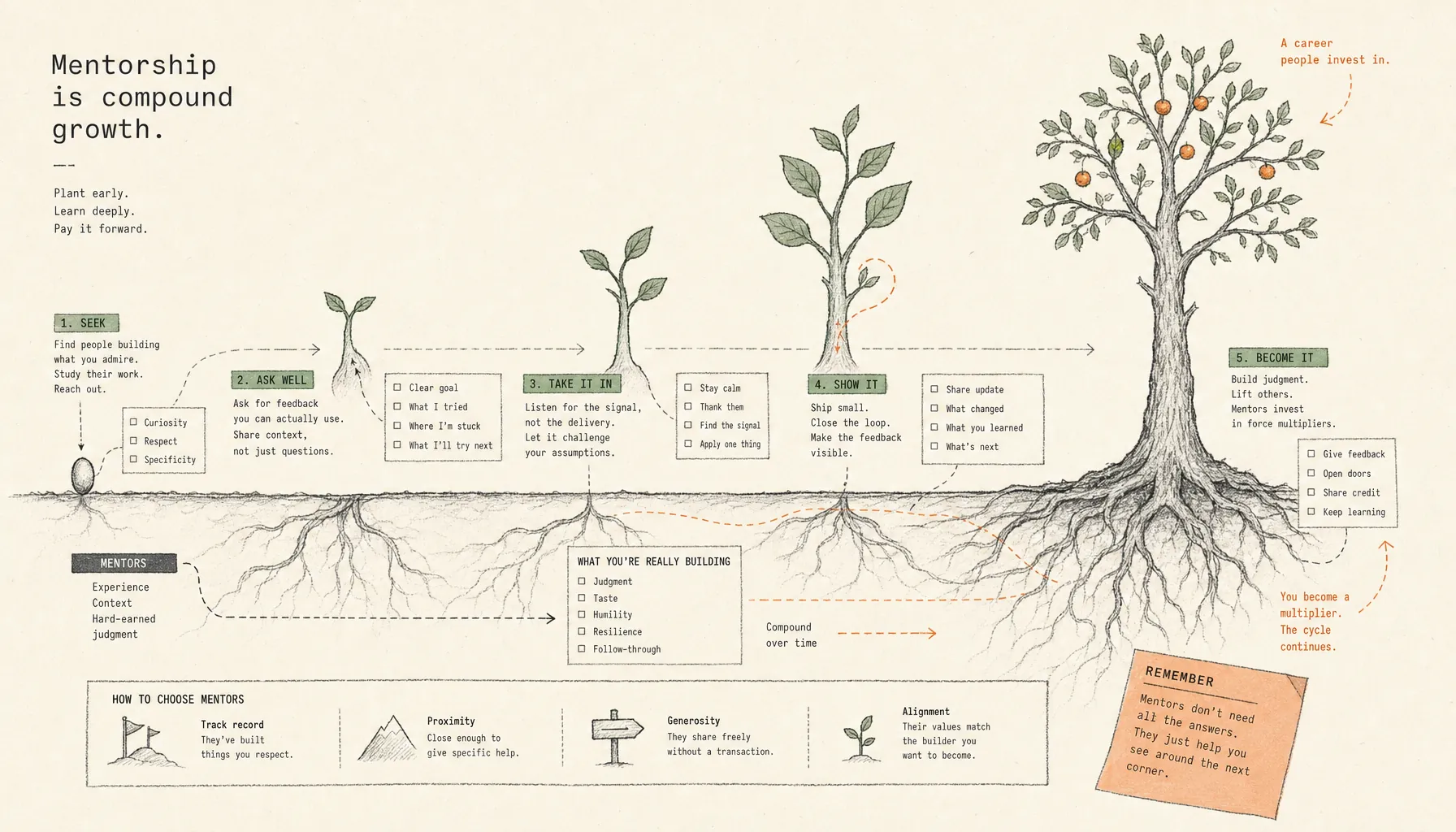
How to Find a Mentor as an Early-Career Builder
Microsoft’s 2024 Work Trend Index found that 75% of knowledge workers already use AI at work. Early-career builders are walking into teams where the work changed faster than the training did. Microsoft’s 2024 Work Trend Index on AI at work makes the point pretty clearly: AI is already all over real company workflows, even when the habits around it are still messy.
This page answers how to find a mentor as an early-career builder in that kind of environment. A useful mentor is not a career guru. It is someone who can look at your work, point to the gap, and help you sharpen your judgment.
What are the key takeaways for finding a mentor as an early-career builder?
The best mentor relationships start with actual work, not broad career talk. When a builder brings artifacts, decisions, tradeoffs, and a clear feedback request, the mentor has something real to react to.
- Ask for judgment on a concrete artifact: prototype, product memo, prompt chain, user test, data pull, demo, or postmortem.
- Use a 20-minute feedback packet: context, goal, constraints, decision made, question for review, and what you already tried.
- Separate four mentor types: craft coach, operator, diagnostic mirror, and sponsor. One person usually will not do all four.
- Respond to feedback with a revision within 48 to 72 hours when you can. Speed signals seriousness.
- Be easy to invest in. Show receipts: shipped work, documented learning, and visible improvement over time.
What should a mentor actually do for an AI-native builder?
A mentor should improve your judgment, not manage your ambition. For an early-career builder, the highest-value mentorship is regular contact with better standards.
The word mentor gets stretched way too far. Some people encourage you. Some open doors. Some review work. Some spot the habits that keep dragging your work down. Those are different jobs, and it helps to name them clearly.
The National Academies of Sciences, Engineering, and Medicine describes effective mentorship as work that includes aligned expectations, communication, and professional development in The Science of Effective Mentorship in STEMM. That matters here because AI can make weak work look finished. A good mentor sees past the polish and asks the question that matters: does this actually solve the problem?
| Mentor type | What they review | Best ask | Bad ask |
|---|---|---|---|
| Craft coach | Quality of the artifact | “Where is this prototype weak?” | “How do I become great?” |
| Operator | Execution under constraints | “What would you cut to ship this by Friday?” | “What should my career plan be?” |
| Diagnostic mirror | Repeated patterns in your work | “What mistake do I keep making?” | “Do you think I’m talented?” |
| Sponsor | Readiness for opportunity | “What proof would make you comfortable referring me?” | “Can you recommend me?” |
This distinction keeps the relationship clean. If you need role context, use the broader hiring map in How to Get Hired as an Early-Career Builder in 2026: Proof, Requirements, Timeline, and Process. This page stays focused on one thing: how to earn serious mentorship through the work itself.
How do you find a mentor as an early career builder?
You find a mentor by putting your work in front of the right reviewer and asking for one specific piece of judgment. The fastest path is a small ask that proves you can use feedback well.
Do not open with “Will you mentor me?” That is vague and heavy. Start with proof, then ask for a narrow read.
- Identify the skill gap you want judged, such as product framing, agent reliability, interface clarity, data reasoning, or user research.
- Find three people whose public work reflects the standard you want to learn from. That might be operators, builders, founders, senior designers, engineers, or product leads.
- Study one specific artifact from each person, such as a launch note, teardown, open-source repo, demo, talk, or product decision.
- Create or revise one artifact of your own in that same problem area.
- Send a short note with context, the artifact link, the decision you made, and one question that requires judgment.
- Ask for 15 to 20 minutes, or offer an async response if that is easier.
- Apply the feedback quickly and send a short follow-up showing what changed.
This works because it filters for seriousness on both sides. The mentor sees effort before obligation. The builder learns whether the reviewer is precise, honest, and worth listening to.
If the artifact itself is weak or missing, fix that first. The related guide Proof of Work for Early-Career Builders: Examples, Checklist, and Steps covers how to make your work reviewable before asking anyone to spend time on it.
How do you ask for feedback without wasting the mentor’s time?
A good feedback request gives the mentor context, constraints, and a decision to evaluate. The worst request asks for general advice when what you actually need is judgment.
Use a feedback packet. It does not need to look polished. It just needs to be easy to inspect.
- Context: “I built a small agent that summarizes five sales calls and flags objections.”
- Goal: “The goal is to help a founder prepare better follow-ups.”
- Constraint: “I limited the build to two evenings and used off-the-shelf transcription.”
- Decision: “I ranked objections by frequency instead of revenue impact.”
- Question: “Is that the wrong ranking logic for this user?”
That gives the mentor a real job to do. They can evaluate a decision instead of drifting into generic career advice.
MENTOR, the national mentoring organization, includes match support and ongoing monitoring in its Elements of Effective Practice for Mentoring. Informal mentorship needs the same discipline. Define the ask, close the loop, and make the next conversation better than the first.
For portfolio review, the feedback packet should point to evidence. The narrower breakdown in Early-Career Builder Portfolio: Evidence, Judgment, and Review Criteria explains what reviewers need to see when they are judging work instead of credentials.
How do you absorb judgment and turn it into better work?
You absorb judgment by separating the quality of the work from your identity as a builder. The mentor is not grading your worth. They are naming what the artifact proves and what it does not.
This is where a lot of early-career builders burn the relationship. They ask for honesty, then fight every note. Or they accept every note without thinking. Neither response helps. One is defensive. The other is passive.
Use a three-column review after every serious feedback session:
| Feedback received | What it means | What I will change |
|---|---|---|
| “The demo hides the failure cases.” | The system looks better than it is. | Add a failure log and explain mitigation. |
| “The user is too vague.” | The problem framing is generic. | Name one user and one workflow. |
| “The AI output is unverified.” | The artifact lacks trust controls. | Add source links, human review, or confidence rules. |
The National Association of Colleges and Employers defines career readiness through competencies such as communication, professionalism, technology, and critical thinking in NACE’s career readiness framework. In practice, mentors are often testing those same signals through how you handle feedback. Do you clarify? Do you revise? Do you understand tradeoffs? Do you protect the user from sloppy AI output?
Your response becomes part of the signal. Companies hiring builders do not just look at the finished artifact. They look for evidence that your judgment gets better under pressure, which connects directly to Hiring Manager Expectations for Early-Career AI Builders: Signals and Evidence.
How do you become worth investing in?
You become worth investing in by turning feedback into visible improvement. Mentors keep showing up when each interaction produces a stronger builder, not a deeper dependency.
The fastest way to lose a serious mentor is to ask the same kind of question twice without showing what changed. The fastest way to earn the next conversation is to send a short note like this:
“I changed the ranking logic from frequency to revenue impact, added a failure log, and tested it on three more calls. The summary is better, but the agent still misses objections when two speakers overlap. I’m deciding whether to improve transcription or narrow the use case. Which tradeoff would you make?”
That note proves the loop is working. It shows follow-through, judgment, and a real decision that still needs a call.
The Gallup-Purdue Index found that graduates who strongly agreed they had a mentor who encouraged their goals and dreams were about twice as likely to be engaged at work, according to the Gallup-Purdue Index report on college graduates and work. The useful takeaway is not that mentorship feels nice. It is that lasting encouragement usually follows visible direction.
Provn’s view is simple: proof beats polish. Mentorship follows the same rule. A mentor does not need your perfect story. They need enough evidence to believe their judgment will turn into better work.
What is the best way to use a mentor in the first two years?
The best way to use a mentor in the first two years is to build a repeatable calibration loop. Bring work, get judgment, revise, document what changed, repeat.
Early AI-native work comes with one obvious trap: output shows up fast, so builders start confusing speed with progress. A good mentor slows down the right part. They ask whether the problem is real, whether the user is specific, whether the evaluation is honest, and whether the AI system fails safely.
A practical cadence is one review every two to four weeks around a concrete artifact. Weekly mentorship often turns into status updates. Quarterly mentorship is too slow for fast-moving builder work. Two to four weeks is usually the sweet spot. It gives you time to ship, observe, revise, and come back with something worth judging.
If the relationship becomes more formal, the companion page AI Mentorship for Early-Career Builders: Process, Expectations, and Fit covers structure and expectations. The core rule does not change: the work leads, the relationship follows.
Frequently Asked Questions
How do I ask someone to mentor me as an early-career builder?
Ask for one specific review before you ask for an ongoing mentorship relationship. Send a short artifact, explain the goal and constraint, name the decision you want judged, and ask for 15 to 20 minutes or an async response.
What should I send a potential mentor?
Send a link to a concrete artifact and a short feedback packet. Include context, goal, constraint, the decision you made, what you already tried, and one question that requires judgment instead of generic advice.
How often should I meet with a mentor in the first years of an AI-native career?
A two-to-four-week cadence works better than constant check-ins for most early-career builders. That window gives you enough time to ship work, test assumptions, apply feedback, and come back with a stronger artifact.
What if a mentor gives feedback I disagree with?
Treat disagreement as a decision point, not a debate. Restate the feedback, identify the assumption behind it, test it against the artifact or user need, and decide what you will change, reject, or investigate next.