
What Is an Early-Career Builder? 2026 Definition
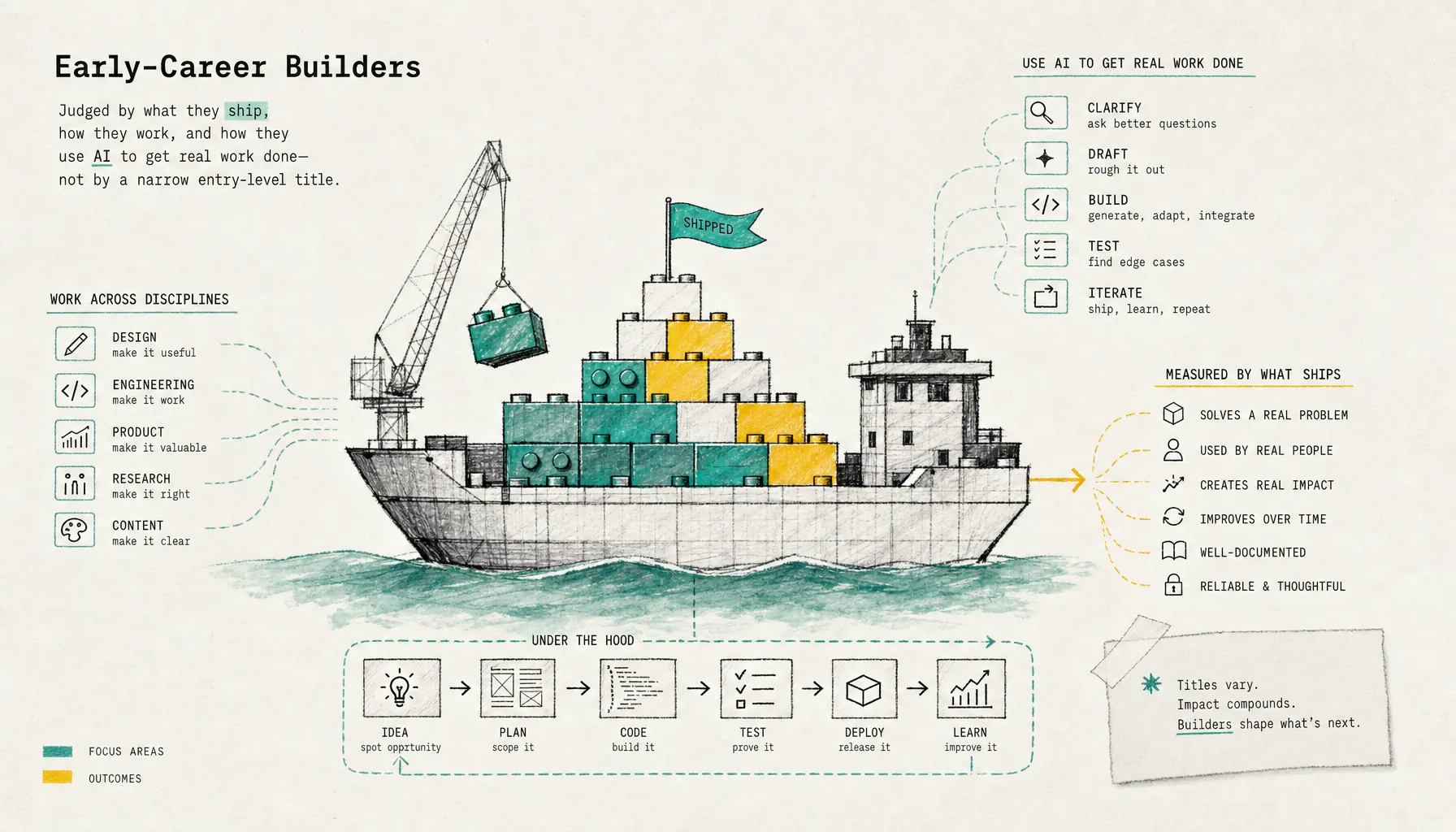
Early-career builders are judged by what they’ve shipped, how comfortably they work across disciplines, and how well they use AI to get real work done, not by a narrow entry-level title.
What Is an Early-Career Builder? Definition and Examples
In 2026, an early-career builder is someone with limited formal work history who can still ship useful work across product, design, engineering, writing, automation, and AI-assisted workflows.
This glossary page explains what an early-career builder is, gives concrete role examples, and shows why companies hiring builders treat shipped evidence as a stronger signal than school names, internships, or polished self-description.
Key Takeaways
- An early-career builder is early in formal work history but already ships real work across tools and disciplines.
- The signal is proof: working prototypes, product judgment, design artifacts, code, research synthesis, automation, or agent-directed workflows.
- AI raised the floor. According to the World Economic Forum Future of Jobs Report 2025, 86% of employers expect AI and information-processing technologies to change their business by 2030.
- Early-career builders are reviewed less like entry-level specialists and more like small, fast teams: scope the problem, choose tools, ship, explain tradeoffs.
What is an early career builder?
An early-career builder is someone near the start of formal work history who uses AI, software, design, writing, and product judgment to ship usable work across disciplines.
The phrase matters because “entry level” usually describes tenure. “Builder” describes output. A builder can take an ambiguous problem, cut it down to something testable, make the artifact, and explain what changed after feedback. That artifact might be a prototype, a customer research synthesis, a working script, a landing page, a prompt workflow, a Figma flow, or an AI agent that handles a narrow operational task.
The hiring screen still lags behind the work. Resumes reward recognizable inputs: school, prior employer, network, title. Those inputs are easy to scan and bad at proving whether someone can actually build with AI. Provn uses a narrower frame: performance over pedigree, proof over polish. For the broader hiring path around this role, see How to Get Hired as an Early-Career Builder in 2026: Proof, Requirements, Timeline, and Process.
Why does the early-career builder definition matter in 2026?
It matters because AI shrank the distance between an idea, a prototype, and something shipped.
A new graduate no longer needs a full product team to test a small workflow. They can use a large language model for research synthesis, a coding assistant for scaffolding, Figma or Framer for interface work, spreadsheets for lightweight analysis, and automation tools for repeatable tasks. Tool familiarity by itself is not the signal. Judgment under compression is.
According to Stanford University’s 2025 AI Index Report, AI systems keep improving on benchmark tasks while still struggling with complex reasoning, reliability, and evaluation. That gap is the job. Builders who treat AI output like finished work create noise. Builders who direct, inspect, test, and revise AI output create signal.
That is why proof matters. A builder’s work sample shows the parts a resume hides: what they noticed, what they ignored, what they shipped first, and where they corrected the machine. For a tighter look at evidence, see Proof of Work for Early-Career Builders: Examples, Checklist, and Steps.
What does an early-career builder ship across roles?
An early-career builder ships artifacts that cross job boundaries: product decisions, design flows, code, research, content, automation, and AI-directed operations.
The simplest way to understand the role is to look at output. The title changes by company. The behavior does not.
| Role mode | What the builder ships | What strong proof looks like |
|---|---|---|
| Product | Problem framing, user stories, feature scope, experiment plans, launch notes | A short product spec tied to user evidence, with a clear tradeoff and a shipped prototype |
| Design | Figma flows, interaction states, copy, usability notes, before-and-after revisions | A clickable flow that shows the original assumption, user friction, and the revised decision |
| Engineering | Scripts, internal tools, small apps, API integrations, tests, deployment notes | A working repo with setup instructions, constraints, error handling, and a plain-English walkthrough |
| Agentic operations | AI workflows that research, classify, draft, route, summarize, or trigger software actions | A narrow agent workflow with inputs, tools, guardrails, evaluation checks, and failure cases |
Product example
A product-oriented early-career builder turns an unclear customer complaint into a small tested feature or workflow.
For example, “users abandon onboarding” is too vague. A builder narrows it to “users stop after connecting their calendar,” reviews support notes, writes three hypotheses, prototypes a shorter flow, and measures completion in a small test. That is product judgment, even without a formal product manager title.
Design example
A design-oriented early-career builder shows how an interface decision changed after evidence.
A polished mockup alone is weak signal. A stronger artifact includes the first flow, the observed friction, the revised flow, and a note explaining why one interaction was removed. The proof is the decision trail, not the visual finish.
Engineering example
An engineering-oriented early-career builder ships code that solves a real problem and explains its limits.
A useful example is an internal tool that cleans CSV uploads, validates fields, and sends exceptions to a review queue. The work does not need to be large. It needs to run, fail visibly, and make the tradeoffs clear.
Agentic role example
An agentic early-career builder manages AI workflows as systems with tools, constraints, and checks.
According to Anthropic’s guide to building effective agents, agents differ from simple workflows when the model directs its own process and tool use. According to OpenAI’s tools documentation, tool use connects model output to actions such as retrieval, function calls, and computer tasks. The builder’s job is to set the task boundary, define review points, and catch failure modes. For a deeper role path, see Managing AI Agents at Work: Skills, Examples, and Career Path.
How do companies recognize an early-career builder?
Companies recognize an early-career builder by reviewing evidence of shipped work, judgment, iteration, and explanation.
In practice, the review looks more like a combine than a resume screen. The question is not where the builder trained. It is what happens when the builder gets a real problem, a short clock, and imperfect tools.
- Ask for one shipped artifact tied to a real or realistic problem.
- Review the builder’s explanation of scope, constraints, and tool choices.
- Inspect the artifact for evidence of iteration, not surface polish alone.
- Test whether the builder can name failure modes, edge cases, and next revisions.
- Compare the work against the role’s actual operating needs, not pedigree shortcuts.
According to the National Association of Colleges and Employers career readiness competencies, employers evaluate communication, technology, teamwork, professionalism, and critical thinking. Early-career builder review makes those visible through artifacts. For portfolio structure, see Early-Career Builder Portfolio: Evidence, Judgment, and Review Criteria.
What is the difference between an early-career builder and a traditional junior hire?
A traditional junior hire is usually evaluated by role fit and trainability. An early-career builder is evaluated by demonstrated ability to ship across boundaries.
That does not mean every early-career builder replaces a specialist. It means the first screen changes. A junior developer might be judged mainly on language fundamentals and ticket execution. An early-career builder shows a wider loop: problem selection, tool direction, implementation, communication, and revision.
That shift changes hiring design. Teams that need deep mentorship should say so directly. Teams that need fast cross-functional output should test for it directly. The useful distinction is operating mode, not seniority theater. Provn exists for that screen: find builders whose work already shows capability, including people a credential-first process would miss.
Frequently Asked Questions
Is an early-career builder the same as an entry-level employee?
No. Entry level describes limited formal work experience. Early-career builder describes demonstrated output. A builder can be early in tenure while still showing product judgment, design sense, code execution, research ability, or AI workflow control through shipped artifacts.
Does an early-career builder need to code?
Not always. Coding helps in many builder roles, but the core requirement is shipping useful work. A product, design, or operations builder can show strong evidence through prototypes, research synthesis, automation workflows, agent instructions, evaluation plans, and clear tradeoff explanations.
What proof should an early-career builder show?
The strongest proof includes a shipped artifact, a short explanation of the problem, the tools used, the constraints, the revisions made, and the next failure mode to test. A polished screenshot without process evidence is weaker than a rough artifact with clear judgment.
Why do companies hire early-career builders?
Companies hire early-career builders when they need people who can move across product, design, engineering, research, and AI-assisted execution. This is not about vague enthusiasm for AI. It is about turning ambiguous work into usable output with visible judgment.