
AI Native Builder vs Junior Developer: Positioning
AI-native builders and junior developers compete for the same early-career roles, but companies hiring builders judge them on different signals: shipped work, judgment, craft, and proof.
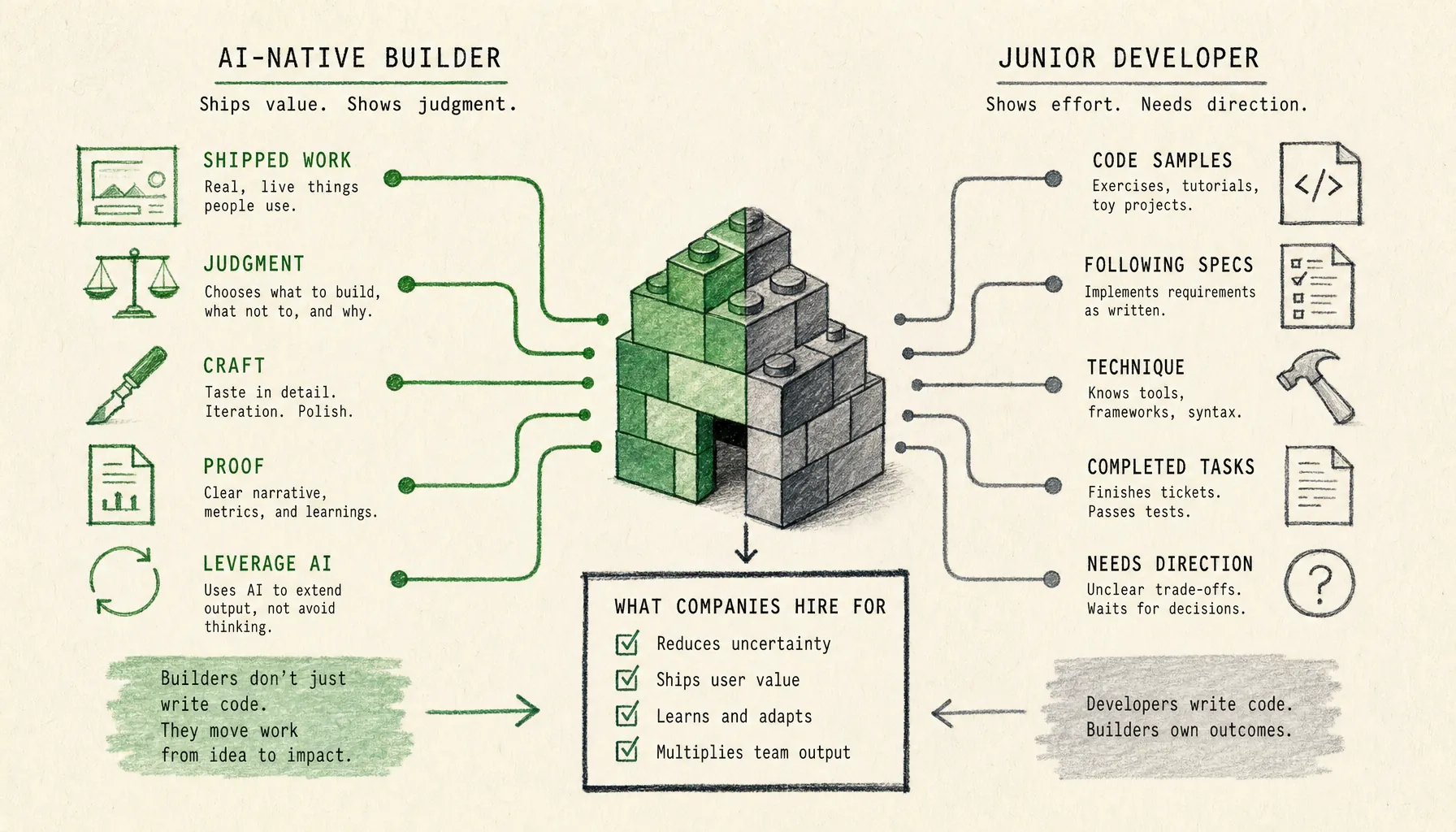
In 2026, "AI-native builder" and "junior developer" point to different things in hiring. That choice affects what evidence companies hiring builders look for, how they read early work, and whether they see you as a trainee inside one lane or someone who can already ship with AI in the mix.
The mistake is turning it into a prestige fight. A junior developer role is about engineering apprenticeship. An AI-native builder role is about showing you can take a messy problem, make something real, and still respect the boring but essential parts that keep software dependable.
What should builders take away?
The clearest positioning separates scope from depth. AI-native builders show broader ownership. Junior developers show focused engineering growth.
- AI-native builder is a market position built on shipped proof, tool coordination, product judgment, and speed from ambiguity to artifact.
- Junior developer is a narrower engineering role built on code quality, maintainability, review habits, and growth inside an existing technical system.
- AI fluency is now common. According to the Stack Overflow 2024 Developer Survey AI section, 76% of respondents were using or planning to use AI tools in their development process. The signal has shifted from access to judgment.
- Engineering craft still matters. AI can raise output, but results get shaky fast when developers are working in unfamiliar or complex codebases.
- The best positioning is specific. Name the problems you solve, show what you shipped, and explain the decisions AI did not make for you.
What does AI native builder vs junior developer actually mean?
AI native builder vs junior developer describes two different hiring signals. One gets judged on end-to-end problem execution. The other gets judged on readiness to grow inside an engineering team.
A junior developer is usually measured against a familiar ladder. Can this person write clean code? Can they read an existing codebase? Can they take a ticket, ask smart questions, and improve through review? That role still matters because companies hiring builders still need people who can become strong engineers inside production systems.
An AI-native builder gets measured against a wider question: can this person use AI, code, design, writing, data, and product judgment to move from a vague problem to a usable result? They may write plenty of code, but the signal is not just coding. It includes scoping, prompting, testing, editing, instrumentation, explanation, and knowing when the model is wrong.
This is where a lot of builders sell themselves short. They describe themselves as junior developers who happen to use AI tools. That framing misses the real value. A sharper version is: “I build working solutions from ambiguous problems, and I can show how I made the decisions.”
For the broader hiring path, the cluster pillar on How to Get Hired as an Early-Career Builder in 2026: Proof, Requirements, Timeline, and Process covers the full process. This article stays on the comparison itself: how to describe your work so companies hiring builders do not drop you into the wrong box.
| Dimension | Junior developer | AI-native builder |
|---|---|---|
| Primary hiring question | Can this person grow into a reliable engineer? | Can this person ship useful work from ambiguity? |
| Core proof | Code samples, technical interviews, review readiness | Working artifacts, decision logs, demos, iteration history |
| Risk for employer | Needs coaching before meaningful production ownership | May move fast without enough engineering discipline |
| Best fit | Teams with strong code review, architecture, and onboarding systems | Teams that need prototypes, internal tools, workflow automation, and cross-functional execution |
| Weak positioning | “I know some frameworks.” | “I use AI to build faster.” |
| Strong positioning | “I can learn your codebase and improve safely under review.” | “I can turn unclear problems into tested artifacts and explain the tradeoffs.” |
Why are companies separating builders from narrow junior developer roles?
Companies are separating builders from narrow junior developer roles because AI changed how much work one early-career person can attempt, while making polished applications a lot less useful as evidence.
The stack is noisy. A hiring manager might get hundreds of resumes that all say Python, React, LLMs, automation, and prompt engineering. Those words do not tell you much anymore because anyone can generate them. The work is still harder to fake.
That does not mean engineering stopped mattering. According to the U.S. Bureau of Labor Statistics Occupational Outlook Handbook for software developers, quality assurance analysts, and testers, employment in this group is projected to grow 17% from 2023 to 2033, much faster than the average for all occupations. Software demand is still real. What changed is that some companies hiring builders now want early builders who can operate before the work gets cleaned up into a tidy engineering ticket.
Think of it like the NFL draft. A junior developer interview often looks like a position drill: mechanics, fundamentals, repeatability. An AI-native builder evaluation looks more like a scrimmage: broken play, messy field, make something useful happen, then explain why it worked. Both tests are valid. They just measure different things.
This is also where hiring strategy is moving. Some AI-heavy teams are pairing very senior technical leaders with unusually capable early builders and cutting back on the middle layer of routine implementation work. That pattern is covered in the related article on Barbell Hiring Strategy in AI Teams: Fresh Graduates, Veterans, and Mid-Career Pullback. For builders, the takeaway is simple: if you position yourself only as a junior implementer, you are competing for a smaller bucket of work.
The stronger position is not “I am cheaper than a senior engineer.” That is weak and, honestly, forgettable. The stronger position is “I can expand what the senior team can inspect, test, and deploy by producing useful first versions with clear reasoning.”
Where does engineering craft still matter?
Engineering craft matters the moment AI-generated speed runs into the line between a demo and a system other people have to rely on.
The market has learned one basic lesson: faster code is not the same thing as better software. In a controlled study, GitHub research on Copilot productivity found that developers using Copilot completed a programming task 55% faster than the control group. That helps explain why AI coding tools spread so quickly.
But the productivity story is not one clean upward line. In 2025, the METR study on experienced open-source developers using early-2025 AI tools found that developers expected AI to speed them up by 24%, but actually took 19% longer on the measured tasks. The study looked at experienced developers working in familiar repositories, which makes the result more useful. It shows how context, review burden, and hidden complexity can wipe out the gains.
Builders should take that seriously. AI-native does not mean light on craft. It means you need craft at higher speed. A builder who can produce a prototype in two hours but cannot explain data flow, failure modes, permissions, logging, or test coverage has built a demo, not proof.
Craft shows up in small decisions:
- Naming the failure mode before shipping the feature.
- Writing the test that catches the model hallucination or bad API response.
- Knowing when a no-code workflow is enough and when you need a real service.
- Keeping secrets out of prompts, logs, screenshots, and public repos.
- Documenting what the model generated and what you verified yourself.
Builders who want a stronger technical signal should read the companion piece on AI-Native New Graduate Skills: Signals, Examples, and Hiring Criteria. The practical distinction is simple: tool fluency gets attention, but engineering judgment keeps the conversation going.
How should builders position themselves without sounding unfocused?
Builders should position themselves around a specific class of problems, a visible proof trail, and a clear explanation of where engineering discipline shows up in the work.
The risk with the builder label is sprawl. If you say you can do product, design, code, content, automation, and AI orchestration, you can start to sound like every other profile on the internet. The proof has to tie those skills to one real business problem. Companies hiring builders do not reward a shopping list of tools. They reward a pattern of useful shipped work.
Use this positioning sequence:
- Choose one problem category you want to be known for solving.
- Name the user or team affected by that problem.
- Show one shipped artifact that addresses the problem.
- Explain the manual workflow that existed before your artifact.
- Describe the AI systems, APIs, code, or tools you used.
- Identify the judgment calls you made without handing them off to AI.
- Document the failure cases you tested or found.
- Translate the result into a hiring claim a manager can understand.
Here is what that sounds like in practice.
| Weak positioning | Stronger positioning | Why it works |
|---|---|---|
| “I am an AI-native builder who uses Cursor, Claude, and Python.” | “I build internal tools that turn messy spreadsheet workflows into reviewable web apps.” | It names a problem, an artifact type, and a business context. |
| “I can do front end, back end, and product.” | “I can take a support team workflow from interview notes to a tested prototype with logs, permissions, and a handoff doc.” | It shows scope without sounding vague. |
| “I build AI agents.” | “I build agent-assisted workflows where a human can review each action before anything touches production data.” | It signals safety and judgment, not tool excitement. |
The best proof for this kind of positioning is not a polished claim. It is a trail: demo, repo, walkthrough, constraints, decisions, and iteration. The article on Proof of Work for Early-Career Builders: Examples, Checklist, and Steps gives a dedicated checklist for that evidence. In this comparison, the main point is that builder positioning has to make broad capability legible without reading like random activity.
What proof separates an AI-native builder from a tool user?
The difference between an AI-native builder and a tool user comes down to judgment. What got built, why it got built that way, what broke, and what changed after testing.
AI tool use is too common now to stand on its own as a signal. According to Stack Overflow’s 2024 developer survey, AI adoption and planned adoption are already widespread among developers. A hiring manager learns almost nothing from “I use AI.” The real question is: what can you do with AI that another early builder cannot?
Strong proof has four layers:
- Artifact: a working demo, deployed tool, repo, automation, or prototype.
- Context: the user, workflow, constraint, or business problem behind it.
- Decision record: the tradeoffs you made around architecture, data, UX, model choice, and scope.
- Verification: tests, user feedback, logs, before-and-after examples, or failure analysis.
A portfolio that only shows screenshots leaves too much unanswered. A portfolio that shows the work under pressure creates signal. Companies hiring builders want to know whether you can tell the difference between a clever prompt and a usable system.
The dedicated article on Early-Career Builder Portfolio: Evidence, Judgment, and Review Criteria goes deeper on portfolio review. For this comparison, the test is simpler: if the artifact vanished, would the reasoning still prove skill? If not, you showed output, but not judgment.
How do hiring managers compare junior developers and AI-native builders?
Hiring managers compare junior developers and AI-native builders by asking which risk they are taking on: training time, technical depth, ambiguity handling, or production safety.
A junior developer creates a familiar risk profile. The company expects onboarding, code review, smaller tickets, and gradual responsibility. The upside is that the builder can be shaped inside the company’s engineering standards from day one.
An AI-native builder creates a different risk profile. The upside is faster movement from problem to prototype, especially when the work cuts across functions. The risk is that speed can hide shallow understanding. That is why strong builders need to show review habits, not just output.
The evaluation usually comes down to five questions:
- Can this person define the problem before building? Builders who skip discovery often make impressive artifacts that solve the wrong problem.
- Can this person use AI without giving up judgment? The company needs to know what the builder verified independently.
- Can this person work inside constraints? Real teams have privacy, security, design, data, and technical debt constraints.
- Can this person accept review? Builder speed only matters if the work survives feedback from engineering, product, and operations.
- Can this person maintain what they ship? A prototype nobody can operate turns into a liability fast.
This is where the phrase “managing AI agents” stops being abstract. Companies hiring builders do not need someone who treats agents like magic coworkers. They need someone who can define tasks, inspect outputs, set guardrails, and keep humans in the loop when mistakes are expensive. The related page on Managing AI Agents at Work: Skills, Examples, and Career Path covers that operating skill in detail.
The strongest AI-native builders make the decision easier. They do not ask the company to guess from a title. They show the artifact, the reasoning, and the review surface.
When is the junior developer path still the stronger position?
The junior developer path is stronger when the company needs disciplined engineering growth inside a mature codebase, not broad early ownership across product and workflow problems.
There is no reason to dismiss the junior developer path. Engineering craft compounds. Builders who want to work on infrastructure, security, distributed systems, performance, developer tooling, or large production platforms often get more from entering through a junior engineering role and learning under strong technical review.
Choose the junior developer position when the role is shaped by:
- Large codebases with established review standards.
- Production systems where reliability matters more than prototype speed.
- Teams that already know what needs to be built.
- Managers who are evaluating growth on an engineering ladder.
- Work where correctness, maintainability, and operational safety matter more than breadth.
The junior developer path also gives a builder a cleaner story when the company has no builder category. Some companies hiring builders still map early-career talent into traditional titles because their compensation bands, interview loops, and onboarding systems depend on it. In those settings, calling yourself an AI-native builder can create confusion unless you tie it clearly to engineering expectations.
The distinction is about fit, not status. If you want deep mentorship in code review, architecture, testing, and production operations, do not avoid a junior developer title for branding reasons. The real question is whether the title gives you access to the work and feedback loop that will make you stronger.
How does mentorship change the comparison?
Mentorship changes the comparison because AI-native builders need review of decisions, while junior developers need review of implementation and engineering habits.
AI can make solo work look more complete than it really is. A builder can produce an app, a dashboard, a workflow, and a polished explanation without ever running into the friction of a senior reviewer asking: why this architecture, why this data model, why this permission boundary, why this test?
That friction is where a lot of growth happens. Good builder mentorship does not slow someone down just for process theater. It adds inspection points where mistakes become visible before users pay for them. A senior engineer, product lead, or operator can spot the difference between a happy-path demo and a tool that can survive real use.
For junior developers, mentorship is usually more structured. It often centers on pull requests, pair programming, codebase orientation, tickets, estimation, and debugging. For AI-native builders, mentorship also has to cover ambiguity review: scoping, user discovery, risk assessment, model evaluation, handoff quality, and operational fit.
The related article on AI Mentorship for Early-Career Builders: Process, Expectations, and Fit breaks down that model. In this comparison, the practical rule is simple: the more freedom a builder has to ship, the more visible the review process needs to be.
What is the clearest market position for AI-native builders in 2026?
The clearest market position for AI-native builders in 2026 is proof-based ownership of ambiguous work, backed by enough engineering discipline to make the output reviewable and safe.
Do not position yourself as a junior developer who happens to use AI. That puts you into a crowded technical checklist. Do not position yourself as a generalist who can do anything. That makes you hard to place. Position yourself as a builder who can own a defined problem space and produce artifacts a serious team can inspect.
A strong positioning statement has three parts:
- Problem space: “I build tools for customer operations teams drowning in repetitive review work.”
- Builder method: “I use AI-assisted coding, workflow mapping, and user interviews to get from problem to prototype quickly.”
- Proof standard: “I document assumptions, tests, failure modes, and handoff notes so the work can be reviewed.”
That phrasing does two useful things. It tells a company where to place you, and it tells them how to evaluate you. Just as important, it avoids the fake choice between AI-native breadth and engineering seriousness.
Provn exists for this exact sorting problem: performance over pedigree, proof over polish. Pedigree-heavy hiring keeps surfacing the same names and the same titles. It misses the builder who can take a messy workflow, ship a useful first version, explain the decisions, and improve under review. The market does not need more polished claims. It needs proof that holds up when someone actually looks closely.
What do builders ask about AI native builder vs junior developer positioning?
Builders usually ask whether the title changes the work, the interview, the proof standard, or where the best opportunities are.
Is an AI-native builder the same as a junior developer?
No. A junior developer is usually evaluated for engineering growth inside an existing technical team, while an AI-native builder is evaluated for turning ambiguous problems into working artifacts with visible judgment. The roles overlap when a builder writes code, but the proof standard is different.
Should I call myself an AI-native builder or a junior developer on my profile?
Use the label that matches the role you want and the proof you can show. If your strongest evidence is code quality, tests, pull requests, and growth under review, junior developer is clearer. If your strongest evidence is shipped tools, workflows, demos, and decision records across product and engineering, AI-native builder is clearer.
Do companies in San Francisco, New York, or remote markets evaluate this differently?
Yes, to a point. Dense startup markets like San Francisco and New York usually have more room for builder-shaped roles because teams often need ambiguous work turned into usable artifacts quickly. Larger remote-first or enterprise companies hiring builders often map early builders into standard software engineering titles because their leveling and compensation systems are more formal.
Does AI-native positioning hurt me if I want to become a strong engineer?
No, if the positioning includes craft. The weak version is “I use AI to code fast.” The strong version is “I use AI to move faster while documenting architecture, tests, review points, and failure cases.” Engineering managers respect speed when the work stays inspectable.
What is the fastest way to prove the difference?
Ship one small artifact that solves a real workflow problem, then publish the proof trail: demo, repo or walkthrough, problem statement, tradeoffs, tests, failure cases, and what changed after feedback. That shows builder range without asking a hiring manager to trust a title.