
Entry Level AI Builder Roles: What to Target | Provn
A clear guide to entry-level AI builder roles across product, design, engineering, and agent work, plus the proof each one actually asks for.
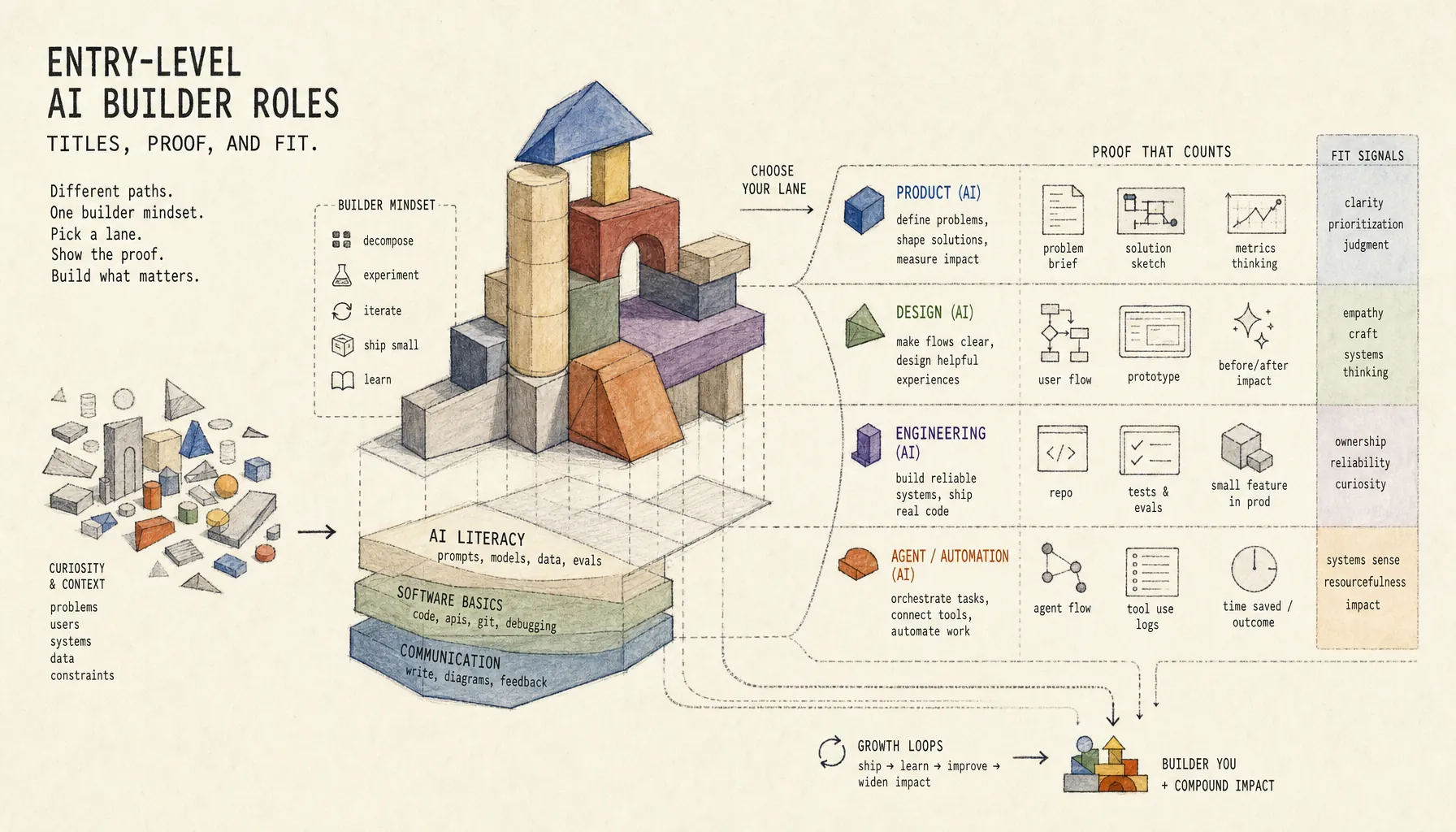
One company calls the role associate product manager. Another calls it design technologist, full stack engineer, automation specialist, or AI agent operator. A lot of the time, they want the same kind of builder.
That is why searching for entry level AI builder roles by title alone is a great way to waste an afternoon. The better move is to map each title to the work underneath it: product judgment, interface craft, shipping ability, systems thinking, agent direction, or some combination of those.
Key Takeaways
- Entry level AI builder roles usually cut across product, design, engineering, and agentic operations instead of sitting inside one tidy career ladder.
- Product-facing roles need proof of judgment: problem framing, user tradeoffs, prototypes, experiments, and clear decision logs.
- Design-facing roles need proof of interface thinking: flows, interaction states, usability choices, and before-and-after artifacts.
- Engineering-facing roles need proof of shipped systems: working software, Git history, integrations, tests, deployment notes, and failure handling.
- Agentic roles need proof that you can direct AI systems, evaluate outputs, set guardrails, and improve workflows after errors show up.
What are entry level AI builder roles in 2026?
Entry level AI builder roles are early-career jobs where the main signal is simple: can you use AI to ship useful work across product, design, engineering, or operations?
A clear definition matters because plenty of postings still hide behind older titles. A company may need someone who can turn a vague customer problem into a working internal tool, but the posting says “product analyst.” Another may need a builder who can wire together LLM APIs, evaluate outputs, and document failure modes, but the title says “automation associate.”
It is the same broken screen in a different outfit. Hiring systems sort by school, employer history, keywords, and networks. Builder roles need proof that someone can make something useful. Those are different signals. For the broader process, see How to Get Hired as an Early-Career Builder in 2026: Proof, Requirements, Timeline, and Process.
The labor data helps explain why these titles keep multiplying. According to the U.S. Bureau of Labor Statistics Occupational Outlook Handbook for software developers, quality assurance analysts, and testers, employment in that group is projected to grow 17 percent from 2023 to 2033. The title may still be “software developer.” The actual work now often includes AI-assisted prototyping, integration, testing, and product judgment.
Which product entry level AI builder roles should builders target?
Builders should target product roles when their strongest proof shows they can pick the right problem, define a useful workflow, and explain tradeoffs clearly.
Product roles are where it is easiest to sound smart and hardest to prove you can actually do the work. A product memo by itself is thin. A prototype without a decision trail is thin too. Strong product proof combines a user problem, a working artifact, a prioritization rationale, and a short walkthrough of what changed after testing.
| Common title | What the company is usually hiring for | Proof that carries weight |
|---|---|---|
| Associate Product Manager | Problem framing, execution, user judgment | One shipped prototype, a PRD, usage notes, and a 3-minute decision walkthrough |
| Product Analyst | Metric thinking and workflow improvement | Dashboard, funnel analysis, experiment writeup, and recommendation memo |
| AI Product Operations Associate | Process design around AI tools | Workflow map, prompt or agent spec, error log, and before-after cycle time estimate |
| Growth Product Associate | Fast experiments tied to acquisition or activation | Landing page test, onboarding flow, hypothesis log, and measured result |
A real product-role packet looks less like a glossy portfolio and more like a compact case file. Here was the user. Here was the constraint. Here is what I shipped. Here is what broke. Here is what I changed. That is the signal companies hiring builders look for when they want judgment instead of résumé polish.
Which design entry level AI builder roles should builders target?
Builders should target design roles when their strongest proof shows they can turn messy workflows into interfaces people can actually understand and use.
Design builder roles are no longer just static mockups. The work now often includes Figma flows, interactive prototypes, front-end implementation, prompt-driven design exploration, and usability evidence. According to the U.S. Bureau of Labor Statistics profile for web developers and digital designers, employment for web developers and digital designers is projected to grow 8 percent from 2023 to 2033.
| Common title | Best fit for | Proof required |
|---|---|---|
| Product Designer | Builders with strong interaction and product judgment | End-to-end flow, states, constraints, usability notes, and final prototype |
| UX Designer | Builders who can structure messy user tasks | Research notes, journey map, wireframes, test findings, and revised flow |
| Design Engineer | Builders who can design and implement | Live component, code repo, design rationale, and accessibility checks |
| Design Technologist | Builders who prototype emerging interactions | Interactive demo, toolchain notes, limitations, and iteration history |
The common mistake is showing taste without evidence. A polished screen does not prove you can handle real constraints. A better artifact shows the ugly parts too: empty states, loading states, error states, permission issues, handoff notes, and why one flow beat another.
For a deeper look at how that evidence gets judged, use Early-Career Builder Portfolio: Evidence, Judgment, and Review Criteria.
Which engineering entry level AI builder roles should builders target?
Builders should target engineering roles when their strongest proof is a working system other people can run, inspect, and test.
Engineering hiring still cares about fundamentals. AI changes the speed of implementation. It does not remove the need for judgment. A builder who generates code without understanding error handling, data flow, security boundaries, and deployment gets exposed fast. According to the U.S. Bureau of Labor Statistics profile for computer and information research scientists, employment in that occupation is projected to grow 26 percent from 2023 to 2033, which points to strong demand around advanced computing work. Most entry-level builders reach that market through applied software roles first.
| Common title | What it really tests | Proof required |
|---|---|---|
| Junior Software Engineer | Code quality, debugging, collaboration | Repo, commits, tests, README, deployed demo, and issue history |
| Frontend Engineer | User-facing implementation | Responsive UI, component structure, API integration, and performance notes |
| Full Stack Builder | End-to-end shipping | Database schema, backend routes, frontend, auth, deployment, and known bugs |
| AI Application Engineer | LLM integration and product reliability | Prompt chain, retrieval setup, eval cases, failure examples, and monitoring plan |
| Automation Engineer | Workflow replacement or compression | Before-after workflow, scripts, integrations, exception handling, and runbook |
The difference between a builder and a conventional junior developer shows up in the artifact. The builder proves they can move end to end, from problem to shipped system. The developer title still matters, but the proof needs to show more than syntax. For the role comparison, see AI-Native Builder vs Junior Developer: Skills, Evidence, and Hiring Fit.
Which agentic work roles are real entry points for builders?
Agentic work is a real entry point when the role involves directing AI systems, measuring output, and improving the workflow after failures show up.
The title market is a mess. “Prompt engineer” got stretched so far that it barely means anything now. More specific titles are starting to replace it: AI agent operator, agent workflow builder, AI operations associate, LLM evaluation analyst, support automation builder, and internal tools builder.
According to Anthropic’s engineering guide to building effective agents, agent systems work best when teams start with the simplest pattern that does the job and add complexity only when they need it. That matters for entry-level builders. The valuable proof is not a complicated demo. It is a workflow that handles normal cases, exposes failure modes, and gives a human a clear point of control.
The National Institute of Standards and Technology makes a similar point from the risk side. The NIST Artificial Intelligence Risk Management Framework organizes AI risk work around govern, map, measure, and manage. For builders, that turns into practical artifacts: eval sets, escalation rules, logging, review checkpoints, and documented limits.
If this lane fits your work, the next read is Managing AI Agents at Work: Skills, Examples, and Career Path.
How should builders choose the right entry level AI builder role to target?
Builders should choose roles by matching their strongest proof to the job’s real work, then ignoring titles that ask for proof they do not have yet.
This is basically a combine problem. In football, a player does not send the same generic highlight reel for every position. A receiver shows route running and separation. A lineman shows power, footwork, and repeatable technique. Builders need the same discipline.
- List three shipped artifacts you can explain without notes.
- Label each artifact by its dominant proof: product, design, engineering, data, automation, or agent direction.
- Match that dominant proof to three role families, not twenty job titles.
- Rewrite your project description using the language of the role family, not the language of your class, bootcamp, or side project.
- Cut roles where the required proof is missing, even if the title sounds good.
- Prepare one walkthrough that shows the problem, artifact, tradeoff, failure, and revision.
| Your strongest proof | Best role family | Weak fit |
|---|---|---|
| User interviews plus prototype | Product, UX, product operations | Backend-heavy engineering |
| Live app with repo and deployment | Software, full stack, AI application engineering | Pure research roles |
| Workflow automation with error handling | AI operations, automation, agent workflow roles | Brand or visual design roles |
| Interface system with implemented components | Design engineering, frontend, product design | Data science roles |
For builders starting with a thin project base, AI Portfolio With No Experience: Steps, Proof, and Examples covers how to create evidence without waiting for permission from a prior company.
What proof does each role require before applying?
Each role requires proof that matches the work pattern, not a generic portfolio link full of disconnected projects.
Product proof should show judgment. Design proof should show interaction clarity. Engineering proof should show a working system. Agentic proof should show control over an AI-assisted workflow. The common mistake is treating all projects as interchangeable. They are not. A chatbot demo, a redesign, and an analytics dashboard prove very different things.
- Product: PRD, prototype, user problem, tradeoff memo, launch or test notes.
- Design: flow map, wireframes, final screens, usability notes, edge states.
- Engineering: repo, deployed demo, tests, README, architecture notes, bug log.
- Agentic work: agent spec, eval set, failure cases, escalation rules, monitoring notes.
- Data or analyst roles: dataset, cleaning steps, analysis, decision memo, reproducible notebook or dashboard.
One artifact can serve multiple paths if it is documented well. A customer-support triage agent, for example, can prove product thinking, automation skill, LLM evaluation, and basic engineering. What changes is the packaging. For a more specific checklist, use Proof of Work for Early-Career Builders: Examples, Checklist, and Steps.
What titles should builders treat carefully?
Builders should treat titles carefully when the posting uses AI language but never names the work, access, tools, manager, or output.
Some postings reflect real experiments. Some are vague because the company has not figured out the role. You can usually tell from the details. A serious role names workflows, users, systems, metrics, and review process. A weak posting says “AI enthusiast,” “prompt wizard,” or “wear many hats” and somehow never explains what actually ships.
- Prompt engineer: Treat carefully unless the posting names evaluation, deployment context, and ownership.
- Founding AI intern: Ask what access, manager support, and decision rights actually exist.
- Junior ML engineer: Check whether it really requires graduate-level research depth.
- AI strategist: Look for a building requirement. Strategy without artifacts is a weak entry point.
- Automation intern: Strong fit when it names tools, workflows, success metrics, and exception handling.
A good posting makes the proof obvious. A bad posting makes the builder guess. Guessing leads to generic applications, and generic applications disappear into the same pile as everyone else’s AI-polished résumé.
Frequently Asked Questions
What are the best entry level AI builder roles for new graduates?
The best entry level AI builder roles for new graduates include associate product manager, product analyst, UX designer, design engineer, frontend engineer, full stack builder, AI application engineer, automation engineer, and AI agent operator. The right target depends on the proof you have already built, not the major on your transcript.
Do entry level AI builder roles require a computer science degree?
Some engineering roles still screen for computer science fundamentals, but many AI builder roles evaluate shipped work, product judgment, design clarity, and workflow automation. A builder without a computer science degree needs stronger visible proof: a working demo, repo or artifact trail, a clear decision explanation, and evidence of iteration.
What is the difference between an AI builder role and a junior developer role?
A junior developer role usually tests code contribution inside an existing engineering system. An AI builder role tests whether someone can use AI to move from an ambiguous problem to a working artifact across product, design, engineering, or operations. The overlap is strongest in AI application engineering, full stack building, and automation roles.
Are entry level AI builder roles remote or location-based?
Both exist. Early-career roles tied to mentorship, product teams, security access, or internal operations are often hybrid or office-based in major hiring markets such as San Francisco, New York, Seattle, Austin, and Boston. Remote roles usually require clearer proof because companies hiring builders have fewer informal ways to observe how someone works.