
What Is Managing AI Agents? Builder Definition | Provn
Managing AI agents means directing AI work toward clear goals, real constraints, useful feedback, and solid evaluation. For early-career builders, it shows judgment and coordination, not just familiarity with the tools.
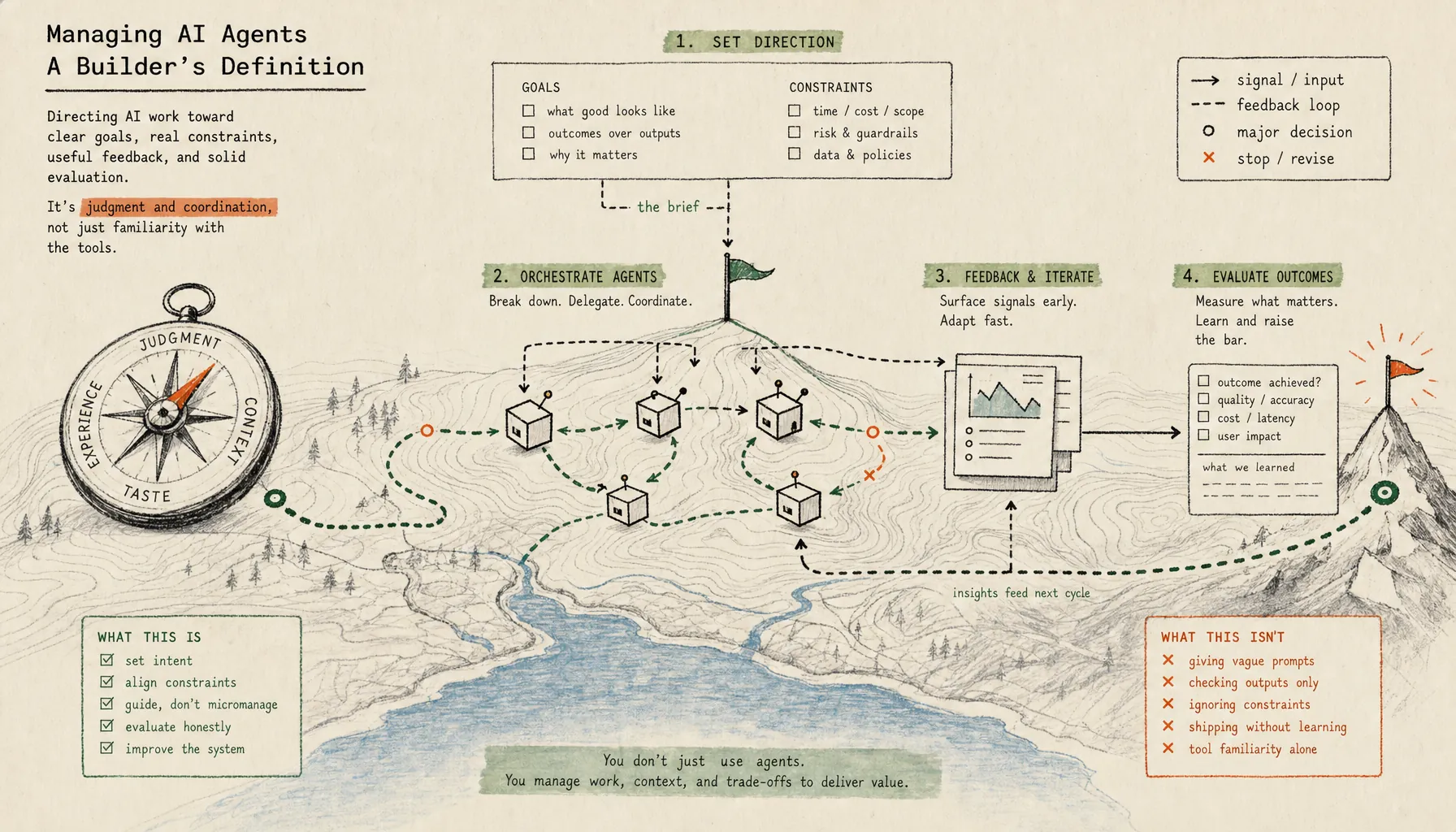
What Is Managing AI Agents? A Builder Definition
By 2026, the interesting question is not whether a builder has used ChatGPT. It is whether they can direct multiple AI systems toward a result that actually holds up. What is managing AI agents? It is assigning AI systems clear goals, setting limits, checking their work, giving feedback, and deciding whether the output is good enough to use.
That shift changes the job. Agent work looks less like typing clever prompts and more like running a small project. The builder is the shift supervisor. The agent handles tasks. The builder decides what counts as correct.
Key Takeaways
- Managing AI agents means directing work through four controls: goals, constraints, feedback, and evaluation.
- An AI agent is useful only when the builder defines the task, checks the work along the way, and decides whether the result meets the standard.
- Entry-level agent management can show judgment through small projects: research workflows, QA checks, data cleanup, customer support triage, or prototype testing.
- The skill goes beyond prompt writing because it includes sequencing, review, tradeoffs, and failure handling.
- Companies hiring builders look for proof: logs, before-and-after outputs, evaluation rubrics, screenshots, demos, and short explanations of decisions.
What does managing AI agents mean?
Managing AI agents means coordinating AI systems so they do useful work under human direction and against measurable standards.
An AI agent is a software system that can use a model, tools, instructions, memory, or external data to work through a task. According to OpenAI's guide to building agents, agents combine models with tools and instructions to take actions. Anthropic describes tool use as a way for models to interact with external systems through defined schemas in Anthropic's tool use documentation.
That is the technical definition. In practice, the management part is simpler and more important. A builder decides what the agent should do, what it should avoid, when it should ask for help, how the output gets checked, and what evidence proves the work is done.
That is why the shift supervisor comparison holds up. A supervisor does not personally do every task. They assign work, clarify the standard, inspect results, catch mistakes, and adjust the process. Managing AI agents works the same way.
Why is managing AI agents a coordination skill?
Managing AI agents is a coordination skill because the real work is deciding how tasks, rules, review loops, and success criteria fit together.
Prompting is one input. It is not the whole system. A builder managing an agent has to decide the order of operations. Should the agent research first, draft second, and verify third? Should it stop after each stage? Should it use a source list, a database, or a browser? Should it write directly into production systems, or only make recommendations?
This is where weak agent work falls apart. Builders give a vague instruction, accept the first output, and call the project done. Strong builders add checkpoints. They ask for assumptions. They test outputs against examples. They keep notes on where the agent failed.
The National Institute of Standards and Technology Artificial Intelligence Risk Management Framework organizes AI risk work around govern, map, measure, and manage functions in NIST's AI Risk Management Framework. The same logic applies here: define the context, measure the output, and manage the risk before the work touches customers or codebases.
For the broader hiring path, this skill sits inside the larger process described in How to Get Hired as an Early-Career Builder in 2026: Proof, Requirements, Timeline, and Process.
What are the four controls of managing AI agents?
The four controls of managing AI agents are goals, constraints, feedback, and evaluation.
They are easy to name and easy to skip. They also separate a useful agent workflow from a pile of polished nonsense.
| Control | What the builder decides | Entry-level example |
|---|---|---|
| Goal | The result the agent must produce | Find 20 qualified local businesses for a sales list |
| Constraint | Rules, limits, sources, formats, and permissions | Use only company websites and LinkedIn pages, no scraped personal emails |
| Feedback | Corrections given during the work | Reject businesses outside the target geography and rerun the search |
| Evaluation | The test for whether the output is usable | Manually verify 10 records and require 90 percent field accuracy |
The hidden skill is tradeoff judgment. A fast agent that invents details creates cleanup work. A cautious agent that asks for permission every 30 seconds slows everything down. The builder picks the operating mode based on risk.
For portfolio evidence, the strongest version is not a screenshot of an agent running. It is a record of decisions: the original goal, the constraints, the failed output, the correction, and the final evaluation. That is the kind of proof discussed in Proof of Work for Early-Career Builders: Examples, Checklist, and Steps.
What are entry-level examples of managing AI agents?
Entry-level examples of managing AI agents include research, quality assurance, data cleanup, support triage, and prototype testing.
The projects do not need to be huge. They need visible coordination. A builder who manages a small agent workflow well shows the same pattern a company needs at larger scale.
| Project | Agent task | Builder management signal |
|---|---|---|
| Research assistant | Summarize 15 sources on a market question | Source rules, citation checks, rejection of weak evidence |
| QA helper | Test a simple web form across browsers | Bug reproduction steps, severity labels, retest notes |
| Data cleaner | Normalize messy CSV fields | Schema design, exception handling, spot-check process |
| Support triage | Classify inbound tickets by issue type | Escalation rules, confidence thresholds, false-positive review |
| Prototype tester | Generate user flows and edge cases | Selection of realistic cases, removal of irrelevant suggestions |
The pattern stays the same. The agent produces work. The builder inspects it. The builder changes the process. The final artifact shows both the output and the judgment behind it.
This is also where AI-native skill shows up without the puffed-up claims. The related piece on AI-Native New Graduate Skills: Signals, Examples, and Hiring Criteria covers the broader skill set, but agent management is narrower. It proves a builder can coordinate machine work without outsourcing judgment.
How do you manage an AI agent on a small project?
A small AI agent project should be managed through a written brief, bounded tool access, checkpoint reviews, and a final evaluation rubric.
The process below is intentionally plain. A company hiring builders should be able to read it and understand exactly how the builder thinks.
- Define the task in one sentence with a specific output, audience, and deadline.
- Set constraints for sources, tools, data access, tone, format, and actions the agent cannot take.
- Create two or three examples of acceptable and unacceptable output before running the agent.
- Run the agent in stages instead of asking for the final answer in one pass.
- Review each stage for accuracy, relevance, missing context, and unsupported claims.
- Give targeted feedback that changes the next run instead of rewriting the output yourself.
- Evaluate the final output against a rubric with pass, revise, or reject decisions.
- Document the workflow with screenshots, logs, failure notes, and the final artifact.
Risk controls matter even in small projects. The OWASP Top 10 for Large Language Model Applications lists risks such as prompt injection, sensitive information disclosure, and excessive agency in OWASP's LLM application security project. A builder does not need to be a security engineer to take those risks seriously. They do need to avoid giving an agent unnecessary permissions and avoid feeding it private data without a reason.
How do hiring teams evaluate managing AI agents?
Hiring teams evaluate managing AI agents by looking for evidence of judgment, not evidence that a builder used a popular tool.
A polished demo is easy to fake. A decision trail is harder. Strong proof includes a project brief, agent instructions, output samples, review notes, evaluation criteria, and a short video explaining what changed after feedback.
This matters because companies hiring builders are trying to separate signal from noise. AI-generated resumes and generic portfolios now blur together. Work samples show who can define a problem, control an agent, and decide when the result is usable. For more on how this evidence gets reviewed, see Early-Career Builder Portfolio: Evidence, Judgment, and Review Criteria.
The strongest builders do not present agent work like magic. They show the handoffs. They show the mistakes. They show the standard. That is performance over pedigree in a form a hiring team can actually inspect.
Frequently Asked Questions
Is managing AI agents the same as prompt engineering?
No. Prompt engineering focuses on instructions given to a model. Managing AI agents includes prompts, but also goals, constraints, tool permissions, checkpoints, feedback loops, and evaluation. The builder is responsible for whether the work is safe, accurate, and useful.
Do entry-level builders need to code to manage AI agents?
Not always. Some agent workflows use no-code tools, spreadsheets, browser automation, or chat-based systems. Coding helps when the workflow needs APIs, data validation, or repeatable tests. The core skill is still coordination: defining the work and judging the output.
What is a good first project for learning AI agent management?
A good first project is a bounded research or data cleanup workflow. For example, ask an agent to classify 50 public company descriptions into a defined schema, then manually audit a sample and document the error rate. The project is small, but it shows goals, constraints, feedback, and evaluation.
How can a builder prove they managed an AI agent well?
A builder can prove it with artifacts: the task brief, agent instructions, tool limits, intermediate outputs, feedback notes, evaluation rubric, final result, and a short explanation of tradeoffs. The proof should show decisions, not only the finished output.