
AI-Native New Graduate Skills Hiring Teams Read
For new grads, AI-native skills matter less as tool familiarity and more as the ability to direct AI toward useful, verified, shipped work across product, design, engineering, and agentic workflows.
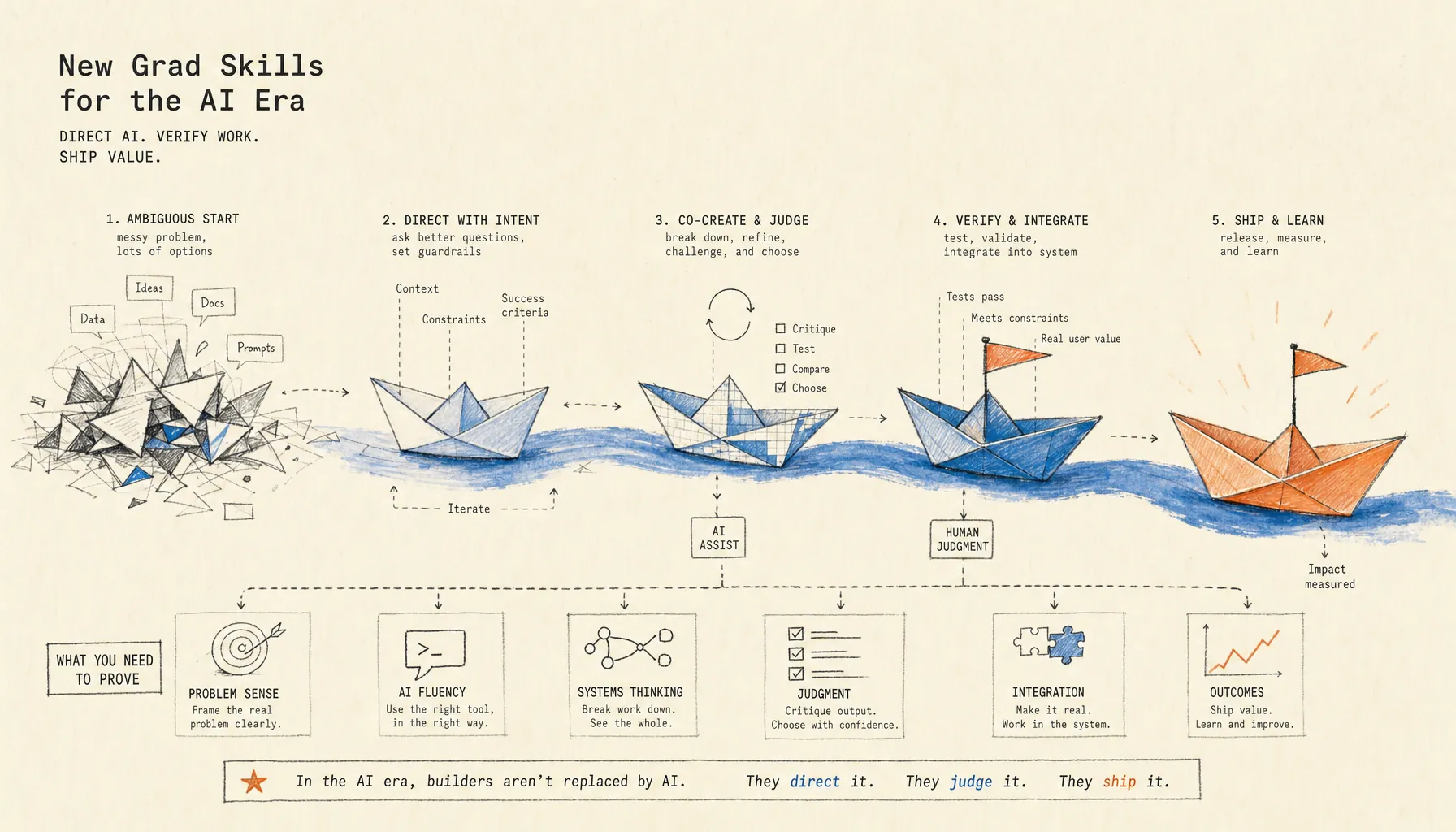
AI-Native New Graduate Skills: What Builders Need to Prove in 2026
A recent grad who uses ChatGPT to summarize a product requirements doc is doing something very different from a builder who can take a vague customer complaint and turn it into a tested prototype, a bug report, and a product recommendation by steering AI through each step.
That gap is the heart of AI-native new graduate skills. In 2026, companies hiring builders are trying to tell the difference between basic tool use and the harder thing: getting useful, reliable work out of AI in product, design, engineering, and agentic workflows.
Key Takeaways
AI-native skill shows up when a builder can frame the work, use AI to move it forward, check what came back, and explain the tradeoffs.
- Tool familiarity is the floor. According to Microsoft and LinkedIn’s 2024 Work Trend Index, 75% of knowledge workers used AI at work, so knowing the popular tools no longer sets a builder apart.
- Direction is the signal. The strongest new grads can turn ambiguous work into scoped tasks, prompts, checks, revisions, and shipped artifacts.
- AI-native skill crosses functions. Product builders define the problem, designers test the interaction, engineers set the constraints, and agentic builders coordinate multi-step workflows.
- Evidence beats claims. A visible artifact, change log, evaluation notes, and a short walkthrough say more than a polished line claiming “AI proficient.”
- Judgment is the scarce skill. The work gets better when builders know where AI helps, where it breaks, and when senior review is required.
What are AI-native new graduate skills?
AI-native new graduate skills are the abilities that let a recent graduate use AI to produce reliable work: framing problems, breaking tasks apart, prompting, checking outputs, shipping prototypes, explaining tradeoffs, and coordinating agents or tools. Tool familiarity matters, but companies hiring builders judge AI-native skill through outcomes, judgment, and review discipline.
The most useful analogy is a flight deck. A tool user knows where a few buttons are. An AI-native builder understands the route, the weather, the instruments, the handoff points, and when to abort. The plane still needs a pilot.
That is why the phrase “AI-native” gets misunderstood. It does not mean a new grad grew up around AI tools. It means the builder can work inside a system where AI is part of production. The builder still owns the work. The model does not own the decision.
For a tighter definition of the role itself, see what does AI native mean for new graduates. This page goes one level deeper: the skills that show up in real work, not just the label.
What separates tool familiarity from AI-native work?
Tool familiarity means a builder can use an AI interface. AI-native work means the builder can direct a system from problem to checked output.
The distinction matters because basic AI access is already common. Microsoft’s Work Trend Index reported that 78% of AI users brought their own AI tools to work, which tells you a lot. Many teams already assume builders can find and operate public tools. The hiring question changed. It is no longer “Have you used AI?” It is “Can you make AI useful inside messy work?”
That is the difference between asking for a landing page and shipping one that respects the brand, loads correctly, handles empty states, and explains why the conversion path changed. It is the difference between generating research notes and separating customer quotes from model inference. It is the difference between asking an agent to prospect leads and catching that it is duplicating contacts, violating outreach constraints, or chasing the wrong audience.
For builders who want the sharper version of this distinction, the related guide on directing AI vs learning AI tools breaks down the hiring signal. The short version is straightforward: a tool user produces outputs. A builder produces reviewed outcomes.
| Level | What the builder does | What hiring teams can evaluate |
|---|---|---|
| Tool familiarity | Uses ChatGPT, Claude, Cursor, Figma AI, or similar tools for single tasks. | Speed, comfort, basic prompt quality. |
| Workflow direction | Breaks work into steps, assigns AI to the right pieces, and defines checks. | Problem framing, sequencing, judgment, error detection. |
| Outcome ownership | Ships a prototype, analysis, agent, design, or code change with review notes. | Execution quality, tradeoffs, reliability, communication. |
Which AI-native skills matter across product, design, engineering, and agentic work?
The strongest AI-native new graduate skills show up across functions, but each function reveals them through different artifacts.
Companies hiring builders are not just filling old junior roles with new labels. They want people who can move across product thinking, design taste, engineering constraints, and workflow automation. That does not mean every builder needs to be equally strong at everything. It means the useful builder can cross the boundary without losing the thread.
The reason is simple. According to Stanford University’s 2025 AI Index Report, organizational AI use rose sharply across businesses, with generative AI moving into ordinary operations instead of staying in labs. Once AI becomes part of normal work, translation becomes the valuable skill: turning business intent into something a model, tool, agent, teammate, or reviewer can actually act on.
That is also why entry level AI builder roles do not map neatly to old titles. Some look like product analyst roles. Some look like junior engineering roles. Some sit in operations, growth, design, or founder’s office teams.
What product skills show AI-native judgment?
AI-native product skill shows up when a builder can turn ambiguity into a testable decision.
Weak product use of AI produces a feature list. Strong use starts with the user problem, defines a target behavior, compares alternatives, and recommends a measurable next step. For example, a builder looking at churn might ask AI to cluster support tickets, then manually inspect the clusters, pull exact quotes, isolate one high-frequency failure mode, and propose a product change with clear risk.
The artifact should show the chain of decisions without dumping private tool transcripts into the document. A one-page memo can include the original question, the data used, prompts summarized at a high level, findings that survived review, rejected options, and the final recommendation.
What design skills show AI-native judgment?
AI-native design skill shows up when a builder uses AI to widen exploration, then uses human taste and usability judgment to narrow the work.
AI can generate interface variations fast. That speed creates its own mess: too many plausible directions. The builder’s job is to set constraints. What is the primary action? What does the user know at this moment? What error state needs handling? What has to stay consistent with the existing product?
A strong design artifact includes three to five AI-assisted explorations, a rationale for the chosen direction, and notes on what got rejected. It also includes the boring states polished mockups love to ignore: empty states, loading states, permission failures, long text, mobile breakpoints, and accessibility concerns.
What engineering skills show AI-native judgment?
AI-native engineering skill shows up when a builder uses AI to speed up implementation while still owning correctness, maintainability, and tests.
Code generation is common now. Ownership is not. A builder who copies model output without reading it creates risk. A builder who asks AI for implementation options, chooses one that fits the existing codebase, writes tests, checks edge cases, and documents the tradeoff is working at a different level.
That distinction sits at the center of AI native builder vs junior developer. The strongest early builders are not trying to sound senior. They are showing disciplined execution: small commits, clear test cases, readable diffs, and a short explanation of what they verified.
What agentic work skills show AI-native judgment?
AI-native agentic skill shows up when a builder can define goals, tools, guardrails, handoffs, and failure checks for an AI-assisted workflow.
An agent is useful only when the workflow has clear boundaries. “Find customers” is not a workflow. “Identify 30 seed-stage fintech companies hiring compliance roles, exclude current customers, enrich each with one source link, and write a first-draft outreach note for human review” is much closer.
Builders who want the foundation should start with what is managing AI agents, then move to the applied version in managing AI agents at work. In practice, this looks a lot like operations design. The builder defines the task, tool access, stop conditions, and human review point.
How should a new graduate practice AI-native work without inventing experience?
A new graduate should practice AI-native work by picking a real problem, shipping a small artifact, documenting the AI-assisted workflow, and recording the checks that made the output reliable.
This is where a lot of builders get stuck. They think the missing piece is permission. Usually it is scope. A useful project does not need a famous company, a giant dataset, or a fancy title. It needs a clear problem and evidence that the builder can move from messy input to reviewed output.
The process below creates work that can support an early career builder portfolio or a narrower piece of proof of work for early career builders.
- Choose a problem with a visible user, such as a confusing signup flow, a slow manual research task, or a repeated support question.
- Define the outcome in one sentence, including what will be true when the work is done.
- Break the work into AI-suitable tasks and human-owned decisions, such as research clustering, copy drafting, code scaffolding, test writing, or QA review.
- Build a small artifact, such as a prototype, workflow, agent, analysis memo, design revision, or pull request.
- Record the checks you used, including source validation, test cases, edge cases, user feedback, or manual review.
- Write a short walkthrough explaining the original problem, the AI workflow, the decisions you owned, and what changed after review.
- Publish the artifact in a format a hiring manager can inspect, such as a demo video, GitHub repository, annotated Figma file, or one-page case note.
A builder starting from scratch can use the companion guide on how to build an AI portfolio with no experience. A builder who wants a concrete agent project can start with build an AI agent for LinkedIn connections. For examples of how finished work can look, see AI builder portfolio examples.
The key is not volume. Ten thin projects make a builder look scattered. One useful project with clear decisions, review notes, and a shipped artifact gives companies hiring builders something real to judge. This also helps builders with limited formal history, which is why the article on how to get hired with a thin resume as early career builder focuses on evidence instead of trying to polish credentials into something they are not.
How do hiring managers read AI-native skill evidence?
Hiring managers read AI-native skill evidence by looking for the builder’s decisions, not the model’s output.
Companies hiring builders are drowning in polished applications. AI made those easier to produce. It also made sameness cheaper. A builder who says “I used AI to improve productivity” gives hiring teams nothing to inspect. A builder who shows the starting point, the workflow, the review method, and the final artifact gives them signal.
That is the core argument in how to get hired as an early career builder in 2026. The screen still runs on resumes, credentials, and networks. None of those reliably proves that a builder can use AI to ship work.
The evidence hiring teams read usually falls into four buckets:
| Evidence type | Strong signal | Weak signal |
|---|---|---|
| Artifact | A working prototype, agent, design file, analysis, or code change. | A screenshot of a prompt or generic tool certificate. |
| Workflow | Clear breakdown of what AI did and what the builder reviewed. | Broad claim that AI was used throughout the project. |
| Judgment | Rejected options, risk notes, tests, and edge cases. | Only the final polished output. |
| Communication | Short walkthrough that explains tradeoffs plainly. | Buzzwords with no way to inspect the work. |
For a closer look at the review side, see what hiring managers want from early career AI builders. For campus-specific proof signals, see campus hiring AI native builders. Builders preparing for live conversations can use AI native interview questions to practice explaining decisions without reciting tool names like they are magic words.
Where do early builders need senior judgment and mentorship?
Early builders need senior judgment most when AI output touches correctness, privacy, customer trust, security, legal exposure, or product strategy.
AI-native does not mean solo. The best early builders know when to move fast and when to ask for review. That matters even more when model output sounds confident, because confidence is cheap. The National Institute of Standards and Technology AI Risk Management Framework emphasizes validity, reliability, safety, security, accountability, and transparency as core AI risk categories. That is not abstract policy language when a builder is shipping customer-facing work.
A recent graduate can often build the first draft faster than a traditional process would allow. The senior layer matters because first drafts hide traps. A product recommendation can mistake correlation for cause. A design can create accessibility issues. Generated code can pass the happy path and fail on permissions. An agent can repeat the wrong task over and over because the goal was underspecified.
That is why AI mentorship for early career builders is a production issue, not a perk. Senior pairing helps builders develop taste, review habits, and risk judgment. Builders who do not have that structure can use the more tactical guide on how to find a mentor as an early career builder, especially when they need review on projects outside a formal job.
The interview version of this skill is direct. A builder should be able to say, “I would ship this part myself, test this part, and ask for senior review on this decision.” That answer shows maturity. It also connects to how to show curiosity and resilience in an interview, because strong builders change their minds when the evidence says they should.
What mistakes make AI-native work look weak?
AI-native work looks weak when the builder hides the decision process, overstates autonomy, or presents AI output without review.
The most common mistake is confusing speed with quality. AI can compress the first draft. It cannot replace taste, verification, or context. Anthropic’s Economic Index found that computer and mathematical tasks made up the largest share of Claude usage in its early usage analysis, which matches what a lot of builders already see: technical workflows are especially open to AI assistance. That makes review discipline more important, not less.
Here are the failure patterns hiring teams notice quickly:
- Tool-name padding: listing ten AI tools without showing what changed because of them.
- No before state: presenting a polished artifact with no original problem, constraints, or baseline.
- No human check: treating model output as final because it sounds complete.
- Scope inflation: claiming to have built a full product when the artifact is really a narrow prototype.
- Agent vagueness: describing an autonomous agent without tools, guardrails, logs, or failure handling.
- Fake certainty: making claims about customers, performance, or business impact without evidence.
The hiring market is changing around these signals too. The barbell hiring strategy AI pattern explains why some teams want high-agency fresh grads paired with experienced operators, while fresh graduates vs mid career hires AI teams covers the tradeoffs more directly. Early builders get a real opening when they show speed plus review discipline.
How should builders describe AI-native skills on a resume or profile?
Builders should describe AI-native skills through specific artifacts, workflow ownership, and measurable checks instead of broad claims of AI proficiency.
The sentence “AI-native builder skilled in ChatGPT, Claude, and Cursor” is weak because it gives the reader nothing to evaluate. The stronger version names the work and the judgment.
Use this structure:
- Problem: what needed to change.
- AI workflow: how AI was used and where the builder made decisions.
- Artifact: what was shipped or produced.
- Check: how the result was tested, reviewed, or improved.
Examples:
- Built an AI-assisted onboarding audit for a budgeting app, clustered 42 user complaints into five failure modes, redesigned the first-run checklist, and documented three rejected alternatives.
- Created a support triage prototype that classified incoming tickets, flagged low-confidence outputs for human review, and tested the workflow on 100 historical examples.
- Used Cursor and manual review to refactor a React component, added tests for empty and error states, and recorded the before-and-after diff in a two-minute walkthrough.
This is also where naming matters. If the reader is still sorting out the category, the page on what is an early career builder explains why the builder identity is organized around shipped work rather than pedigree. Provn’s view is the same: performance over pedigree, proof over polish.
Frequently Asked Questions
What are the most important AI-native new graduate skills in 2026?
The most important AI-native new graduate skills are problem framing, task decomposition, prompt direction, output verification, prototype shipping, agent coordination, and tradeoff communication. Tool knowledge matters, but companies hiring builders care more about whether a builder can turn AI-assisted work into a reliable artifact.
Is being AI-native the same as knowing ChatGPT, Claude, Cursor, or Figma AI?
No. Knowing tools is just the operating layer. AI-native skill means the builder can decide what work should go to AI, what needs human judgment, how outputs will be checked, and what artifact should be shipped. The difference shows up in workflow notes, tests, rejected options, and the quality of the final work.
How can a new graduate prove AI-native skills without full-time experience?
A new graduate can prove AI-native skills by shipping a small project with a clear problem, visible artifact, documented AI workflow, review method, and short walkthrough. Examples include a product teardown, support triage workflow, AI-assisted design revision, small code change, or a bounded agent with logs and human review.
Do AI-native skills differ by location or campus hiring market?
The core skills do not change by location, but proof expectations do vary by hiring channel. Campus hiring in large tech hubs often puts more weight on structured interviews, referrals, and portfolio review. Smaller local companies hiring builders often respond better to practical artifacts tied to their business, such as an operations workflow, prototype, or customer research summary.
What is the biggest mistake new graduates make when presenting AI-native work?
The biggest mistake is presenting AI output as if the output alone proves skill. Companies hiring builders need to see the builder’s decisions: the original problem, the workflow, the checks, the revisions, and the final artifact. Without that trail, polished AI work all starts to look the same.