
Show AI Judgment in a Portfolio - Provn AI Career Hub
Employers don’t need another polished AI draft. They want to see how you defined the problem, directed the model, made judgment calls, and verified the result.
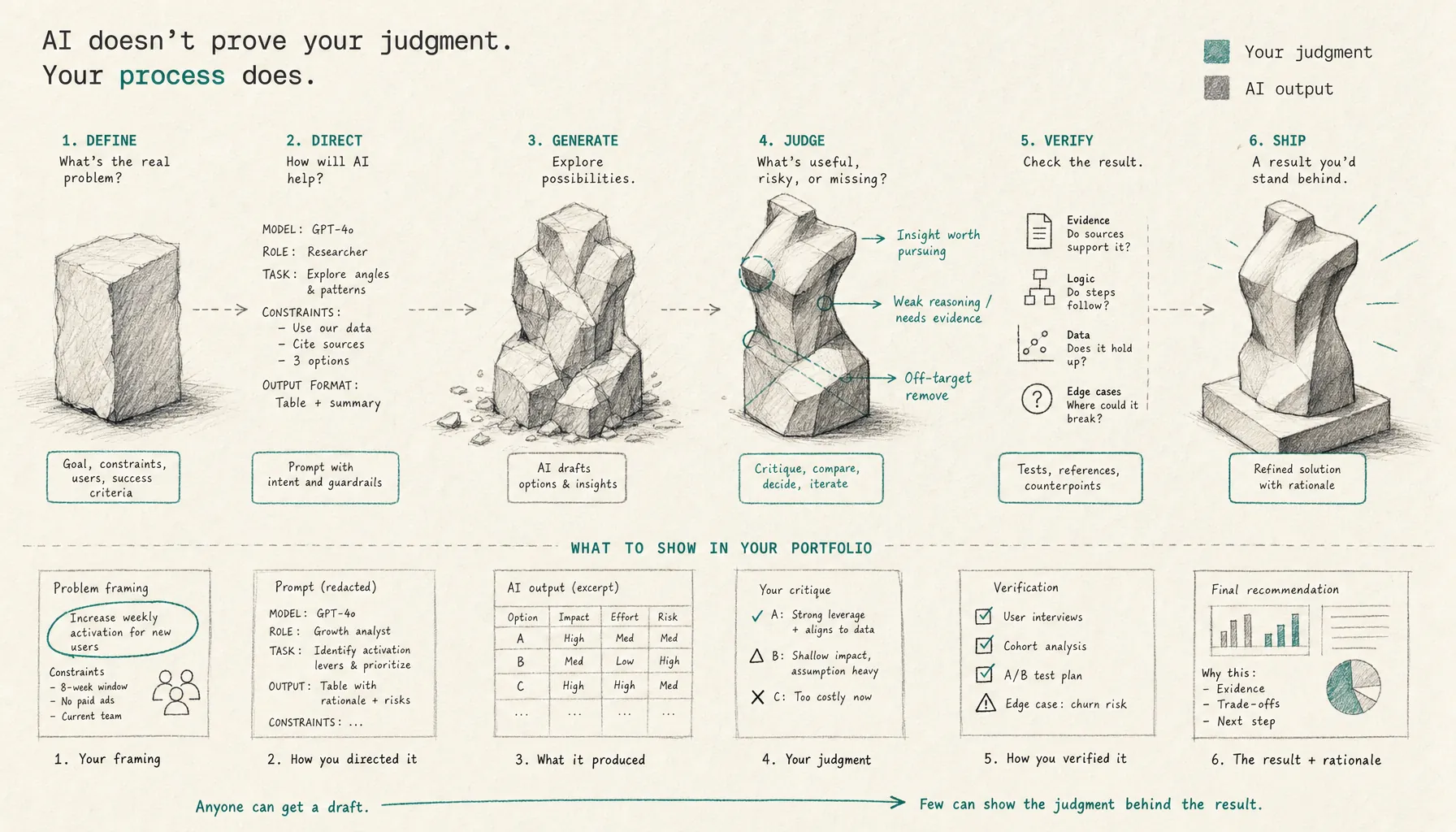
A portfolio that shows only the AI-generated final output tells an employer almost nothing about how you think.
To show AI judgment in a portfolio, document the decisions behind the work: how you framed the problem, what constraints shaped the job, how the prompts changed, which outputs you threw out, what the model cost, what risks you checked for, and what you edited yourself at the end. The goal is not to prove you touched AI. It is to prove you were in charge.
That matters in 2026 because using AI no longer sets anyone apart. According to McKinsey’s 2025 global AI survey, 78% of respondents said their organizations use AI in at least one business function. Usage is ordinary. Judgment is not.
Key Takeaways
- Employers judge AI-assisted work by the decisions behind it, not just the final artifact.
- A strong AI portfolio case study includes the starting problem, constraints, prompt excerpts, tradeoffs, cost awareness, validation steps, and before-and-after artifacts.
- Prompt dumps are weak evidence. Short excerpts with context show how you narrowed scope, fixed failures, and improved the output.
- Cost awareness belongs in builder portfolios because AI systems charge differently for input, output, cached input, tool calls, and repeated runs.
- The strongest format is an evidence packet: one public artifact, one process note, one tradeoff table, and one short walkthrough.
How to show AI judgment in a portfolio
Show each AI-assisted project as a decision record: what you asked the model to do, where it failed, what you changed, which tradeoffs you accepted, and how you checked the result. Hiring managers need to see your judgment under uncertainty, not a pretty screenshot at the end.
The weak version says: “Built a customer support classifier using GPT.” The stronger version says: “Reduced manual triage by grouping 1,200 tickets into 14 intent categories, threw out the model’s first taxonomy because it lumped billing disputes together with refund requests, added examples from edge cases, and checked the final categories against 100 manually labeled tickets.”
The second version gives an employer something real to inspect. It shows how you framed the problem, where you corrected the model, and how you validated the result. It also shows you know the difference between an output that looks good and a workflow that actually works.
This is the same logic behind AI Skills in Hiring (2026): Portfolio Proof and Interview Signals. A resume says you used a tool. A portfolio shows whether you used it well.
AI portfolio documentation structure: use a case study that exposes decisions
An AI-assisted project case study should revolve around decisions, not a step-by-step timeline. Employers look for the moments when a weaker builder would have accepted the model’s answer and moved on.
Keep the format compact. A reviewer should be able to read it in three minutes, but it also needs enough detail to hold up in an interview.
| Section | What to include | What it proves |
|---|---|---|
| Problem | The business or user problem, baseline workflow, and measurable target | You can frame the work before reaching for tools |
| Constraints | Time, budget, data access, privacy limits, quality bar | You understand real operating conditions |
| AI role | What the model handled and what stayed human-owned | You know where automation should stop |
| Prompt excerpts | Two to five short excerpts showing iteration | You can steer, test, and correct the model |
| Tradeoffs | Accuracy vs. speed, cost vs. quality, automation vs. review | You can make choices under constraints |
| Validation | Manual review, test set, user feedback, error analysis | You checked the work instead of trusting it |
| Result | Before-and-after artifact plus measured outcome | You shipped something useful |
The case study should not sound like a product launch post. It should sound like notes from someone who had to make judgment calls with incomplete information. Because that is the job.
For a broader cost frame, connect your project logic back to the larger question of AI cost vs employees. Employers increasingly want to know whether a builder can scale output without quietly piling on review, compute, and coordination costs.
Prompt excerpts portfolio: include evidence, not a transcript
Prompt excerpts should show how your thinking changed the model’s behavior. A full transcript usually creates clutter. Selected excerpts create proof.
Use three kinds of excerpts. First, show the initial instruction. Second, show a correction after the model got something wrong. Third, show a constraint that made the result more reliable. Keep each excerpt short enough that a reviewer can see the pattern without digging through a prompt graveyard.
According to OWASP’s Top 10 for Large Language Model Applications, LLM systems face risks including prompt injection, sensitive information disclosure, excessive agency, and overreliance. That matters in a portfolio because a raw prompt can leak customer data, internal strategy, or private examples. Redact names. Swap proprietary data for synthetic samples. Explain what you changed.
Good prompt excerpt example
A strong prompt excerpt pairs the instruction with the reason it existed. In most cases, the explanation matters more than the prompt itself.
Original prompt: Classify these support tickets into product issue categories.

Revision: Do not create a new category unless at least five tickets share the same underlying user intent. Keep billing disputes separate from refund requests.

Why I changed it: The first output overfit rare complaints and merged two workflows owned by different teams.
This works because it shows judgment. It names a model failure, ties that failure to the actual operation, and adds a constraint that changes the outcome.
If the project used agents or multi-step workflows, also note where prompt design changed cost. The reason is covered in Why AI Agents Use So Many Tokens: Workflow Causes in 2026 and Reduce AI Agent Token Usage: Prompting Controls and Review Steps. Repeated reasoning loops are great in demos and surprisingly expensive everywhere else.
AI project tradeoff notes: document accuracy, speed, cost, and risk
Tradeoff notes are where AI judgment becomes easy to see. A builder who can explain what they gave up, why they gave it up, and how they managed the downside is much easier to trust than someone who says the model “saved time” and leaves it there.
According to the National Institute of Standards and Technology AI Risk Management Framework, trustworthy AI systems should be valid and reliable, safe, secure and resilient, accountable and transparent, explainable and interpretable, privacy-enhanced, and fair. Your portfolio does not need to read like a compliance binder. It should show that you thought about those issues in the real project, where the mess actually lives.
Cost belongs in the same table as quality. According to OpenAI’s API pricing page, API usage is priced differently for input tokens, output tokens, and cached input on supported models. According to Anthropic’s prompt caching documentation, prompt caching can cut cost and latency for repeated long prompts when the workflow is set up correctly. The practical point is simple: the same feature can look cheap in a demo and get expensive fast in production.
| Decision | Option A | Option B | Chosen path | Reason |
|---|---|---|---|---|
| Model use | One high-capability model for all steps | Smaller model for draft, stronger model for review | Option B | Reduced repeated expensive calls while keeping review quality |
| Review level | Fully automated classification | Human review for low-confidence cases | Option B | Misrouting billing issues cost more than manual review |
| Prompt design | Long general instruction | Short instruction plus examples and category rules | Option B | Reduced category drift and made failures easier to inspect |
This is a good place to include cost analysis without letting it swallow the whole portfolio. If you need the budgeting side, see AI Token Costs (2026): Pricing Forecasts and Budget Controls, AI Token Cost Estimate: Team Budget Formula for 2026, AI Token Budget for Startups: Cost Controls for Small Teams, Why AI Token Costs Are High: Pricing Drivers in 2026, Agentic AI Costs (2026): Token Usage and Workflow Controls, and AI Agents vs Chatbots Cost: Token Usage and Budget Impact.
Before-and-after portfolio artifacts: show the work changed something
Before-and-after artifacts prove the project improved a workflow instead of just producing a nice slide. Employers need to see the messy starting point, the intervention, and the better result.
For a writing workflow, show the original brief, the model-assisted outline, rejected drafts, and the final edited version. For a data workflow, show the raw spreadsheet, cleaning logic, sample classification errors, and final dashboard. For an internal tool, show the manual process, the prototype, the review queue, and the failure log.
The best artifacts show friction. A polished final screen hides the hard parts. A marked-up before-and-after sequence shows whether you can diagnose weak inputs, clean up muddy requirements, and keep the final output tied to the original goal.
This connects directly to AI Productivity vs Usage: Output Metrics and ROI Signals. Usage is not the metric. Better throughput, fewer errors, faster review, lower cost per accepted output, or cleaner handoffs are metrics.
Document AI workflow for hiring: build an evidence packet
The most useful AI portfolio format is an evidence packet. It gives a hiring manager enough proof to evaluate your work before the interview, and enough detail to ask smart questions during it.
- Choose one AI-assisted project where you made at least three real decisions, not just one decent prompt.
- Write a 150-word problem statement with the baseline workflow, constraint, and target outcome.
- Select two to five prompt excerpts that show a failure, correction, constraint, or validation step.
- Create a tradeoff table covering accuracy, speed, cost, risk, and human review.
- Add before-and-after artifacts that show the input, intermediate work, and final output.
- Document validation with a small test set, manual review notes, user feedback, or error examples.
- Record a three-minute walkthrough explaining what the model did, what you changed, and what you would change next.
Keep the packet tight. One public page is enough. Add a private appendix only if the work includes sensitive data or proprietary context. The public version should show the shape of the work without exposing the client, employer, or user.
For builders targeting AI-heavy roles, this format pairs well with AI Builder Jobs (2026): Portfolio Proof and Team Scale. For interview prep, connect the packet to examples from AI Judgment at Work: Examples and Evaluation Criteria.
What employers actually read for
Employers read AI-assisted portfolios for evidence of ownership. They want to know whether you can use models inside a real system with constraints, review, and consequences.
Three signals matter most. First, you can separate model output from your own decisions. Second, you can explain failure modes without pretending the tool somehow acted alone. Third, you understand when automation creates more work for humans instead of less.
That last signal matters because blind automation often moves work around rather than removing it. The related hiring and operating risks are covered in AI Replacing Employees (2026): Hidden Costs and Rehiring Signals, Replace Employees with AI: Cost Risks and Team Tradeoffs, and AI Headcount Cuts: Failure Patterns and Rehiring Signals. Strong builders do not claim AI removes judgment. They show exactly where judgment enters the system.
If your project needed review queues, escalation rules, or human approval thresholds, say that plainly. It is not a weakness. It is evidence that you understand Human-in-the-Loop AI Teams: Governance and Scale Models.
Frequently Asked Questions
How do I show AI judgment in a portfolio if the project is confidential?
Use a sanitized evidence packet. Replace company names, customer data, proprietary prompts, and internal metrics with synthetic examples, but keep the decision structure intact: problem, constraints, prompt excerpts, tradeoffs, validation, and before-and-after artifacts.
Should I include full prompts in an AI portfolio?
No. Include selected prompt excerpts with explanations. Full prompts are usually too long, often expose sensitive information, and rarely prove judgment on their own. A short excerpt plus a note on the failure it fixed is much stronger evidence.
What is the best AI-assisted project case study format?
The best format is a one-page case study with a problem statement, constraints, AI role, prompt excerpts, tradeoff table, validation notes, and before-and-after artifacts. Add a three-minute walkthrough if the project is complex.
How much cost detail should I include in an AI portfolio?
Include enough cost detail to show you understand production reality: model choice, repeated runs, input versus output tokens, caching, review time, and human escalation. You do not need a full finance model unless the project was built to scale.
What do employers look for in AI-assisted portfolio projects?
Employers look for ownership, judgment, validation, and practical tradeoffs. A strong project shows what the model did, what you changed, how you checked the result, and why the final workflow was better than the starting one.