
Why AI Agents Use So Many Tokens - Provn AI Career Hub
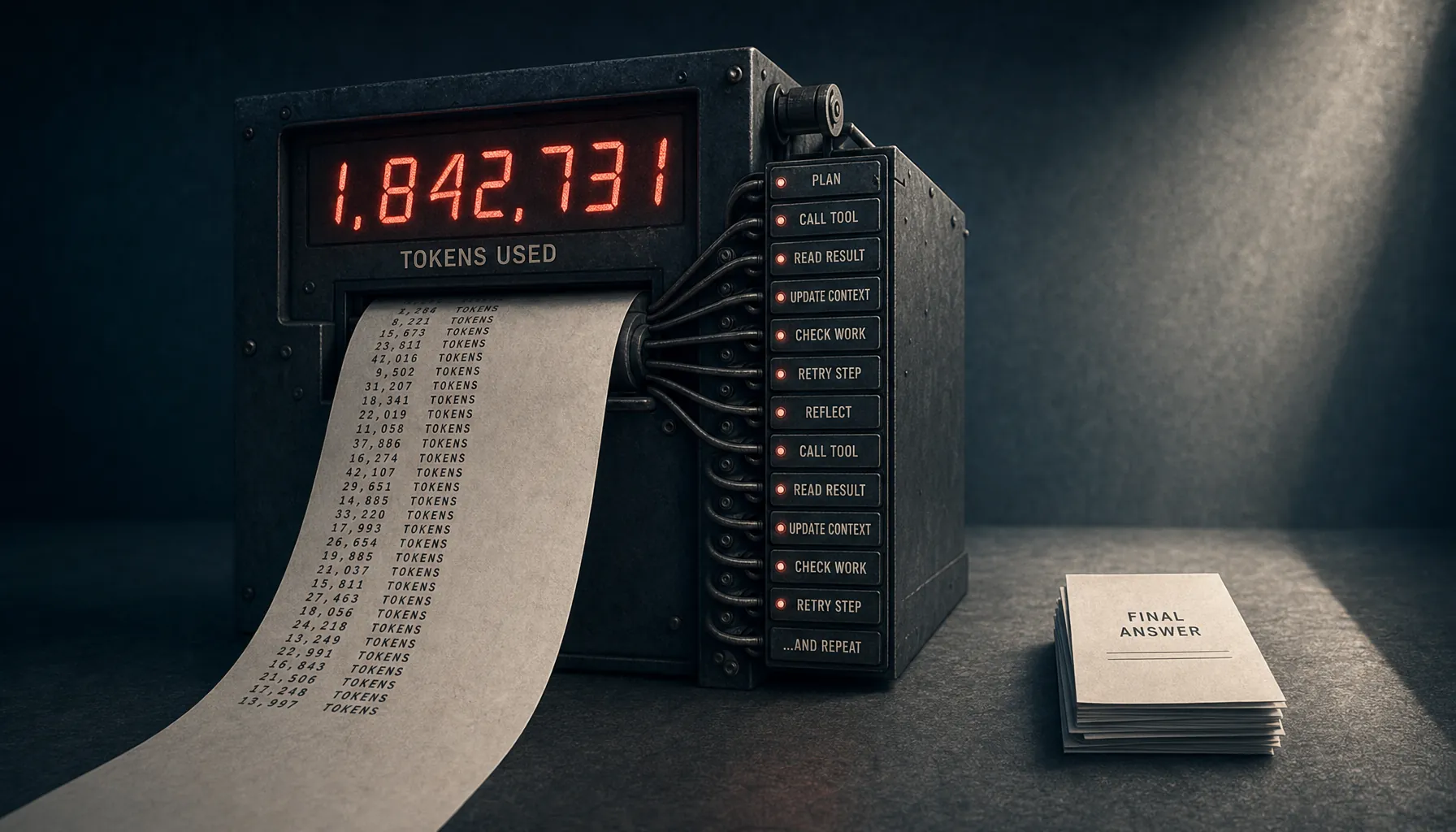
AI agents burn through more tokens than direct prompts because they keep planning, calling tools, reading results, updating context, checking their own work, and retrying when a step fails.
Why AI Agents Use So Many Tokens
An AI agent that takes ten steps can easily use 10 to 30 times more tokens than a single prompt asking for the same final answer. That is the real answer to “why do AI agents use so many tokens?” Autonomy is not one model call. It is a loop: planning, tool use, memory, self-checks, and retries.
The expensive part is often not the final response. It is everything wrapped around it. A direct prompt pays for one pass. An agent pays for all the extra work around that pass.
Key Takeaways
- AI agents burn tokens because each step usually resends instructions, task history, tool outputs, and partial state back into the model.
- Tool calls are not free in token terms. The model has to read function schemas, produce arguments, ingest results, and decide what happens next.
- Memory drives up token use when stored facts get pulled into the prompt instead of staying outside model context.
- Self-checking helps reliability, but every critique, validation pass, or retry is another model call.
- The cost problem is usually architectural, not just pricing. A sloppy agent loop can turn a two-cent task into a workflow that costs a dollar.
Why AI Agents Use So Many Tokens: The Short Answer
AI agents use so many tokens because they turn one request into a series of model calls, and each call carries context, instructions, intermediate results, and often tool output. According to OpenAI’s token explanation, tokens are the text units models process, with one token roughly equal to about four English characters.
A direct prompt is simple: input, model, output. An agent is a loop: plan, act, observe, revise, act again, then summarize. That loop is the product. It is also the bill.
This matters when teams compare automation to labor. A human might spend five minutes deciding whether a database lookup is needed. A badly scoped agent might spend five calls figuring out the same thing. For the broader cost model, see Provn’s pillar page on AI cost vs employees. This page sticks to the narrower question: why the token meter starts spinning once a system behaves like an agent.
Why AI Agents Use So Many Tokens in Planning
Planning burns tokens before the visible task even starts because the model has to turn an open-ended goal into steps, constraints, assumptions, and success criteria. The more autonomy you give the agent, the more text it tends to generate and reread while deciding what to do.
The ReAct pattern made this obvious. In the ReAct paper from Yao et al., agents interleave reasoning traces with actions so they can decide, observe, and adjust. That works well on tasks that need outside information. It also creates repeated text. Even when the user never sees the reasoning trace, many agent frameworks still keep planning state, task notes, prior observations, and tool decisions inside the working context.
The tradeoff is pretty straightforward. Planning tokens buy flexibility. They let the system decide whether to search, query a database, run code, or ask for clarification. But when the plan is vague, the model can waste tokens debating options a deterministic workflow should have hard-coded from the start.
Good builders treat agent planning the way sane people treat meetings. Some is useful. Too much is overhead. The best systems give the agent a narrow decision surface: pick from three approved actions, not any action it can dream up.
Tool Calls: Every Search, Database Read, and API Result Adds Context
Tool calls increase token use because the model has to read tool instructions, produce structured arguments, receive results, and then interpret those results in another call. According to OpenAI’s function calling documentation, models can generate structured arguments for developer-defined functions, so tool schemas and tool outputs become part of the interaction design.
This is where a lot of cost estimates fall apart. Teams count the final answer. They ignore the traffic in the middle.
| Agent action | Token source | Why it grows |
|---|---|---|
| Search the web or internal docs | Query text, returned snippets, citations, ranking notes | The agent has to read enough result text to judge relevance. |
| Call an API | Tool schema, JSON arguments, response payload | Structured data often gets pasted back into context. |
| Run code | Code, logs, errors, revised code, test output | Failures create extra loops and bigger observations. |
| Update a task plan | Prior plan, new observation, revised plan | The agent has to preserve continuity between steps. |
Tool use is often worth it. A customer support agent that checks order status should not guess. A coding agent should run tests. The mistake is letting every intermediate artifact flow back into the model untouched. A 900-line log file can end up being the most expensive part of the task even when only six lines matter.
That is why cost control for agent systems lives in architecture, not in some after-the-fact finance review. Provn covers the broader workflow picture in Agentic AI Costs (2026): Token Usage and Workflow Controls.
Memory and Context: Agents Pay to Remember What Direct Prompts Omit
Agent memory uses tokens when stored information gets retrieved and inserted into the active prompt. Memory feels like a database feature, but the model can only use it when the relevant facts are placed into the context it can actually read.
There are two common memory patterns. The cheap one stores facts outside the model and retrieves only a compact summary: “User prefers Python, uses PostgreSQL, production deploys on Fly.io.” The expensive one pulls in long chat history, old tool logs, prior plans, and raw documents because the system does not know what matters.
Prompt caching can cut repeated context cost in some systems, but it does not fix the design problem. According to Anthropic’s prompt caching documentation, caching works best for repeated prompt prefixes such as instructions, examples, or long reference material. That helps when context stays stable. It helps less when every agent step adds new observations and changes the shape of the prompt.
The practical rule is blunt: memory should be summarized, typed, and retrieved on purpose. If an agent needs a user’s timezone, retrieve the timezone. Do not replay forty messages and hope the model digs it out.
Self-Checking and Retries: Autonomy Means Repeated Attempts
Self-checking raises token use because the agent asks the model to evaluate, critique, validate, or repair its own work. Reliability usually gets better when the agent checks itself, but every review pass is another prompt and another output.
You can see this clearly in coding agents. A direct prompt might generate a function once. An agent might generate the function, run tests, read the failure, edit the code, run tests again, inspect lint output, and then write a final explanation. That loop is often the difference between a toy answer and software that actually works. It can also multiply token use by an order of magnitude.
Reasoning models add another wrinkle. According to OpenAI’s reasoning model guide, reasoning models may spend internal reasoning tokens while solving a task. Builders may not see every intermediate step, but usage accounting can still reflect the extra reasoning effort.
The real operator question is not “should agents self-check?” It is where those checks belong. Use deterministic validators when you can: unit tests, schema validation, type checks, policy rules, exact-match assertions. Save model-based critique for ambiguity, judgment, or cases where deterministic checks cannot express what good looks like.
The Practical Token Multiplier: A Builder’s Cost Model
The simplest way to estimate agent token burn is to count calls, context size, tool payloads, and retries separately. A direct prompt has one token envelope. An agent has a stack of them.
Use this rough model before you ship an agent workflow:
| Workflow type | Typical calls | Context pattern | Token multiplier vs direct prompt |
|---|---|---|---|
| Direct answer | 1 | User request plus instructions | 1x |
| Retrieval-assisted answer | 2–4 | Prompt plus selected documents | 3–8x |
| Tool-using agent | 4–10 | Plan, tools, observations, revisions | 8–25x |
| Coding or research agent with retries | 8–25+ | Files, logs, tests, errors, summaries | 15–60x |
These are planning ranges, not vendor prices. Actual spend depends on model rates, input and output mix, cached context, and task failure rate. For price forecasting, use Provn’s separate breakdown of AI Token Costs (2026): Pricing Forecasts and Budget Controls or the formula page for an AI token cost estimate.
The deeper point is that agent cost tracks uncertainty. The more the system has to discover, inspect, and repair, the more tokens it uses. Good agents reduce uncertainty. Bad agents just narrate it expensively.
How to Keep Agent Token Burn Visible Before It Becomes Budget Drift
Agent token use gets manageable when teams measure each loop, not just the final response. Part of this is instrumentation. Part of it is product judgment.
- Log input tokens, output tokens, tool calls, retries, and elapsed time for every agent run.
- Separate fixed context from variable context so stable instructions can be cached or compressed.
- Cap the maximum number of planning steps, tool calls, and retry attempts for each task class.
- Summarize tool outputs before sending them back to the model, especially logs, documents, and search results.
- Route simple tasks to direct prompts or deterministic code instead of the full agent loop.
- Review high-cost traces weekly and remove steps that do not change the final output.
The last step is usually where the money is. Agent traces show dead branches: searches that never affect the answer, validators that always pass, memory retrievals that add noise, retry loops caused by vague tool errors. Cut those and you usually improve cost and quality at the same time.
This is also where hiring signals show up. A builder who can show token traces, failure analysis, and before-and-after cost reduction is proving judgment, not just AI familiarity. That distinction matters in Provn’s view of AI Skills in Hiring (2026): Portfolio Proof and Interview Signals and AI Judgment at Work: Examples and Evaluation Criteria.
What This Means for Builders and Hiring
High token use is not automatically waste. Unexplained token use is the problem. An agent that spends more because it verifies facts, runs tests, and avoids bad outputs may still be cheaper than a direct prompt that hands a human a mess to clean up.
The hiring market is moving toward proof. Saying “I built an AI agent” does not tell anyone much. Showing that the agent reduced average calls from 14 to 6, cut retrieved context by 70%, and kept output quality intact is much better evidence. That is the difference between using AI and actually building with it.
Provn’s broader cluster on AI Productivity vs Usage: Output Metrics and ROI Signals makes the same point from the measurement side. Usage is not output. Token burn is not productivity. The useful builder knows when autonomy earns its cost and when a direct prompt, script, or human review is the cleaner answer.
Provn is where builders get hired. Performance over pedigree. Proof over polish. Token discipline is part of that proof now.
Frequently Asked Questions
Why do AI agents use more tokens than chatbots?
AI agents use more tokens than chatbots because they run multiple model calls around one task: planning, tool selection, tool output review, memory retrieval, validation, and retries. A chatbot usually answers in one exchange. An agent may create a loop of ten or more exchanges before it gives the final answer.
Do tool calls count as tokens?
Tool calls add token usage when tool definitions, arguments, results, logs, or retrieved documents pass through the model context. The external API call may have its own fee, but the token cost comes from the text the model has to read or generate around that call.
Does agent memory always increase token usage?
Agent memory increases token usage when retrieved facts are inserted into the prompt. Memory stays cheap when it is stored outside the model, summarized aggressively, and retrieved only when needed. Raw conversation replay is usually the expensive version.
Are expensive AI agents always badly designed?
Expensive AI agents are not always badly designed. Research agents, coding agents, and compliance review workflows may need many steps because the task itself requires evidence, testing, or review. The warning sign is not high spend by itself. It is high spend without trace-level evidence that the extra steps improved the result.
How can builders prove they understand agent token costs?
Builders can prove they understand agent token costs by showing traces, call counts, retry rates, context-size reductions, and quality checks before and after optimization. A portfolio that includes cost per successful task is more credible than a demo that only shows the final answer.