
Reduce AI Agent Token Usage: 9 Controls That Work
Most agent cost control comes down to workflow design: tighter scopes, shorter context windows, model routing, checkpoints, caching, and human review gates.
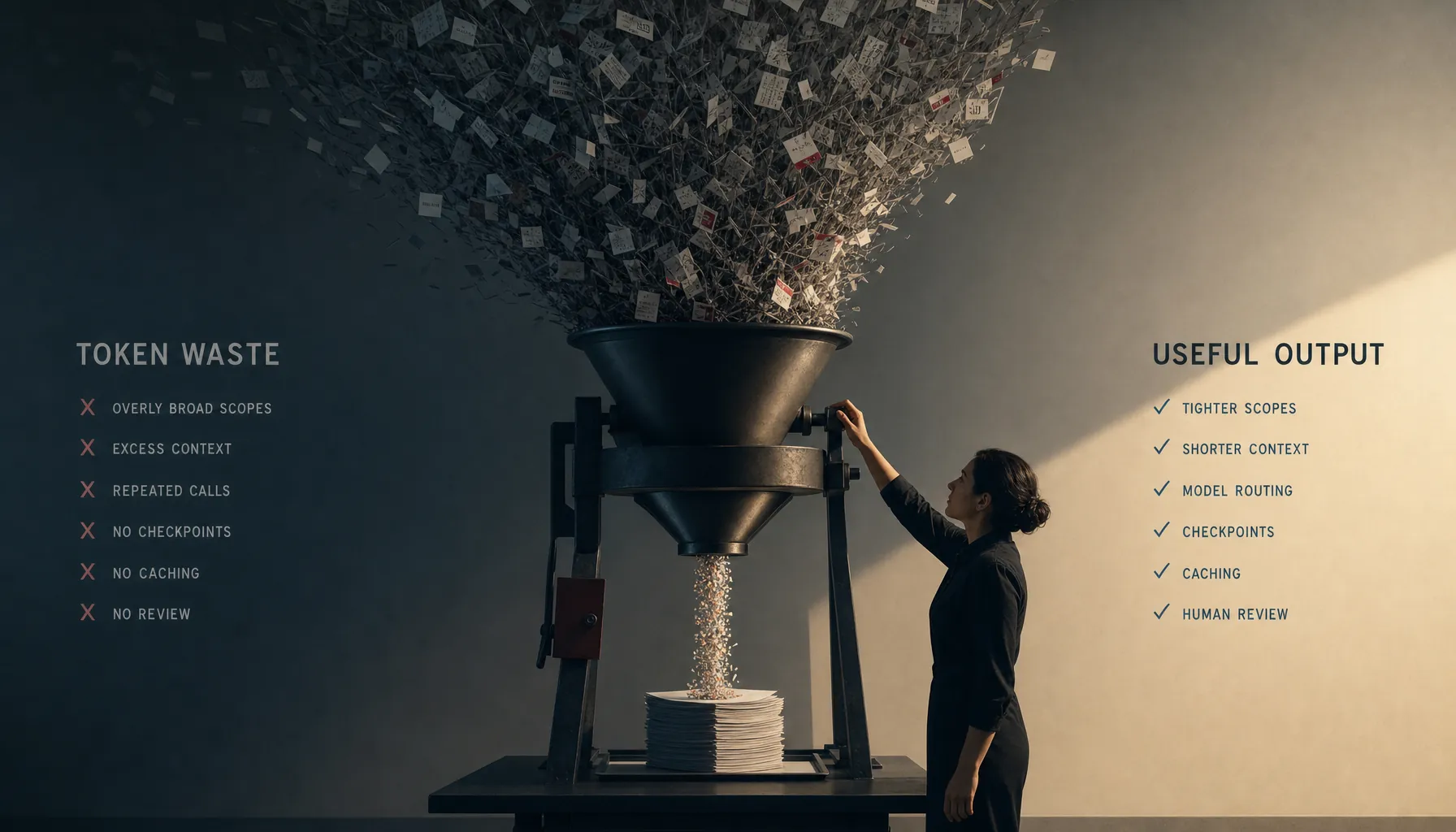
Reduce AI Agent Token Usage Without Cutting Useful Output
A 10-step agent that rereads a 60,000-token context window on every call can chew through 600,000 input tokens before it says anything useful. So the practical way to reduce AI agent token usage is not some clever prompt tweak. It is a system: smaller tasks, shorter context, cheaper model routing, checkpointing, caching, and human review gates.
For builders, this matters because efficiency is now part of the product. If your workflow produces the same accepted output at one-third the token load, it is cheaper to run, easier to scale, and a lot easier to defend when someone asks why this thing deserves a budget.
Key Takeaways
Start with tokens per accepted output, not tokens per prompt. Raw usage can drop while rework climbs, so the number that matters is cost per task that actually passes review.
- Agents waste tokens when they reread full transcripts, call tools with no exit criteria, and use expensive models for low-risk work.
- Before you touch prompts, split broad agents into narrower tasks with fixed inputs, output schemas, and stop conditions.
- Send extraction, classification, formatting, and validation to cheaper models when failure is easy to catch.
- Use checkpoint summaries, retrieval excerpts, and cached stable instructions instead of resending full context at every step.
- Add human review gates before expensive branches, not after the agent has already burned through five retries trying to guess.
Why Agents Spend Tokens Faster Than Chatbots
AI agents spend more tokens than chatbots because they loop. They plan, call tools, inspect results, retry, and then synthesize a final answer. A chatbot usually answers once. An agent may read, act, revise, and call another model before the user sees a single line.
According to OpenAI’s tokenizer documentation, tokens are pieces of text, not whole words, and the same passage can expand differently depending on language, punctuation, and formatting. According to OpenAI’s API response object documentation, model responses report prompt tokens, completion tokens, and total tokens. That matters because agents quietly grow prompt size through memory, tool output, logs, and retry chains.
The failure mode is usually pretty specific. Teams look at the invoice and blame the model. Usually the real problem is orchestration. One broad agent gets told to “research competitors,” then someone dumps in six webpages, a Slack export, prior chat history, a spreadsheet, and mushy instructions. It reads all of it three times because nobody defined what counts as evidence, what output is enough, or when it should stop.
For broader budget planning, the pillar analysis on AI cost vs employees covers when automation costs start to look like headcount costs. This page stays tighter: how to cut token waste inside the agent workflow itself.
How to Reduce AI Agent Token Usage: A Builder Workflow
The fastest way to reduce AI agent token usage is to instrument the workflow, then redesign the agent around smaller decisions. Prompt trimming helps, sure, but it comes later.
Use this sequence when an agent already produces useful output but the cost curve is heading the wrong way.
- Instrument every agent call with input tokens, output tokens, cached tokens where available, latency, model name, tool call count, retry count, and final task outcome.
- Define the accepted output unit, such as one approved research brief, one merged pull request, one qualified lead list, or one resolved support ticket.
- Split the broad agent into named tasks with fixed inputs, output schemas, and stop conditions.
- Route low-risk extraction, classification, formatting, and validation to cheaper models before using a higher-cost model for synthesis or judgment.
- Replace full conversation history with checkpoint summaries and retrieved excerpts that contain only the evidence needed for the next step.
- Cache stable system instructions, policies, style rules, and reference documents instead of resending them as fresh context each time.
- Cap output length with explicit formats, field limits, and refusal rules for unsupported details.
- Add checkpoints after tool calls so the agent summarizes state once instead of rereading raw tool output over and over.
- Insert human review gates before expensive branches where a five-minute decision can prevent multiple autonomous retries.
- Run token regression tests on representative tasks before shipping workflow changes.
- Report cost per accepted output, not average tokens per call.
This is the same discipline good builders already use in software performance work. You do not optimize a database by telling it to “be faster.” You inspect query plans, isolate hot paths, and remove unnecessary reads. Agent tokens deserve the same treatment.
Narrower Tasks Reduce AI Agent Token Usage More Than Prompt Polishing
Narrow tasks cut token usage because the model sees less context and makes fewer decisions. A small agent with a clear job usually beats one general agent carrying a giant instruction stack.
The common mistake is giving one agent the whole workflow: gather evidence, decide relevance, write the answer, check citations, format the output, and update a database. It looks neat on a product diagram. In production, it is a money pit.
| Broad agent behavior | Token problem | Cheaper redesign |
|---|---|---|
| “Analyze these 20 sales calls and write next steps.” | Large transcript context gets reread during synthesis. | First extract objections per call, then synthesize only the extracted fields. |
| “Research this company and draft an account plan.” | Web pages, notes, and CRM fields enter the same prompt. | Separate retrieval, evidence scoring, and plan writing. |
| “Fix this bug.” | The agent may inspect unrelated files and retry tests blindly. | Require file selection, hypothesis, patch, and test result as separate checkpoints. |
The useful design question is not “Can the agent do the whole task?” It is “Which part actually needs judgment, and which part is mechanical?” Box in the mechanical steps. Spend the budget on judgment.
Cheaper Model Routing for AI Agents
Model routing lowers token cost by matching model strength to task risk. Use stronger models where ambiguity is high. Use cheaper models where the answer can be checked automatically.
According to OpenAI’s API pricing page and Anthropic’s API pricing page, API pricing is published by token category and model family, with different rates for input, output, and caching-related tiers where supported. The practical point is simple: if every step goes to the most expensive model, you are probably overpaying.
A practical router has three lanes:
- Cheap lane: extraction, deduplication, tagging, JSON repair, format conversion, short classification.
- Middle lane: summarization, standard drafting, basic comparison, low-risk code edits.
- Expensive lane: ambiguous planning, high-value customer communication, legal-sensitive wording, architecture tradeoffs, final synthesis.
The catch is false economy. If a cheaper model creates retries, cleanup work, or bad output that reaches customers, the invoice went down while the real cost went up. That is why routing should be judged against accepted output. For measurement design, the related piece on AI Productivity vs Usage: Output Metrics and ROI Signals goes deeper on output-based metrics.
Shorter Context, Checkpointing, and Caching
Shorter context reduces token usage when the agent carries forward decisions instead of raw history. Checkpointing turns a messy transcript into a compact state object the next step can actually use.
Long context windows are useful. They are also incredibly easy to abuse. A larger window does not mean every tool result, chat message, and document belongs in every call. According to Anthropic’s prompt caching documentation, prompt caching is meant for repeated prompt content such as long instructions or reference material. According to OpenAI’s prompt caching guide, caching can reduce cost and latency for repeated prompt prefixes on supported models.
The best pattern is a three-part context budget:
| Context component | What belongs there | What should be excluded |
|---|---|---|
| Stable prefix | System rules, tool policy, output schema, evaluation rubric. | One-off user data and full prior transcripts. |
| Checkpoint state | Current goal, decisions made, open questions, accepted evidence. | Raw logs, repeated tool output, abandoned branches. |
| Retrieved evidence | Only passages needed for the next decision. | Whole files when a paragraph or function is enough. |
This is where a lot of agent builds get sloppy. The agent turns into a backpack. Every step adds more junk. A builder who can show a before-and-after trace, same output, 70% less context carried forward, is showing operational judgment, not just “we added AI.”
For cost forecasting across teams, see AI Token Costs (2026): Pricing Forecasts and Budget Controls. For why agent loops create different cost behavior than simple prompts, see Agentic AI Costs (2026): Token Usage and Workflow Controls.
Human Review Gates Before Expensive Retries
Human review gates reduce token waste when the agent is about to enter an expensive branch with shaky information. The right gate shows up early enough to stop retries and stays narrow enough that review takes minutes, not half a day.
This does not mean putting a person behind every output. That would defeat the point. It means recognizing the moments where human judgment is cheaper than autonomous wandering.
Good gates look like this:
- Evidence gate: “Are these the right five sources before synthesis starts?”
- Risk gate: “Is this customer-facing answer allowed to mention pricing, refunds, or compliance?”
- Scope gate: “Should the coding agent modify this module or stop and ask for architecture review?”
- Exception gate: “Does this case fall outside the standard policy?”
According to the National Institute of Standards and Technology AI Risk Management Framework, human oversight is one control for managing AI system risks, including validity, reliability, safety, and accountability. In agent cost control, the same idea also saves money: review stops the model from spending tokens on a path that should have been rejected earlier.
This is also where hiring signals get obvious. A builder who knows when not to automate is usually more valuable than one who wires an agent into every possible step and calls it innovation. The related Provn piece on AI Judgment at Work: Examples and Evaluation Criteria covers that distinction directly.
Efficiency as a Builder Signal
Token efficiency is becoming portfolio evidence because it shows whether a builder can ship useful AI systems under real constraints. A demo proves capability. A trace proves discipline.
The strongest project writeups do not say, “I built an AI agent.” They show the operating numbers:
- Baseline tokens per accepted task.
- Final tokens per accepted task.
- Model routing rules.
- Context budget before and after checkpointing.
- Retry rate before and after human gates.
- Quality measure used for acceptance.
That is performance over pedigree. Proof over polish. Teams do not need more people who can prompt a model in a tidy demo. They need builders who can make systems survive messy inputs, budget limits, and review requirements. The related pages on AI Skills in Hiring (2026): Portfolio Proof and Interview Signals and AI Builder Jobs (2026): Portfolio Proof and Team Scale explain how to turn that work into hiring evidence.
The standard is simple: if your agent produces useful output with fewer tokens, fewer retries, and clearer review points, you improved the product. If token usage drops but accepted output drops with it, you did not improve anything. You just made the agent quieter.
Frequently Asked Questions
What is the fastest way to reduce AI agent token usage?
The fastest reliable method is to measure tokens per accepted output, then strip out repeated context. In most agent workflows, the biggest waste comes from rereading transcripts, tool outputs, and documents at every step. Replace raw history with checkpoint summaries and retrieve only the evidence needed for the next decision.
Should I use a smaller model to reduce AI agent token usage?
Use a smaller or cheaper model for tasks that are easy to verify, such as extraction, classification, formatting, and JSON repair. Keep stronger models for ambiguous planning, final synthesis, and decisions where mistakes are expensive. Model routing only works if you track retry rate and accepted output quality.
Does prompt caching reduce agent costs?
Prompt caching can reduce cost and latency when the same long prompt prefix is reused on supported models. It works best for stable content such as system instructions, policies, style guides, and reference documents. It does not fix waste caused by sending irrelevant task data or uncontrolled tool output.
How do human review gates lower token usage?
Human review gates lower token usage by stopping expensive branches before the agent burns tokens on retries. The best gates happen after evidence collection and before synthesis, customer-facing output, code changes, or compliance-sensitive decisions.
What should builders show in a portfolio to prove agent efficiency?
Show before-and-after traces: tokens per accepted task, model routing rules, context reduction, retry rate, latency, and the acceptance standard. A project that proves the same output with a lower token load is stronger than a polished demo with no operating numbers.