
AI Builder Jobs: Portfolio Proof That Gets Hired - Provn
AI builder jobs go to people who can take fuzzy problems and ship real work across writing, design, code, prototyping, and automation. The best portfolios show faster cycles, fewer handoffs, and sound judgment, not just a list of tools.
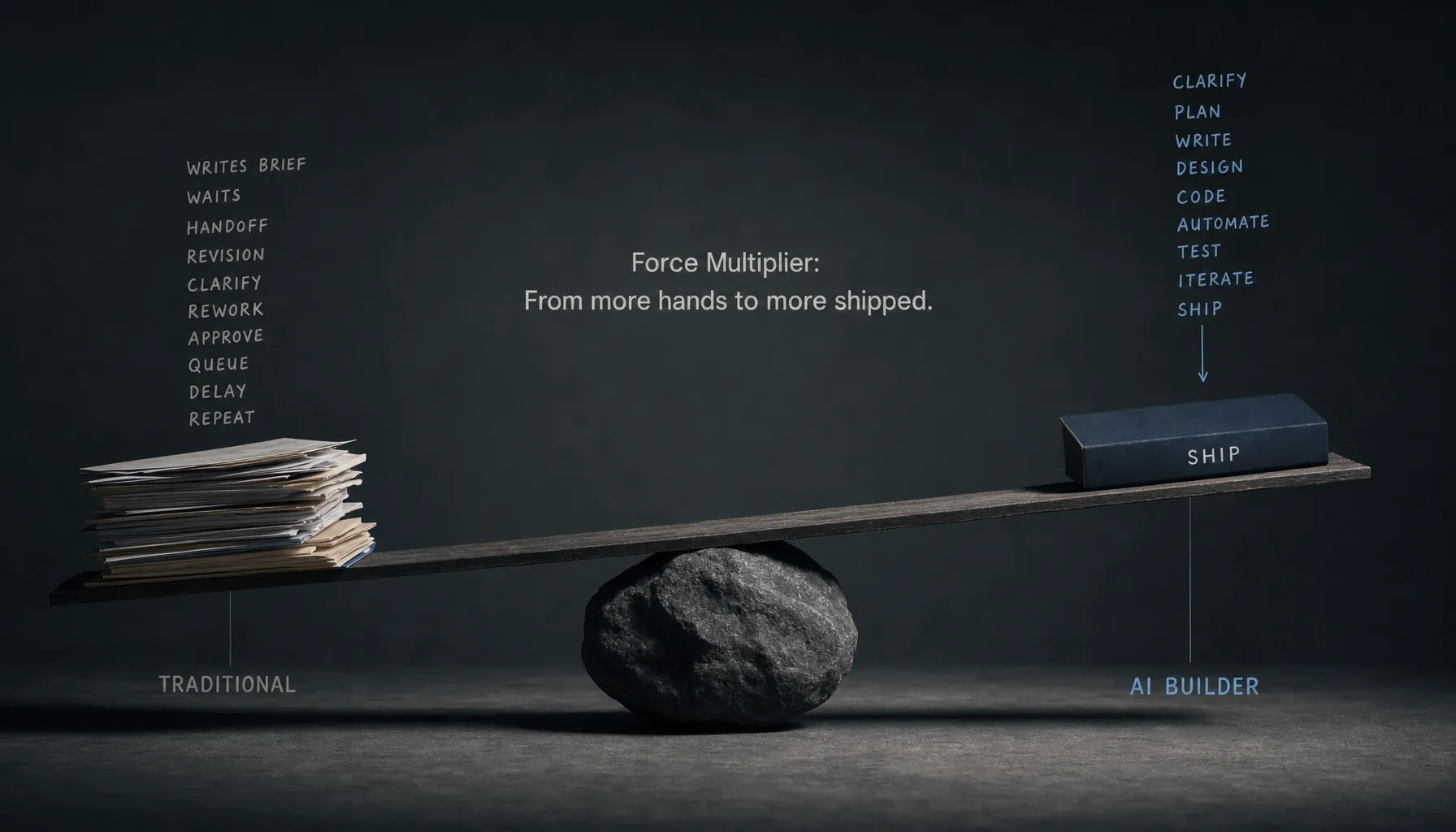
Stanford’s 2025 AI Index found that 78% of organizations used AI in 2024, up from 55% a year earlier. That jump created a new hiring lane: AI builder jobs for people who can move between writing, design, code, prototyping, and automation without waiting on a full team to get started. This article breaks down how to present yourself as someone who increases output, cuts handoffs, and shows judgment through work that actually shipped.
Key Takeaways
AI builder jobs are not generic “AI user” roles. They are execution roles for people who can take a vague business problem and turn it into a working system, prototype, workflow, content engine, or decision tool.
- Companies are hiring builders because AI adoption moved faster than operating discipline. According to Stanford University’s 2025 AI Index Report, organizational AI use reached 78% in 2024.
- The best AI builder portfolios show a before and after: cycle time cut, manual steps removed, decisions improved, or revenue work shipped faster.
- Tool lists are weak evidence. Hiring teams want proof that you can write, prototype, automate, evaluate, and explain tradeoffs.
- Early-career builders should show range and speed. Mid-career builders should show system design, governance, cost control, and judgment under ambiguity.
- The strongest positioning is economic: “I help a team produce more without adding unnecessary headcount, vendor spend, or operational drag.”
AI Builder Jobs: What Companies Are Actually Hiring For
AI builder jobs are roles where companies hire people to use AI tools, automation, product thinking, and domain judgment to produce working output across functions. These jobs often sit in the gaps between product, operations, marketing, engineering, design, and analytics. The point is not knowing one tool. The point is turning messy work into a system people can actually use.
That distinction matters. A prompt user asks a model for help. A builder designs the workflow around the model. They decide what should be automated, what still needs human review, what data is safe to use, what “good” looks like, and where the output will fail once it hits real work.
In practice, AI builder jobs show up under messy titles:
- AI operations associate
- Growth builder
- Product automation specialist
- AI content systems lead
- RevOps automation builder
- Prototype engineer
- AI workflow designer
- Technical generalist
The title matters less than the operating pattern. These companies need people who can write a spec, build a rough interface, test model output, connect tools, document the workflow, and hand it off without creating a maintenance nightmare.
That is why AI builder jobs fit a lot of early-career and mid-career candidates who do not slot neatly into one credential box. The hiring signal is not pedigree. It is proof. Provn’s view is simple: performance over pedigree, proof over polish.
Why AI Builder Jobs Are Growing in 2026
AI builder jobs are growing because companies bought AI access faster than they learned how to turn it into reliable work. The problem is no longer access. It is execution.
According to the <strong>World Economic Forum Future of Jobs Report 2025</strong>, 86% of employers expect AI and information processing technologies to change their business by 2030. The same report says 39% of workers’ current skill sets are expected to change or become outdated between 2025 and 2030.
That leaves companies with a hiring problem. They cannot patch every workflow gap by hiring a full engineer, full designer, full analyst, full copywriter, and full operator. Most teams do not have the budget, and honestly, many do not need that many specialists for the first pass. They need people who can work across the seams.
The labor market points the same way. The <strong>U.S. Bureau of Labor Statistics Occupational Outlook Handbook</strong> projects employment for software developers, quality assurance analysts, and testers to grow 17% from 2023 to 2033. But not every AI builder job is a software developer job. Many are hybrid execution roles where the candidate needs enough technical skill to build, enough taste to design, enough language skill to explain, and enough judgment to know when automation is a bad idea.
This is the mismatch. Traditional hiring systems still want clean categories. Companies increasingly need people who work well between categories. The resume struggles here. A portfolio can carry the proof the resume cannot.
For broader cost context, the pillar article on AI cost vs employees explains why companies do not automatically save money by throwing models at work. This page stays on the candidate side: how builders prove they make AI economically useful.
The Builder Stack: Writing, Design, Code, Prototyping, and Automation
The useful AI builder stack is not a pile of tools. It is a set of output modes that remove handoffs. A builder who can write, design, code, prototype, and automate can compress five partial workflows into one working loop.
That compression is the job. On a typical team, a product idea might move from founder to PM, then to design, then to engineering, then to marketing, then back through analytics. Every handoff adds delay and a little translation damage. A strong builder can push the first version much farther before a specialist team needs to step in.
| Builder capability | What it proves | Portfolio evidence hiring teams trust |
|---|---|---|
| Writing | You can clarify ambiguous work and communicate decisions. | Specs, strategy memos, landing pages, onboarding flows, documentation, changelogs. |
| Design | You can structure user experience before engineering time is spent. | Wireframes, Figma prototypes, interface revisions, before-and-after UX decisions. |
| Code | You can make ideas executable instead of leaving them as slides. | GitHub repos, working demos, scripts, APIs, small apps, internal tools. |
| Prototyping | You can test assumptions quickly before the team commits resources. | Clickable demos, user tests, mock datasets, recorded walkthroughs, iteration logs. |
| Automation | You can remove repeated manual work without creating unmanaged risk. | Zapier, Make, n8n, Airtable, Retool, Python, or LLM workflow examples with checks. |
The experienced move is to show the seams. Do not just show the polished prototype. Show the prompt that failed, the design assumption you changed, the automation rule you removed because it produced junk, and the manual approval step you kept because the work needed judgment.
Hiring teams do not need proof that you can generate content or ask a model to write code. They need proof that you can decide what belongs in the system and what does not. That is also why AI Judgment at Work: Examples and Evaluation Criteria matters for builder candidates. The scarce signal is judgment, not AI excitement.
How to Build an AI Builder Portfolio That Shows Scale
An AI builder portfolio should show the business problem, the workflow you built, the outputs it produced, and the measurable change from the old process. A portfolio full of screenshots and tool names does not prove much.
Think like a hiring manager sorting through 200 applicants. Most candidates will say they use ChatGPT, Claude, Cursor, Midjourney, Zapier, or Notion AI. Fine. So does everyone else. The stronger portfolio says: “This manual workflow took six hours a week. I rebuilt it into a reviewed automation that now takes 45 minutes, with two approval checkpoints and an error log.”
Portfolio Steps for AI Builder Jobs
The best AI builder portfolio is built on repeatable proof, not personal branding. Each project should make a reviewer think, “This person could own real work on a small team.”
- Choose a workflow with a visible before-and-after state, such as lead research, onboarding, support triage, content production, reporting, QA, or prototype testing.
- Define the business constraint in one paragraph, including the original cycle time, error pattern, bottleneck, or handoff problem.
- Build a working version of the workflow using the lightest tool stack that can produce reliable output.
- Add human review points where the system can create legal, customer, financial, brand, or data-quality risk.
- Measure the output using at least two metrics, such as time saved, revisions reduced, accuracy improved, conversion lift, or manual steps removed.
- Record a five-minute walkthrough explaining your decisions, failed attempts, tradeoffs, and what you would improve with more data.
- Publish a one-page case study with screenshots, artifacts, metrics, and links to a demo, repo, prompt log, or workflow diagram.
This structure works because it mirrors how work gets judged inside a company. Nobody cares that the workflow was clever if it breaks because a customer name is misspelled. Nobody cares that the interface looks clean if the output cannot be reviewed. Nobody cares that the model produced 100 drafts if 90 still need cleanup.
If you want project examples instead of a framework, anchor your portfolio in concrete work: internal tools, AI-assisted research systems, automated QA checks, data-cleaning scripts, prototype launch pages, support macros, or reporting dashboards. The related article on AI Productivity vs Usage: Output Metrics and ROI Signals goes deeper on measuring outcomes instead of activity.
The Economics: Show You Reduce Work, Not Add Tool Spend
AI builder jobs reward candidates who can show that their work reduces operating load instead of adding subscriptions, token usage, and review burden. The economic case is simple: a builder matters when the whole system gets cheaper, faster, or more accurate.
Companies have already learned that AI spend is not automatically efficient. Model vendors usually price usage by input and output tokens. For example, <strong>OpenAI’s API pricing page</strong> and <strong>Anthropic’s API pricing page</strong> both show token-based pricing by model. Long prompts, repeated agent loops, huge context windows, retries, and unreviewed automation can turn a supposedly cheap workflow into an expensive mess.
This is where builders can separate themselves. A weak builder says, “I automated the process.” A strong builder says, “I removed 14 manual steps, kept three review gates, reduced average turnaround from two days to four hours, and capped model calls by summarizing inputs before the final generation step.”
| Weak portfolio claim | Stronger builder claim | Why hiring teams care |
|---|---|---|
| “Built an AI content workflow.” | “Reduced first-draft production from 90 minutes to 22 minutes while preserving editor review.” | Shows cycle-time impact and quality control. |
| “Created an AI research agent.” | “Limited research runs to approved sources, logged citations, and flagged unsupported claims before handoff.” | Shows reliability, not just automation. |
| “Used AI to code faster.” | “Shipped a working internal dashboard in three days, with test cases and rollback notes.” | Shows production discipline. |
| “Automated support replies.” | “Routed 38% of tickets into draft responses while keeping billing, cancellation, and legal questions human-reviewed.” | Shows risk judgment. |
If your project uses agents or long-running workflows, be explicit about cost controls. The sibling articles on AI Token Costs (2026): Pricing Forecasts and Budget Controls and Agentic AI Costs (2026): Token Usage and Workflow Controls cover the budget side. In your portfolio, the hiring signal is narrower: prove that you understand AI output comes with a cost structure.
The practical move is to include a “cost and control” note for each project. List the model or tool class, the number of automated steps, where retries happen, where humans review, and what you would monitor if the workflow scaled from 10 uses a week to 10,000.
Early-Career vs. Mid-Career AI Builder Jobs
Early-career AI builders get hired for speed, range, and learning velocity. Mid-career AI builders get hired for judgment, systems thinking, and cross-functional ownership. The portfolio should change with seniority.
Early-career candidates often make the mistake of trying to sound senior. That usually backfires. A better signal is fast execution with clean thinking. Show that you can take a problem, build something useful, explain what broke, and improve it.
Mid-career candidates face a different test. Companies expect them to understand tradeoffs. They need to show how AI workflows affect existing teams, customer promises, data rules, brand standards, and budgets. The bar is not “can you build?” The bar is “can you build without making the company fragile?”
| Candidate stage | Best positioning | Portfolio evidence | Red flag to avoid |
|---|---|---|---|
| Early-career | “I can turn unclear tasks into usable drafts, prototypes, and workflows quickly.” | Three to five small projects with demos, metrics, and clear decision notes. | Claiming strategic ownership without evidence of shipped work. |
| Mid-career | “I can redesign workflows so teams produce more with fewer handoffs and less rework.” | Case studies showing process change, adoption, controls, and business impact. | Showing only tool experimentation instead of operating results. |
| Career switcher | “I bring domain knowledge and can convert it into AI-assisted systems.” | Projects grounded in a real industry workflow, not generic AI demos. | Ignoring the domain expertise that makes the candidate different. |
A former teacher might build a student feedback triage tool. A former recruiter might build a candidate screening research assistant with bias checks and source logs. A former operations manager might build a vendor onboarding tracker that drafts follow-ups and flags missing documents.
The goal is not to cosplay as a full-stack engineer if you are not one. The goal is to prove you can turn domain knowledge into a working system. That is often more valuable than yet another generic AI wrapper.
Interview Signals: How Hiring Teams Test Builders
Hiring teams test AI builders by giving them ambiguous work and watching how they make decisions, not by quizzing them on a specific tool. Most of these interviews are work-sample tests wearing a slightly nicer outfit.
A company may ask you to redesign a manual workflow, audit an AI output, build a quick prototype, critique a prompt chain, or explain how you would measure productivity gains. Strong candidates talk through constraints before they talk about tools. Weak candidates sprint straight to automation.
Expect tests like these:
- Workflow redesign: “Here is our current customer onboarding process. Where would you use AI, and where would you not?”
- Prototype task: “Build a lightweight demo that helps sales reps summarize discovery calls.”
- Quality audit: “Review these AI-generated outputs and identify failure patterns.”
- Cost-control scenario: “This agent produces good results but runs too many steps. What would you change?”
- Judgment screen: “What tasks should stay human-owned even if the model can draft them?”
The best interview answer has four parts: goal, constraint, workflow, evaluation. For example: “The goal is to reduce onboarding delays. The constraint is that billing and contract fields cannot be auto-approved. I would automate document collection reminders and draft internal summaries, but keep final account setup human-reviewed. I would measure time-to-complete, missing-field rate, and number of escalations.”
That answer does something most candidates miss. It shows judgment. It also helps the hiring manager picture you inside the company instead of just talking about tools from the outside. For more interview-specific proof patterns, the sibling article on AI skills in hiring focuses on portfolio proof and interview signals, while prove AI skills in an interview covers work samples in more detail.
Common Mistakes That Make Builders Look Expensive
The fastest way to lose credibility as an AI builder candidate is to make automation look uncontrolled. Companies do not want another person building hidden systems nobody else can maintain.
The first mistake is tool maximalism. Listing 25 AI tools makes you look scattered unless each one maps to a real workflow. Hiring teams do not reward software tourism. They reward shipped output.
The second mistake is hiding the human review layer. If your workflow touches customer communication, hiring, legal content, finance, health, education, or regulated data, the reviewer wants to see control points. The <strong>U.S. Equal Employment Opportunity Commission guidance on adverse impact in AI employment tools</strong> is a useful reminder: automation used in employment decisions can create compliance exposure. Even if you are not applying for HR roles, the principle still applies. When AI systems affect people, they need review.
The third mistake is confusing volume with productivity. Generating 1,000 outputs does not help if the team can only review 50 and ship 10. This is where a lot of AI replacement plans fall apart. The related article on AI Replacing Employees (2026): Hidden Costs and Rehiring Signals explains the company-side version of the same problem.
The fourth mistake is failing to document. A builder who ships a workflow without documentation becomes a dependency. A builder who ships a workflow with a diagram, owner notes, fallback rules, and monitoring metrics becomes an asset.
A strong AI builder portfolio includes a short “operating manual” for each project:
- What the workflow does
- What it should not do
- What data it uses
- Where a human reviews output
- What failure looks like
- How to stop or roll back the workflow
- Which metric proves whether it is working
This is the difference between a demo and a system. Companies hire builders when they believe the work will survive contact with real operations.
How to Position Yourself for AI Builder Jobs
The strongest AI builder positioning is a one-sentence economic claim backed by project proof. The sentence should make clear what kind of output you scale and what risk you understand.
Use this structure:
“I help [team type] produce [output] faster by building [workflow type], with controls for [risk].”
Examples:
- “I help growth teams produce tested landing pages faster by building AI-assisted research, copy, and prototype workflows, with controls for brand accuracy.”
- “I help operations teams reduce manual follow-up by building document intake and reminder systems, with controls for customer data and exception handling.”
- “I help product teams test ideas faster by building clickable prototypes and lightweight data tools, with controls for user feedback quality.”
Then your resume, portfolio, and interview should all reinforce the same claim. Do not present yourself as a general AI enthusiast. Present yourself as a builder who improves a specific kind of work.
Provn is built around that idea. Companies need proof that a candidate can perform. Candidates need a way to show work that does not fit on a resume. AI builder jobs make that gap impossible to ignore because the old signals — school, title, company logo — tell you very little about whether someone can move a workflow from idea to output.
Frequently Asked Questions
What are AI builder jobs?
AI builder jobs are roles where candidates use AI tools, automation, product thinking, and cross-functional execution to create working outputs such as prototypes, workflows, internal tools, content systems, dashboards, or operational automations. They differ from generic AI roles because the hiring signal is shipped work, not tool familiarity.
Do AI builder jobs require coding?
Some AI builder jobs require coding, but many call for enough technical ability to prototype, automate, test, and work well with technical teams. A candidate who can write basic scripts, connect APIs, build no-code workflows, and explain system limits may be competitive for hybrid roles even without a traditional software engineering background.
What should an AI builder portfolio include?
An AI builder portfolio should include three to five projects with a business problem, workflow diagram, tool stack, human review points, output examples, before-and-after metrics, and a short walkthrough. The strongest projects show reduced cycle time, fewer manual steps, better quality control, or faster prototype learning.
Are AI builder jobs better for early-career or mid-career candidates?
AI builder jobs can fit both groups, but the proof looks different. Early-career candidates should show speed, range, and learning through small shipped projects. Mid-career candidates should show operating judgment, cost awareness, workflow redesign, and the ability to introduce AI without creating unmanaged risk.
How do companies evaluate AI builder candidates?
Companies usually evaluate AI builder candidates through work samples, portfolio reviews, workflow redesign exercises, prototype tasks, and judgment questions. Strong candidates explain goals, constraints, review points, cost controls, and success metrics before naming tools.