
Why Are AI Token Costs So High? 2026 Bill Drivers
AI token costs go up because teams pay for the model tier, input and output length, retries, agent loops, multimodal processing, and hidden workflow volume, not just the chat messages they can see.
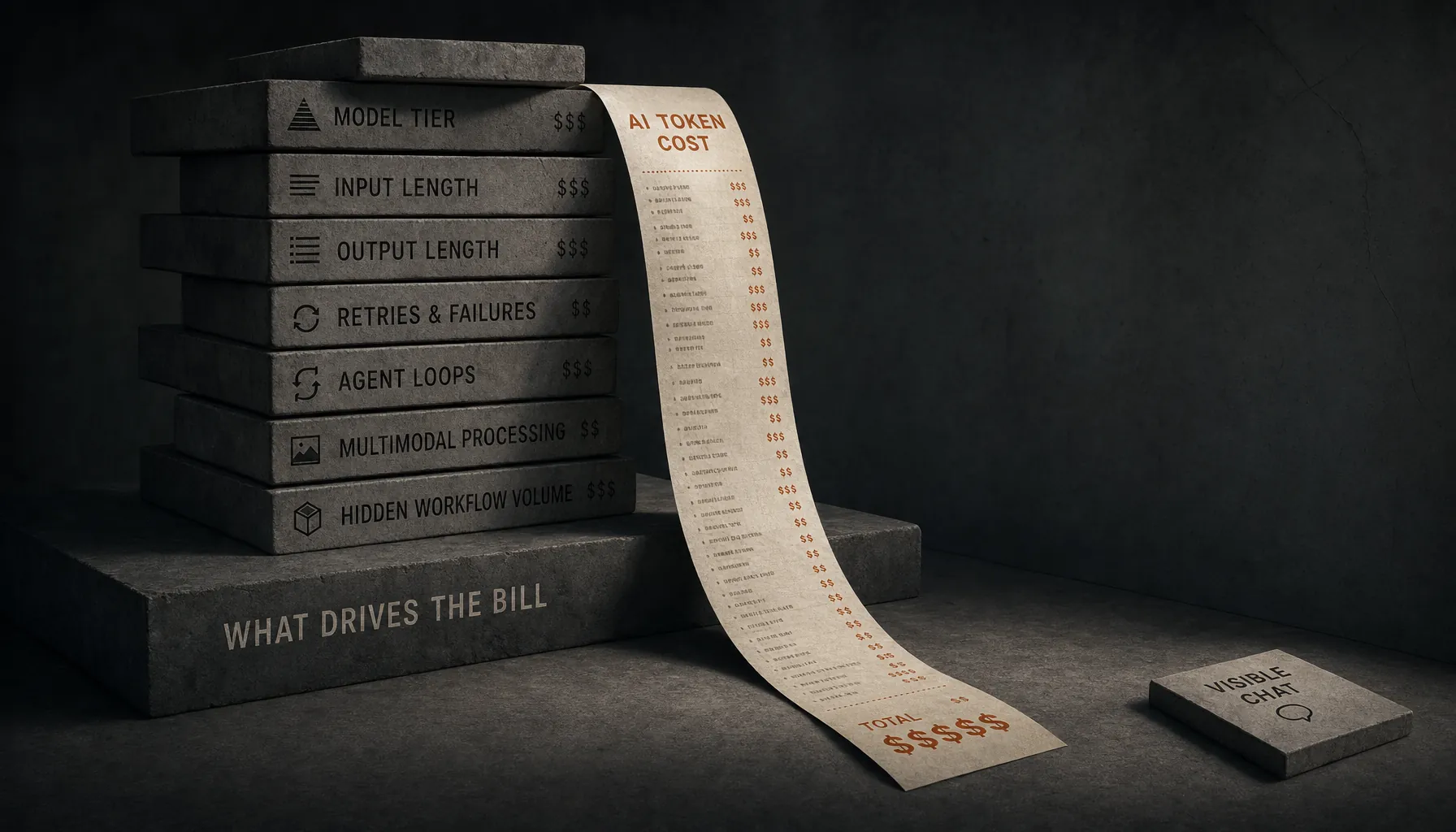
Why Are AI Token Costs So High? The Real Bill Drivers
A 1,500-word document review can quietly turn into a 40,000-token workflow once the model reads the file, pulls examples, calls tools, retries failed steps, and writes a structured answer. That is why “why are AI token costs so high” almost never has a one-line answer. The bill usually comes from a pile of things: model pricing, context size, output length, retries, agent behavior, multimodal processing, and workflow volume nobody bothered to measure.
Direct answer: AI token costs get high because providers charge for far more than the prompt a user sees. You pay for input tokens, output tokens, premium model tiers, large context windows, repeated calls, tool use, multimodal files, and retries. What looks like one user action can contain ten or more model calls behind the interface.
For the broader budget question, see Provn’s pillar analysis on AI cost vs employees. This page stays focused on one thing: why the token meter climbs faster than most teams expect.
Key Takeaways
- AI bills usually jump when teams use premium models for routine work, especially because output tokens often cost more than input tokens.
- Large context windows are not free storage. Sending the same 50-page brief with every request can turn a cheap task into a recurring expense.
- Retries, tool calls, retrieval, and agent loops can turn one visible request into five, ten, or twenty billable calls.
- Multimodal workflows charge for more than text. File interpretation, image processing, audio transcription, and document parsing can all add cost, depending on the provider.
- The first fix is measurement: log input tokens, output tokens, model, user action, retry count, and business outcome for every workflow.
Why Are AI Token Costs So High?
AI token costs get high when teams treat model calls like search queries instead of metered compute jobs. Every call burns tokens on instructions, user input, retrieved context, intermediate reasoning, tool outputs, and the final response.
The chat box is a terrible accounting surface. A user may type one sentence. The system may tack on a 2,000-token policy prompt, retrieve five internal documents, summarize them, call a database, reject one answer, retry with tighter instructions, and then write the final response. The user sees one answer. The invoice sees a chain of events.
According to OpenAI’s tokenizer explanation, models process text as tokens, not words. One token might be a word fragment, punctuation mark, or short word depending on the text. That matters because cost follows the tokenized workload, not the sentence count a human notices at a glance.
The practical point is simple. Token costs are not high because one prompt is expensive. They get high because production workflows repeat, expand, retry, and hide that expansion from the person approving the spend.
Model Pricing: Why the Same Prompt Can Have Different Costs
The same prompt can cost very different amounts depending on the model. Premium reasoning and frontier models charge more because the compute is more expensive and the models are meant for harder work.
You can see this on provider pricing pages. According to OpenAI’s API pricing page, prices vary by model and by input versus output tokens. According to Anthropic’s API pricing page, Claude tiers price input and output separately, and the stronger models cost more than the smaller ones. According to Google AI for Developers pricing, Gemini pricing changes by model, context length, and modality.
This is where teams make the first expensive mistake. They send every task to the strongest model because it worked in testing. Fair enough for ambiguous legal analysis, multi-step code review, or high-risk customer support. Not so smart for classification, formatting, extraction, deduplication, routing, or first-pass summarization.
| Task type | Typical model choice mistake | Better cost pattern |
|---|---|---|
| Email classification | Using a premium reasoning model for every message | Use a smaller model with a confidence threshold and escalate only uncertain cases |
| Contract review | Sending the full contract to the top model for every clause question | Retrieve only relevant clauses, then use the stronger model for final judgment |
| Code generation | Asking one large model to plan, write, test, and revise in one loop | Separate planning, generation, test repair, and human review with different model tiers |
If a workflow has no model-routing policy, it still has a cost policy. It just got there by accident. For forecasting controls, Provn covers the budget mechanics in AI Token Costs (2026): Pricing Forecasts and Budget Controls.
Context Windows: Long Inputs Turn Small Tasks Into Large Bills
Large context windows raise costs because the model has to read the context every time you send it. A 100,000-token window can be useful, but it is not a memory layer and it definitely is not free.
The trap is repetition. Teams paste the same style guide, product spec, codebase excerpt, sales history, or customer record into every call. The model may need only 800 tokens to answer the question, but the request drags along 20,000 tokens because the system prompt and context bundle keep getting copied forward.
According to Anthropic’s prompt caching documentation, caching can cut repeated context costs when the same prompt prefix is reused. According to OpenAI’s prompt caching documentation, cached input can also be priced differently from fresh input on supported models. Caching helps. It does not rescue bad context design. If you cache the wrong 40 pages, you still have a wasteful workflow.
A good rule here: context should earn its place. Every block sent to a model should have a reason to be there. If a retrieval system cannot explain why a document was included, it should not be in the prompt.
Retries and Agents: Hidden Loops Multiply Token Usage
Retries and agents raise token costs because they turn one task into a sequence of model calls. The more autonomy you give the system, the more chances it has to spend tokens before a human ever sees the result.
This is the second hidden bill driver. A chatbot usually answers once. An agent plans, searches, calls tools, reads the tool output, revises the plan, checks the result, and may try again after failure. Sometimes that is exactly the right design. It is also a very different cost profile.
Here is a simple example using a premium-model price pattern of $3 per million input tokens and $15 per million output tokens, a structure visible on some public model pricing pages. A workflow sends 12,000 input tokens and gets back 1,500 output tokens. One run costs about 5.85 cents. If 40 employees run it 15 times per workday for 22 workdays, the monthly cost is about $772. If the workflow averages four model calls because of retries and tool loops, the same visible behavior costs about $3,089.
That is not a pricing surprise. It is workflow volume. Provn covers the deeper version of this pattern in Agentic AI Costs (2026): Token Usage and Workflow Controls and the narrower cause in why AI agents use so many tokens.
Multimodal Usage: Images, Audio, and Documents Add Token Equivalents
Multimodal AI costs rise because files have to be turned into model-readable work. Images, PDFs, spreadsheets, and audio do not move through the system as free attachments.
According to Amazon Bedrock pricing, charges vary by model provider and usage type across text, image, and other model operations. The details vary, but the pattern does not: a workflow that accepts files has more billable surface area than a plain text prompt.
Document workflows are especially misleading. A user uploads one PDF. The system may extract text, preserve layout, run optical character recognition, chunk the document, embed chunks for retrieval, summarize sections, and pass selected sections into a final model call. The final answer may be 300 words. The pipeline behind it may chew through thousands of tokens and several intermediate steps.
This is why procurement teams often underestimate AI spending in legal, finance, healthcare, recruiting, and support. The unit of work is not “one question.” It is “one question plus the files needed to answer it.”
Hidden Workflow Volume: The Cost Driver Finance Teams Miss
Hidden workflow volume is the gap between visible AI use and actual model activity. Most of the time, it is the main reason AI bills rise after a pilot goes well.
Pilots are controlled. Ten users test a workflow. They use cleaner prompts. They tolerate errors. Production is messier. More users show up. Prompts get sloppy. Edge cases appear. The system adds guardrails, retrieval, logging, fallback models, safety checks, and review steps. Each improvement can add tokens.
This is where AI spending starts to look a lot like labor design. If a company cuts people before it understands workflow volume, it can swap salary expense for opaque model expense plus rework. That is not efficiency. It is just a different mess. Provn covers that failure mode in AI Replacing Employees (2026): Hidden Costs and Rehiring Signals.
The better metric is not usage. It is output per dollar. A team that spends $8,000 per month on AI and ships validated work may be doing fine. A team that spends $800 producing drafts nobody trusts is not. For measurement, see AI Productivity vs Usage: Output Metrics and ROI Signals.
How to Diagnose High AI Token Costs in One Billing Cycle
The fastest way to explain a rising AI bill is to instrument the workflow, not argue about the prompt. Token spend gets manageable when each model call is tied to a user action and a business result.
- Log the model name, input tokens, output tokens, cached tokens, retry count, and user action for every call.
- Group calls by workflow instead of by user so hidden repeated steps become visible.
- Separate first attempts from retries, fallback calls, tool calls, and validation calls.
- Rank workflows by total monthly token spend and compare each one with completed business output.
- Move low-risk classification, formatting, and extraction tasks to cheaper models where quality holds.
- Limit context retrieval to the smallest document set that can support the answer.
- Set approval thresholds for workflows that exceed a fixed token budget per completed task.
The common mistake is cutting tokens blindly. A shorter prompt can produce worse answers, more retries, and more human cleanup. The goal is not fewer tokens in isolation. The goal is fewer wasted tokens per accepted output.
When High Token Costs Are Actually a Hiring Signal
High token costs can point to weak workflow design, but they can also show where strong builders create leverage. The valuable person is not the one who uses AI the most. It is the one who turns model usage into shipped work.
This is where hiring changes. A resume that says “used AI tools” proves almost nothing. A portfolio that shows token budgets, model-routing decisions, failure cases, evaluation sets, and before-and-after throughput proves a lot more. Provn’s view of AI Judgment at Work: Examples and Evaluation Criteria starts there.
For builders, the signal is operational proof. Show the workflow. Show the cost curve. Show where you used a smaller model. Show where you kept a human in the loop because the task required judgment. That tells me more than a credential line ever will. See AI Skills in Hiring (2026): Portfolio Proof and Interview Signals and AI Builder Jobs (2026): Portfolio Proof and Team Scale.
Provn’s stance is simple: performance over pedigree. Proof over polish. In AI-heavy work, token discipline is part of performance.
Frequently Asked Questions
Why are AI token costs so high for simple prompts?
Simple prompts can trigger a lot of hidden work. The system may add instructions, retrieved documents, tool outputs, safety checks, retries, and long responses. The user sees one prompt, but the provider bills for every input and output token the model processes.
Do output tokens usually cost more than input tokens?
Often, yes. Many major API pricing pages separate input and output pricing, and output tokens are often priced higher for premium models. Check the current pricing pages from OpenAI, Anthropic, Google, or your cloud provider before you build forecasts.
Do larger context windows automatically mean higher AI bills?
Larger context windows increase how much text a model can process, but the cost depends on how much context you actually send. A team that pushes 80,000 tokens into every request will spend more than a team that retrieves only the 2,000 tokens needed for the answer.
Why do AI agents cost more than chatbots?
AI agents cost more because they usually make multiple model calls per task. They may plan, retrieve information, call tools, inspect results, retry failures, and validate outputs before returning an answer. Each step can add input and output tokens.
How should a team reduce high AI token costs without hurting quality?
Start by logging token use by workflow, not just by provider invoice. Then cut repeated context, route routine tasks to cheaper models, cap retries, cache stable prompt prefixes, and measure accepted output per dollar. Cutting prompt length by itself can raise total cost if quality drops.