
AI Replacing Employees: Hidden Costs - Provn AI Hub
A lot of AI replacement plans cut the obvious salary cost first, before anyone measures the review, rework, tool, context, and judgment costs that made the work reliable.
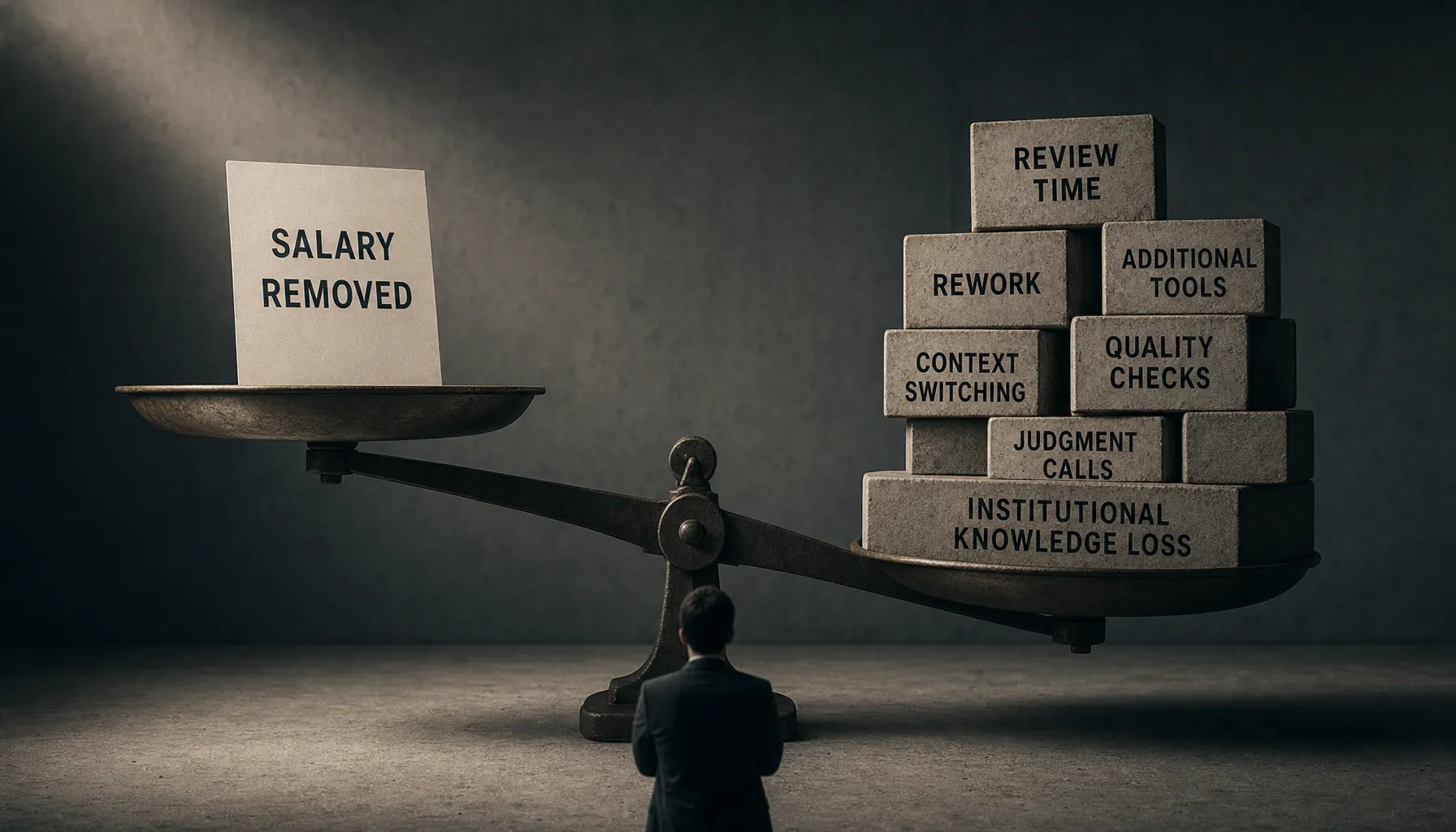
Most AI cuts save money on paper before they blow up the workflow the team was quietly holding together. In 2026, the companies using AI well are not the ones racing to remove people. They are the ones separating repetitive production from judgment, review, context, and accountability.
This is not an anti-AI piece. It is about bad math. A lot of replacement plans count software spend and payroll savings, then somehow forget review time, tool sprawl, rework, lost context, and the very predictable need to hire judgment back later.
Key Takeaways
- AI replacement plans usually undercount review labor, rework, vendor management, security checks, workflow redesign, and domain knowledge transfer.
- According to MIT CSAIL research on economically viable AI automation, only about 23% of wages paid for vision-related tasks were worth automating at then-current costs.
- The usual failure is not that the model cannot do the task. It is that the company removed the person who knew what “good” looked like, which exception mattered, and which shortcut would come back to bite them.
- AI works best as a force multiplier for strong operators who can build workflows, inspect outputs, and make judgment calls when the work gets messy.
- Before cutting headcount, companies should audit the whole system: task volume, error cost, review burden, context dependency, escalation paths, and the cost of buying judgment back later.
AI replacing employees: the savings line is not the cost line
AI replacing employees means using AI systems to do work people used to do, but the economics live in the whole workflow, not just the payroll line. The hidden costs usually show up in review, exception handling, tool management, rework, compliance, customer trust, and the later need for experienced human judgment.
The first spreadsheet looks great. Ten people cost $1.2 million. A stack of AI tools costs a fraction of that. Cut the team, plug the tools into the workflow, and margin goes up.
Then the second spreadsheet shows up.
Now the company is paying for five overlapping AI tools because no single product covers the whole job. Managers spend hours reviewing outputs. Support tickets rise because automated answers miss edge cases. Legal wants to know who approved a generated claim. Sales loses account history that lived in somebody’s head. A senior operator gets brought back as a consultant to explain the process the company thought it had automated.
This is the part missing from most AI replacement announcements. The employee was not just producing text, code, analysis, tickets, or outreach. They were carrying context. They knew which customer always escalates, which data source is stale, which vendor overpromises, which metric gets gamed, and which answer is technically correct but commercially wrong.
AI can compress production time. It can draft, classify, summarize, code, test, search, and monitor. That matters. But replacing labor is not the same thing as replacing accountability. Too many companies are acting like those are interchangeable. They are not.
For a broader cost model, including token spend and scale economics, see Provn’s pillar analysis on AI cost vs employees. This piece is about the costs that show up after a company has already decided to take people out of the loop.
Tool sprawl: the first hidden cost after AI cuts
Tool sprawl starts when a company replaces one human workflow with a pile of AI products, connectors, dashboards, and review systems. The subscription cost is the easy part to see. The real cost is integration, duplication, governance, vendor switching, and the hours employees spend babysitting the stack.
The pattern is boringly predictable. A team cuts headcount and buys a writing assistant, a research tool, a coding assistant, a meeting summarizer, a support chatbot, an analytics copilot, and an automation layer to connect them. Each tool looks useful on its own. Together, they create a new kind of operational drag.
According to IBM’s Global AI Adoption Index 2023, 42% of enterprise-scale organizations surveyed said they had actively deployed AI, while another 40% said they were exploring or experimenting with it. That kind of adoption creates a procurement mess fast: teams buy early, standardize late, and realize six months later they are paying three vendors to do variations of the same thing.
Tool sprawl gets expensive in four ways:
| Cost category | What companies budget for | What they often miss |
|---|---|---|
| Licenses | Monthly or annual per-seat fees | Duplicate tools across teams, unused seats, premium tiers added for security or admin controls |
| Integration | Initial setup | Authentication, permissions, CRM cleanup, data mapping, workflow testing, rollback plans |
| Governance | Basic policy language | Audit logs, vendor risk reviews, model usage rules, sensitive data controls, retention settings |
| Operations | Prompt templates and training | Ongoing evaluation, output drift monitoring, escalation paths, tool owner time |
The expensive version is usually not one giant AI platform. It is a dozen partial systems circling a workflow with no real owner.
This is also where companies confuse usage with productivity. A dashboard can show thousands of prompts, summaries, drafts, and automations. That does not mean the company shipped better work. It may just mean the work moved into a harder-to-see system. Provn gets into that in AI productivity vs usage metrics.
Tool sprawl creates a talent problem too. Somebody has to decide which systems matter, which outputs can be trusted, and which tools should get cut. That person is usually not the loudest AI enthusiast in Slack. It is a builder with workflow judgment, technical fluency, and enough business context to say, “No, we do not need another copilot.”
Quality review and rework: automation shifts labor instead of removing it
Quality review becomes the new labor layer when AI output touches customers, codebases, financial models, legal drafts, or operating decisions. Underfund the review step and the bill comes due somewhere else: rework, escalations, defects, customer churn, or risk controls bolted on after the damage is done.
The clean demo removes friction. The real workflow puts it right back. A model produces 100 support responses, 50 sales emails, 20 code changes, or 10 market research summaries. Somebody still has to ask: Is this true? Is it current? Is it allowed? Is it right for this customer?
According to the National Institute of Standards and Technology AI Risk Management Framework, managing AI risk depends on governance, mapping, measurement, and management across the system lifecycle. That is not paperwork for its own sake. It is the work that stops automation from turning into unmanaged output.
Review cost climbs when three conditions are present:
- The task has a high error cost. A wrong internal summary is annoying. A wrong compliance answer, quote, medical instruction, or production database change is a different category of problem.
- The output looks fluent. Bad AI output often reads smoothly. Reviewers have to check facts, logic, assumptions, and omissions, not just grammar.
- The reviewer lacks context. Junior reviewers can catch formatting issues. They often miss strategic, legal, customer-specific, or technical risk.
Review debt: the cost that grows after the first month
Review debt builds when AI-generated work enters a system faster than qualified people can inspect it. For a little while, the company looks faster. Then defects, inconsistencies, and exception queues pile up, and everything slows down.
You see this all the time in support. A chatbot handles simple tickets and cuts first-response time. Leadership trims the team. Then the remaining people spend more time dealing with angry escalations because the bot closed tickets that should have gone to a specialist. Ticket volume drops. Ticket difficulty rises. That is not the same thing as efficiency.
The same dynamic shows up in engineering. A coding assistant increases pull request volume. If the review process stays the same, senior engineers become the bottleneck. If review standards slip, defects move downstream. Either way, the cost did not disappear. It just changed shape.
Rework math: a simple way to measure the real cost
Rework should be measured as the cost of finding, fixing, and absorbing an error, not just the cost of producing the first draft. A workflow that looks 70% automated can still be a bad deal if the remaining 30% requires senior review and customer cleanup.
| Workflow | AI output gain | Hidden rework risk | Practical test |
|---|---|---|---|
| Outbound sales email drafts | High volume created quickly | Bad targeting, generic claims, brand damage, spam complaints | Measure reply quality and qualified meetings, not emails sent |
| Customer support answers | Lower first-response time | Escalations, refunds, repeat contacts, policy mistakes | Measure reopen rate and customer outcome, not deflection alone |
| Software code generation | More code written per engineer | Security flaws, brittle tests, architecture drift | Measure defect rate, review time, rollback frequency, and maintainability |
| Research summaries | Faster drafts | Outdated sources, missing caveats, false confidence | Measure decision accuracy and source traceability |
The management mistake is obvious once you say it out loud: measuring the draft and ignoring the correction loop. AI output is cheap only if the company has a reliable way to tell whether the output is any good.
Missed context: what disappears when the person leaves
Context is the undocumented judgment that lets work move without constant escalation. When companies cut people before they capture that context, AI systems inherit instructions without the practical knowledge that made those instructions safe.
Most jobs have a layer of unofficial operating knowledge. It usually does not live in a process doc. It lives in Slack history, customer calls, old incidents, pricing exceptions, vendor relationships, and the memory of people who have already seen the same failure twice.
AI systems are weak here when the context is fragmented, political, outdated, sensitive, or never written down in the first place. Retrieval systems can search documents. They cannot recover the reason a team stopped trusting one of those documents two quarters ago.
The four context types companies cut by accident
The context that disappears after AI-driven cuts usually falls into four buckets: customer context, system context, exception context, and consequence context. Each one shapes whether automation produces useful work or polished nonsense.
- Customer context: Which accounts need careful handling, which promises were made verbally, which buyers are price-sensitive, and which contacts actually have authority.
- System context: Which dashboard is reliable, which field is manually updated, which integration breaks during month-end, and which metric has a known blind spot.
- Exception context: Which policy exceptions are acceptable, which need approval, and which create precedent problems.
- Consequence context: What happens if the answer is wrong, delayed, too aggressive, or technically correct but commercially damaging.
This is why replacement strategies often work in narrow, stable workflows and fall apart in messy ones. The model may be strong. The workflow may be poorly specified. Those are different problems, and companies keep pretending they are the same.
MIT’s work on automation economics lands in the same place from a different angle. According to MIT CSAIL’s January 2024 analysis of computer-vision automation, technical exposure did not automatically mean economic viability; only about 23% of wages paid for vision tasks were worth automating at then-current costs. Capability was not enough. The economics depended on deployment costs, task structure, and volume.
The same logic applies well beyond computer vision. A task can be automatable in a demo and still be a bad business decision inside a real company because the context load is too high.
Rehiring judgment: why replacement plans often reverse
Companies hire judgment back when AI systems produce more output than the organization can evaluate, prioritize, or safely act on. The title may change, but the work is familiar: decide what matters, inspect quality, handle exceptions, and own the outcome.
This is the quiet reversal behind a lot of AI staffing plans. The company does not always rehire the same title. It hires an AI operations lead, workflow architect, quality analyst, prompt systems manager, automation PM, or senior generalist who can fix the gap between generated output and useful work.
Goldman Sachs estimated in 2023 that generative AI could expose the equivalent of 300 million full-time jobs to automation effects globally, according to Goldman Sachs Research on generative AI and global GDP. Exposure is not replacement. It means tasks inside jobs are affected. Companies that understand that redesign jobs. Companies that do not cut people and then rebuild the judgment layer under another name.
The World Economic Forum’s Future of Jobs Report 2025 lists analytical thinking among the core skills employers expect to need. That tracks with what companies are learning the hard way. AI increases the supply of output. It does not automatically increase the supply of good decisions.
This is the opening for builders. The valuable person is not the one who simply uses AI. It is the one who can show what changed because they used it: cycle time went down, defect rate stayed under control, customers stayed, decisions improved, costs stayed sane. Provn covers that standard in AI skills in hiring.
When AI replacement works and when it fails
AI replacement works best when the work is high-volume, low-context, reversible, measurable, and easy to review. It fails most often when the work depends on undocumented judgment, trust, accountability, regulated decisions, or customer-specific nuance.
The practical question is not whether AI can do the task. It is whether the company can define the task, measure the output, catch failures early, and assign accountability when the result is wrong.
| Scenario | Replacement risk | Better operating model |
|---|---|---|
| High-volume document classification with clear labels | Low to moderate | Automate first pass, sample outputs, escalate uncertain cases |
| Customer support for simple password, billing, or status questions | Moderate | Use AI for triage and drafts, keep humans for escalations and policy exceptions |
| Sales outreach into named enterprise accounts | High | Use AI for research and drafting, keep account strategy with humans |
| Software development in a mature codebase | High if review is weak | Use AI for scaffolding and tests, require senior review for architecture and security |
| Legal, compliance, hiring, lending, health, or safety decisions | High | Use AI as decision support, document human approval and audit trails |
ISO/IEC 42001:2023 for artificial intelligence management systems moves in this direction too. It sets requirements for organizations establishing, implementing, maintaining, and improving AI management systems. It is not a hiring guide, but it points to the same operating reality: AI systems need governance, clear roles, measurement, and accountability.
The strongest model is not “humans versus AI.” That framing is lazy. The stronger model is task decomposition. Let machines handle speed, recall, transformation, drafting, and pattern detection where risk is controlled. Keep humans where ambiguity, consequence, taste, trust, and tradeoffs define the work. Provn’s piece on human-in-the-loop AI teams goes deeper on how to scale that structure.
How to audit an AI replacement plan before cutting headcount
An AI replacement plan should be audited against total workflow cost before layoffs happen. The audit should show which work is automatable, which work still needs review, which context must be captured, and which failure modes would wipe out the expected savings.
This is the operating check many companies skip. They test the tool against a sample task, not the full system. A useful audit follows the work from request to outcome.
- Map the workflow from intake to final decision, including approvals, exceptions, handoffs, and customer-facing moments.
- Separate repeatable production tasks from judgment tasks, escalation tasks, relationship tasks, and accountability tasks.
- Measure the current baseline for cycle time, error rate, review time, customer outcome, rework volume, and cost per completed outcome.
- Test the AI system on real historical work, including edge cases, stale data, ambiguous requests, and high-consequence examples.
- Calculate total cost after automation, including licenses, tokens, integrations, security review, human inspection, rework, vendor management, and training.
- Assign named owners for output quality, escalation decisions, vendor control, data access, and rollback if the system fails.
- Preserve domain context before any cut by documenting exceptions, customer commitments, known system flaws, and decision rules.
- Pilot the workflow with humans still in place long enough to compare AI-assisted outcomes against the existing baseline.
- Cut only the work that is measurably better, cheaper, or faster after review and rework are included.
The last step is the one that actually protects the company. A replacement plan should earn the right to remove labor. It should not get a free pass because the demo looked slick.
Token pricing and usage forecasting belong in the same audit, especially when workflows rely on long prompts, retrieval, agents, or repeated review loops. Provn covers that budget layer separately in AI Token Costs (2026): Pricing Forecasts and Budget Controls.
What this means for hiring builders in 2026
The AI labor market is shifting toward builders who can prove judgment, not candidates who can merely say they are “familiar with AI tools.” Companies need people who can turn AI into reliable output, measure the result, and keep the workflow from drowning in generated work.
This is where a lot of resumes get flimsy. A resume can say “used AI to automate support workflows.” Fine. That does not prove the candidate reduced reopen rates, preserved escalation quality, prevented bad answers, or redesigned the review queue.
Proof matters more. A strong builder portfolio shows the before-and-after system:
- the original workflow and its cost;
- the AI-assisted workflow and where humans stayed in the loop;
- the metrics used to judge output quality;
- the edge cases that failed during testing;
- the controls added before scale;
- the final business result.
That is the difference between AI fluency and AI judgment. One shows tool use. The other shows responsibility for outcomes.
Provn’s position is simple: performance over pedigree, proof over polish. Companies that cut too deep will need people who can rebuild the judgment layer. The builders who can show that work clearly will have an edge over candidates with prettier credentials and thinner evidence.
Frequently Asked Questions
What are the hidden costs of AI replacing employees?
The main hidden costs are tool sprawl, integration work, quality review, rework, security checks, vendor management, lost domain context, escalation handling, and rehiring experienced judgment. These costs usually show up after payroll reductions because the company still needs humans to inspect outputs, handle exceptions, and own decisions.
Why do companies rehire after cutting people for AI?
Companies rehire after AI cuts when generated output exceeds the organization’s ability to evaluate it. The rehired roles may be called AI operations, automation strategy, quality review, workflow architecture, or senior product operations, but the core need is the same: judgment, context, and accountability.
Is AI replacing employees always a bad strategy?
No. AI replacement can work in stable, high-volume, low-risk workflows with clear rules and measurable outputs. It gets risky in work involving customer trust, regulation, complex systems, undocumented context, or high error costs. In most cases, the better approach is task-level automation with human review where the consequences matter.
How should a company measure whether AI replacement is saving money?
A company should measure cost per completed outcome after including licenses, tokens, integration, review time, rework, escalations, customer impact, security controls, and management overhead. Counting only payroll reduction and tool subscription cost gives a false picture.
What skills matter most for workers in companies using AI?
The strongest signal is not basic AI usage. It is the ability to design workflows, judge output quality, document decisions, handle exceptions, and prove measurable business results. Builders who can show before-and-after evidence of AI-assisted work are much easier to evaluate than candidates who just list tools on a resume.