
AI Cost vs Employees: Why Builders Win - Provn
AI doesn’t neatly replace employees when token costs, agent workflows, retries, review cycles, and shaky judgment turn automation into its own cost center. The real advantage at scale isn’t fewer people. It’s better builders who use AI with discipline.
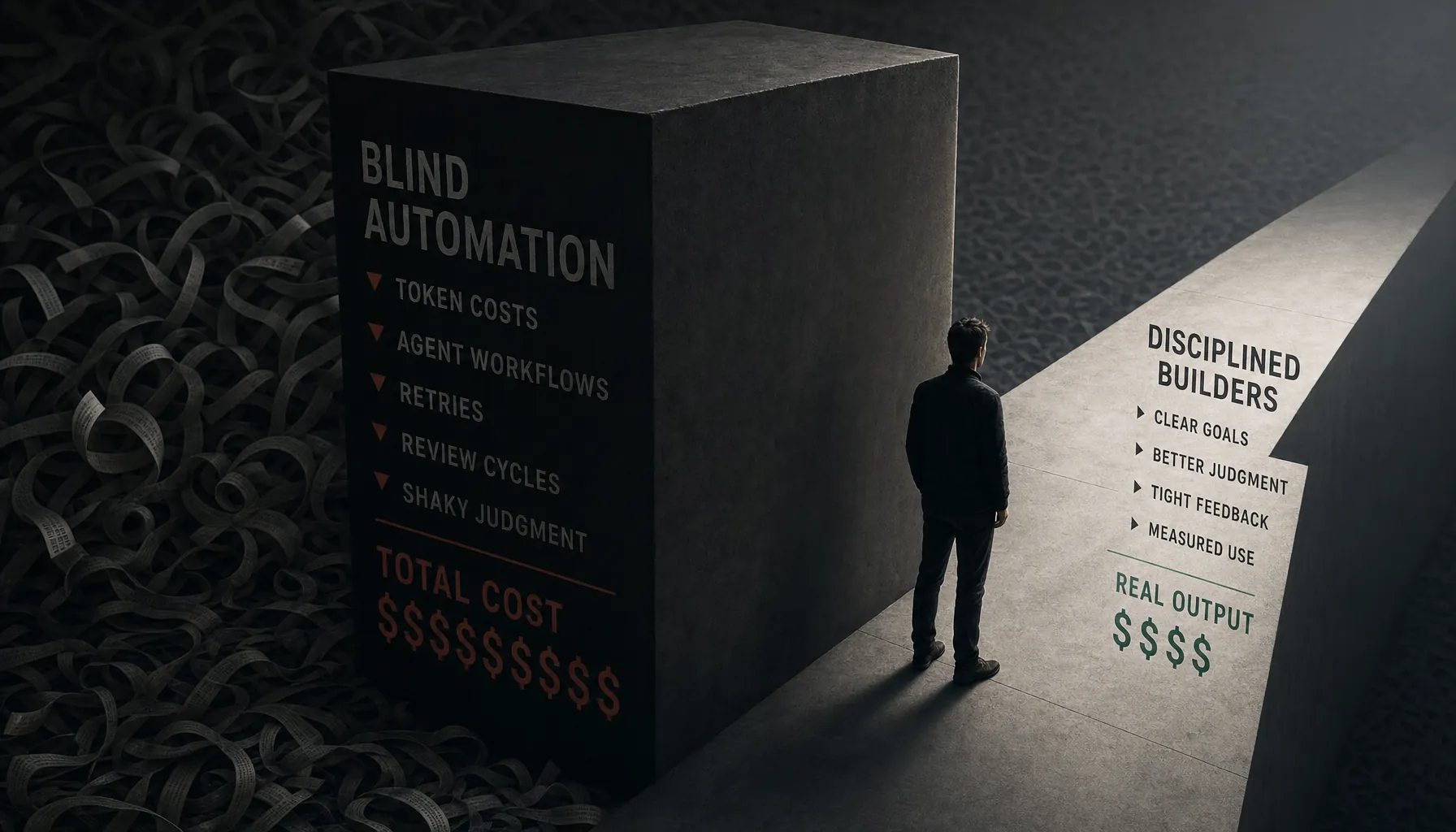
A 200-person company can cut a six-figure salary and still spend six figures on AI if agentic workflows rely on long context windows, retries, review loops, and monitoring without cost controls.
That is the real AI cost vs employees problem in 2026. AI is not simply cheaper labor. It can reduce work, create more of it, or hide it inside token bills and review queues that never connect to actual output.
Key Takeaways
-
AI cost vs employees is a workflow comparison, not a salary-versus-subscription comparison. It must include inference, orchestration, review, rework, security, monitoring, and management time.
-
Token pricing changes cost behavior. Vendors such as OpenAI, Anthropic, and Google Cloud Vertex AI use metered pricing, so costs rise or fall based on workflow design.
-
Agentic systems can burn more money than expected. Planning loops, tool calls, retrieval, memory, retries, and validation can turn one task into many model calls.
-
Weak human judgment gets expensive fast. The people approving, correcting, and constraining AI often determine whether automation saves money or creates hidden rework.
-
High-output builders are the scalable advantage. They use AI to compress cycle time, cut waste, and increase measurable output rather than inflate usage metrics.
AI Cost vs Employees: Compare Workflow Cost, Not Tool Cost
AI cost vs employees should be measured at the workflow level: total AI spend plus human review, integration, governance, and rework, compared with the cost and output of the employee or team being replaced. Comparing salary to model subscriptions misses the fact that AI usage scales with every prompt, retry, document, tool call, and failed handoff.
Payroll is visible. Token usage is scattered across prompts, QA, legal review, support escalations, and manager time. Companies may see lower headcount and higher software bills without knowing whether output improved.
According to the U.S. Bureau of Labor Statistics Employer Costs for Employee Compensation, labor costs include far more than wages. That can make automation look attractive. But AI has its own loaded cost structure. As shown in OpenAI API pricing, Anthropic API pricing, and Google Cloud Vertex AI generative AI pricing, production usage is typically metered by input, output, model class, context length, and related services.
The key mistake is treating AI as cheaper labor instead of what it is: a variable-cost production system. A strong employee costs money even when idle. AI costs money when used, which rewards teams that know when not to call the model.
The Three Ledgers of AI Cost
AI cost has three ledgers: inference, orchestration, and judgment.
-
Inference: model usage, including input and output tokens, embeddings, and model-tier pricing.
-
Orchestration: retrieval, vector databases, workflow engines, observability, tool calls, authentication, and fallback systems.
-
Judgment: the human layer that decides what to automate, reviews outputs, corrects mistakes, handles edge cases, and stops bad automation.
Most companies budget for inference and discover orchestration and judgment after launch. The best builders squeeze all three by using smaller models when possible, limiting context, applying retrieval only when needed, and evaluating outcomes rather than activity.
Why Token Pricing Breaks AI Cost vs Employees Math
Token pricing breaks replacement math because the bill depends on how work is structured, not just how much work exists. The same task can cost pennies or dollars depending on model selection, context size, output length, retrieval design, and retry behavior.
In production, token economics behave more like cloud infrastructure than software seats. A customer support workflow that reads long histories, retrieves policy, drafts a response, checks compliance, and retries after failures is not one query. It is a chain.
According to vendor pricing documentation from OpenAI, Anthropic, and Google Cloud, enterprise AI bills vary by model, token direction, and platform services. Architecture shapes the bill.
A Simple Token Cost Scenario
A realistic AI cost estimate starts with workload volume. In a support workflow, if each ticket consumes 12,000 input tokens and 2,000 output tokens across the chain, then 50,000 tickets per month means roughly 600 million input tokens and 100 million output tokens before retries, monitoring, or escalation.
This is not a vendor quote; it is a budgeting method. Plug in current rates, then add retry rates and human review time. If the workflow retries 20% of cases and sends 15% to human review, the real cost is far above the base token estimate.
Agentic Workflows Inflate AI Cost vs Employees
Agentic workflows increase AI cost because agents do not just answer. They plan, call tools, inspect results, revise, and try again. That can replace some coordination work when tasks are bounded and acceptance criteria are clear. Without those conditions, the agent mainly spends money.
This is why agentic AI costs need a different operating model. A chatbot has a visible exchange. An agent has a loop, and loops are where budgets disappear.
How to Control Agent Cost
Agent cost control depends on explicit boundaries:
-
maximum steps
-
maximum context
-
allowed tools
-
escalation rules
-
acceptance tests
Good operators cap tool calls, use cheaper models for routing and classification, reserve expensive models for judgment-heavy steps, cache repeated context, and stop the agent when confidence is low. They log cost per completed task, not cost per model call.
AI systems often fail financially before they fail technically. They can look useful while producing work at a worse unit cost than the team they replaced.
AI Replacement Fails When Judgment Is Weak
AI replacement fails when companies remove the humans who understood the work and keep the humans who only understand the tool. The model generates options; judgment decides what is valid, safe, useful, and worth shipping.
Companies often cut a coordinator, analyst, support lead, or junior developer because AI can produce drafts. Then the remaining team spends its time correcting bad drafts, rebuilding context, explaining exceptions, and handling escalations. The salary disappears. The work does not.
According to the National Institute of Standards and Technology AI Risk Management Framework, AI risk management depends on governance, mapping, measuring, and managing system behavior. In practice, that means someone must define what the system is allowed to do, what failure looks like, and when a human steps in.
The judgment gap is expensive because AI output is often fluent enough to pass a quick scan but wrong enough to damage the work. That matters in code, hiring, support, compliance, finance, and content. AI scales bad judgment just as effectively as good judgment.
Rehiring after AI-driven cuts is often a signal that the original replacement math missed hidden work such as review, coordination, exception handling, and domain judgment.
High-Output Builders Are the Scalable Advantage
High-output builders make AI cheaper by turning it into throughput instead of noise. They ship measurable work, reduce cycle time, and cut waste by deciding when AI should act, when it should stop, and when a human should take over.
Two people with the same title and access to the same tools can produce radically different results. One creates more drafts. The other ships better work faster.
Usage Is Not Productivity
AI usage is not productivity. Prompts, tokens, and drafts are activity metrics. Productivity means shipped work, quality maintained or improved, cycle time reduced, and cost per useful output kept under control.
According to Stanford University’s AI Index Report, AI capability and adoption continue to expand, but adoption alone does not prove realized value. According to McKinsey’s State of AI research, value capture varies widely depending on how deeply AI is embedded into workflows and management practices.
The metric that matters is output per dollar of total workflow cost.
The Builder Profile That Matters
The builder profile that matters in 2026 combines domain judgment, AI fluency, measurement discipline, and proof of shipped work. Strong candidates bring artifacts, not claims.
A strong AI portfolio shows the problem, workflow, constraints, output, and decision record. Weak portfolios show screenshots of chat outputs. Strong ones show evaluation rubrics, cost caps, test cases, rejected outputs, model-selection notes, latency targets, customer impact, and final shipped work.
How to Compare AI Cost vs Employees Before Cutting Headcount
The right way to compare AI cost vs employees is to model the full workflow before making staffing decisions. That model should include current employee output, AI unit cost, review time, error rates, escalation load, and the value of work shipped.
-
Define the workflow outcome in business terms, such as resolved tickets, qualified leads, merged pull requests, or reconciled invoices.
-
Measure current employee cost per accepted output using loaded labor cost, management time, software, rework, and quality review.
-
Map AI workflow steps including model calls, retrieval, tool use, validation, fallback, human review, and escalation paths.
-
Estimate token and platform usage from realistic input size, output size, task volume, retry rate, model tier, and context requirements.
-
Add human judgment cost by measuring review minutes, correction time, approval bottlenecks, and expert escalation.
-
Run a constrained pilot with step limits, cost caps, routing rules, and clear acceptance criteria.
-
Compare cost per accepted output against the employee baseline.
-
Keep or hire builders where judgment changes the outcome and automate only the parts that reduce cost without lowering trust.
The Workflow Cost Model
Total AI workflow cost = model usage + platform costs + orchestration costs + human review + rework + risk controls.
Cost per accepted output = total workflow cost / accepted outputs that meet the quality bar.
Accepted output is what matters. A generated answer that cannot be sent, a code suggestion that fails review, or a ranking system that managers do not trust is not output. It is work in process.
When AI Actually Beats Employee Cost
AI beats employee cost when the task is frequent, bounded, measurable, tolerant of automation, and cheap to verify. It struggles when work depends on ambiguous judgment, fast-changing context, or errors that are expensive to clean up.
-
Good candidates for automation: high-volume classification and other tasks where humans mainly handle exceptions.
-
Better for AI assist than replacement: customer response drafting, software development, research synthesis, and other workflows where verification and judgment remain significant.
-
Usually human-owned approval: legal, compliance, and financial judgment, where AI is more useful for retrieval and summarization than final decisions.
The common thread is verification cost. If AI output is cheap to verify, automation can scale. If verification requires the same expert the company removed, the savings are fragile.
Human-in-the-Loop Teams Scale Better Than Blind Automation
Human-in-the-loop AI teams scale better when humans sit at judgment points, not every step. The goal is not to keep humans everywhere. It is to place them where their decisions materially change cost, quality, or risk.
A bad design turns people into tired proofreaders. A good design routes only meaningful uncertainty to humans: low-risk tasks pass automatically after validation, medium-risk tasks are sampled, and high-risk cases go to a builder with domain judgment.
The review trap happens when AI increases the volume of work faster than humans can evaluate it. The fix is not more review but better gates: structured outputs, citations, confidence thresholds, deterministic checks, failure limits, and workflow-level approval tracking.
The best AI teams look less like replacement factories and more like small operating teams with high-quality builders.
Hiring for AI Discipline: Proof Beats Credentials
Hiring for AI discipline requires evidence that a candidate can turn AI into accepted output under constraints. Credentials do not show that. Work samples do.
The strongest interview signals are decision artifacts: tradeoffs, constraints, failures, and measured outcomes. Ask candidates to walk through a real AI-assisted project and explain the baseline, what was automated, what was left manual, what choices were made, what outputs were rejected, how quality was measured, and what changed after failure.
Companies should stop rewarding AI theater: long tool lists, inflated prompt libraries, vague automation claims, and dashboards that show activity without accepted output. AI made surface polish cheap. It made proof more valuable.
Where should operators and builders go deeper next?
This hub covers the cost model. The supporting pages go deeper on token economics, agent spend control, productivity measurement, replacement risk, and the proof that gets builders hired.
Use this section as a map. Pick the page that matches the decision in front of you.
| If your question is... | Read next |
|---|---|
| Why do agent workflows cost more than chat? | agentic AI costs |
| How do agents and chatbots compare on cost? | AI agents vs chatbots cost |
| Why do agents consume so many tokens? | why AI agents use so many tokens |
| Why is our token bill so high? | why are AI token costs so high |
| How do I cut agent token usage? | reduce AI agent token usage |
| How do I estimate cost for my team? | AI token cost estimate |
| How should a small team budget tokens? | AI token budget for startups |
| How do I forecast spend for 2026? | AI token costs 2026 |
| Should we replace this role with AI? | replace employees with AI |
| What costs stay hidden after a replacement? | AI replacing employees |
| Why do deep AI-driven cuts fail? | AI headcount cuts |
| Where should humans sit in the workflow? | human in the loop AI teams |
| Why is usage not productivity? | AI productivity vs usage |
| Which metrics prove real output? | AI productivity metrics for builders |
| What separates activity from output? | AI use vs AI output |
| What does AI judgment look like day to day? | AI judgment examples |
| How do builders show judgment on the job? | AI judgment at work |
| How do I show judgment in a portfolio? | show AI judgment in a portfolio |
| What should an AI portfolio contain? | AI portfolio examples for builders |
| What proof do hiring managers trust? | AI skills in hiring |
| How do I prove this in an interview? | prove AI skills in an interview |
| Which roles hire for this skill set? | AI builder jobs |