
AI Skills in Hiring: Proof Managers Trust - Provn
Hiring managers don’t treat AI experience like a resume keyword anymore. They want to see actual work: artifacts, judgment calls, before-and-after output, cost awareness, and things you’ve shipped.
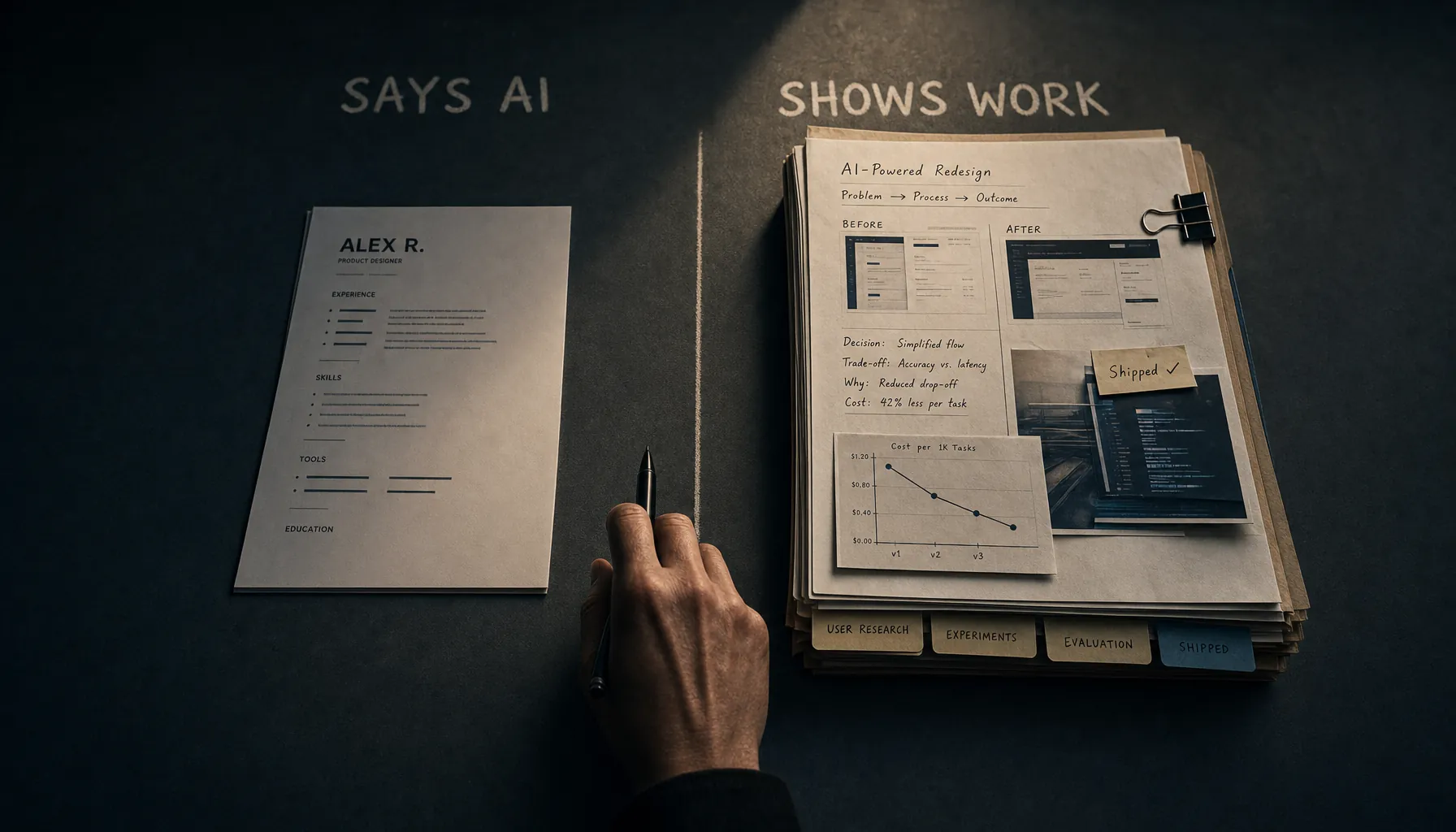
AI Skills in Hiring: What Managers Now Need to See
Microsoft’s 2024 Work Trend Index found that 75% of knowledge workers already use AI at work. At that point, “I use AI” stops meaning much on a resume. AI skills in hiring now means proof: artifacts, judgment, before-and-after output, cost awareness, and shipped work a manager can actually inspect.
In practice, AI skills in hiring means using AI systems to produce better work faster, with human judgment still visible. Hiring managers want evidence that a candidate can frame a task, pick the right tool, verify output, control cost, protect data, and ship something people can use.
Key Takeaways
Hiring managers have moved from asking whether candidates use AI to asking what AI helped them ship. The signal is no longer tool familiarity. It is work quality under real constraints.
- AI claims are now everywhere: according to Microsoft’s 2024 Work Trend Index, 75% of knowledge workers use AI at work.
- The strongest evidence is a proof stack: project artifacts, before-and-after output, decision logs, error checks, cost controls, and shipped results.
- Managers care more about AI judgment than prompt jargon: they want to see when a candidate accepted, rejected, edited, or boxed in model output.
- Cost awareness matters because AI work gets expensive fast at scale. Candidates who understand usage, review loops, and workflow waste usually sound a lot more like operators and a lot less like tool tourists.
- A credible AI portfolio should show process, not just polish: raw inputs, tool choices, rejected paths, evaluation criteria, and the final business result.
AI Skills in Hiring: The Standard Moved From Claims to Evidence
AI skills in hiring are now judged the way technical skills should have been judged all along: by work samples. A candidate who can show the artifact, the decision process, and the shipped result is easier to trust than someone who lists ten tools and hopes that does the job.
The market changed quickly. According to Stanford University’s 2025 AI Index Report, organizational AI use kept spreading across business functions after generative AI became widely available. According to the World Economic Forum’s Future of Jobs Report 2025, AI and big data are among the fastest-growing skill areas employers expect workers to need.
That creates a hiring problem. When every resume says “AI-assisted workflows,” the phrase stops filtering anything. Recruiters are buried in noise. Managers need a better question: did this person use AI to create something that survived contact with reality?
That is where proof beats polish. A polished resume can say a candidate automated reporting. A proof package can show the old reporting process, the new workflow, the checks used to catch hallucinations, the time saved, the cost of the system, and the final dashboard or memo people actually used.
This follows Provn’s broader view of hiring: performance over pedigree, proof over polish. The useful signal is not that someone has touched ChatGPT, Claude, Gemini, GitHub Copilot, or some agent layer with a clever name. The useful signal is that they used AI to make work better without handing judgment over to the model.
What Hiring Managers Look For in AI Candidates Now
Hiring managers want evidence that a candidate can turn ambiguous work into usable output with AI in the loop. The strongest candidates show task framing, tool selection, verification, iteration, and delivery.
The pattern is pretty simple. Weak candidates talk about prompts. Strong candidates talk about systems. They can explain the problem, the constraint, the model’s role, the human review step, the failure mode, and the final outcome.
| Hiring signal | Weak evidence | Strong evidence |
|---|---|---|
| Tool familiarity | “Used ChatGPT for research.” | Compared two models for summarization accuracy, documented error types, and selected the cheaper workflow for repeat use. |
| Output quality | Shows a polished final deck. | Shows the original brief, AI-generated draft, edits, fact checks, and final version. |
| Judgment | Claims the model saved time. | Shows three model outputs rejected because they missed context, invented facts, or violated brand constraints. |
| Cost awareness | Uses the most powerful model for every task. | Routes simple classification work to cheaper tools and reserves higher-cost models for synthesis or reasoning. |
| Shipping ability | Built a prototype. | Deployed a workflow that a team used for two months, with logged changes and measurable output. |
The distinction matters because AI fluency is not the same as AI productivity. Someone can use AI all day and still produce weak work. For the measurement side of that problem, Provn’s related analysis on AI productivity vs usage explains why usage counts are weak evidence unless they connect to output quality, cycle time, or revenue impact.
The best managers ask for traceability. They want to know what the candidate did before the model entered the workflow, what the model changed, and what the candidate did after. If the human contribution disappears from the explanation, the claim gets a lot weaker.
The Proof Stack: Artifacts, Output, Judgment, Cost, and Shipping
A credible AI skills claim needs five layers of evidence: artifacts, before-and-after output, judgment calls, cost awareness, and shipped results.
Most portfolios stop at the final output. That is a mistake. Final output is the easiest part to fake because AI can make mediocre work look finished. Process is harder to fake, and managers know it.
Project artifacts show the work, not the slogan
Project artifacts are the raw materials that prove a candidate actually built the thing. That includes briefs, datasets, prompts, workflow diagrams, evaluation notes, pull requests, recorded demos, dashboards, and version history.
A hiring manager should be able to inspect the artifact trail and understand what happened. For a marketing operations project, that might mean the original campaign data, the AI-assisted segmentation logic, the QA checklist, and the final email performance report. For a software project, it might mean the issue ticket, Copilot-assisted commit history, test failures, review comments, and the production change log.
The artifact does not need to be pretty. Honestly, rough evidence is often more convincing than a polished case study. A screenshot of a prompt is less useful than a decision log showing why the prompt changed. A GitHub repository is also less useful if it has no README, no tests, and no explanation of what AI generated versus what the candidate wrote.
Before-and-after AI output proves improvement
Before-and-after output shows whether AI improved the work or just sped up mediocre work. Managers need to see the baseline because speed without quality is not a hiring advantage.
A strong before-and-after comparison has four parts:
- Baseline: what the work looked like before AI entered the workflow.
- Intervention: which AI tool or workflow changed the process.
- Result: what improved, such as cycle time, accuracy, coverage, conversion, or maintainability.
- Verification: how the candidate checked that the improvement was real.
For example, “reduced customer support tagging time” is thin. “Reduced average ticket triage time from 6 minutes to 2 minutes across 400 tickets, while keeping human review for refunds and legal complaints” is much stronger. The second version shows volume, constraint, workflow design, and risk control.
Judgment calls matter more than prompts
AI judgment means knowing when the model is useful, when it is wrong, and when the task should stay human. Managers trust candidates who can explain rejected outputs as clearly as successful ones.
This is where a lot of candidates fall apart. They show the answer, not the reasoning. They cannot explain why one model was chosen over another, why a hallucinated citation was caught, why a draft was rewritten, or why a workflow needed human review.
According to the National Institute of Standards and Technology’s AI Risk Management Framework, trustworthy AI systems are evaluated across characteristics such as validity, reliability, safety, security, accountability, transparency, explainability, privacy, and fairness. A candidate does not need to recite the framework like they are cramming for a certification exam. But the best candidates act like they understand it: they test, verify, document, and constrain.
Provn covers this skill in more detail in AI Judgment at Work: Examples and Evaluation Criteria. The short version is simple: judgment shows up when the candidate can identify failure modes before a manager has to ask.
Shipping is the difference between a demo and work
Shipped AI work has users, constraints, feedback, and maintenance. A demo proves curiosity. Shipped work proves someone can operate.
Managers know prototypes are cheap now. A candidate can generate a landing page, chatbot, dashboard, or data app in a weekend. Useful, sure. Not enough. The real question is whether anyone used it, whether it handled bad inputs, whether it saved time after the novelty wore off, and whether the candidate improved it after feedback.
A shipped AI project should include usage evidence. That can be a Loom walkthrough, analytics screenshot, GitHub release history, internal adoption note, customer quote, or a simple weekly usage table. The format matters less than the fact that the work left the sandbox.
How to Document AI Work Samples for Hiring Managers
A strong AI work sample should let a manager evaluate the candidate in five minutes and go deeper in fifteen. The document should separate the business problem, AI workflow, human judgment, measurable result, and artifacts.
The best format is a short case file. Not a glossy portfolio page. Not a wall of screenshots. A case file gives the manager enough structure to verify the claim without guessing what the candidate actually did.
- Define the original problem in one sentence, including the user, workflow, or business constraint affected.
- Show the baseline process with time, cost, quality, or error metrics where available.
- Name the AI tools used and explain why each tool fit the task.
- Include the key prompt, workflow diagram, code sample, or automation logic that changed the work.
- Mark which parts were generated by AI and which parts were written, reviewed, or changed by you.
- Document at least two judgment calls, including one AI output you rejected or rewrote.
- Report the final result with measurable evidence such as time saved, accuracy improved, revenue influenced, or users served.
- Attach artifacts a manager can inspect, such as a demo, repository, anonymized dataset, version history, or before-and-after comparison.
- Remove confidential employer, customer, or personal data before sharing the work sample.
Confidentiality is not a footnote. It is part of the evaluation. A candidate who shares private customer data to prove AI skill sends a different signal entirely: poor judgment. Use synthetic data, anonymized samples, redacted screenshots, or a rebuilt public version of the workflow.
Security matters too. According to the OWASP Top 10 for Large Language Model Applications, common LLM application risks include prompt injection, sensitive information disclosure, supply chain issues, and excessive agency. A hiring manager does not expect every candidate to be a security engineer. They do expect a builder to know that AI workflows can leak data, follow malicious instructions, or take actions beyond the intended scope.
The operational test is simple: could this candidate be trusted near real systems? A clear work sample answers yes by showing not only what was built, but how the risk was contained.
AI Project Portfolio Examples That Separate Builders From Talkers
The best AI portfolio examples connect a real workflow to a measurable improvement. They are specific enough that a manager can picture the candidate doing similar work on the team.
A portfolio should not be a museum of prompts. It should be a record of shipped judgment. Different roles need different evidence, but the pattern stays the same: show the work before AI, show the workflow with AI, show the human review, and show the result.
| Role | Strong AI project | Proof a manager wants |
|---|---|---|
| Product manager | Customer feedback synthesis pipeline for 1,200 support tickets | Taxonomy, sample tickets, model error review, roadmap changes, time saved by product team |
| Software engineer | AI-assisted refactor with test coverage improvement | Pull requests, test results, rejected suggestions, performance benchmarks, reviewer comments |
| Sales operations | Lead enrichment and prioritization workflow | Source data, scoring logic, CRM update rules, false positive review, conversion impact |
| Content strategist | AI-assisted content refresh process for decaying pages | Original pages, query data, editing rules, fact-check log, traffic or conversion change |
| Finance analyst | Variance explanation draft system for monthly reporting | Input statements, prompt template, review checklist, error log, reporting cycle time |
Notice what these examples do not rely on: a certificate, a course badge, or a list of tools. Those things can support the story, but they cannot carry it.
The stronger pattern looks more like a builder portfolio. A candidate shows the thing, the constraints around it, and the scar tissue from getting it to work. For more examples focused on builder hiring, Provn’s related page on AI builder jobs covers what a portfolio needs when the role involves making AI useful inside a team.
AI Cost Awareness Is Now a Hiring Signal
AI cost awareness shows whether a candidate understands work at scale. A workflow that looks cheap in a demo can get expensive quickly when it runs across thousands of documents, tickets, calls, or code files.
This does not mean every candidate needs to be a finance lead. It means they should understand the basic mechanics: model calls, input size, output size, retries, evaluation runs, human review, and tool subscriptions all affect cost. According to OpenAI’s API pricing page, API usage is commonly priced by input and output tokens, and pricing varies by model. Other providers use their own pricing structures, but the practical point is the same: scale changes the economics.
Cost-aware candidates ask better questions. Does the workflow need the most capable model, or can a cheaper model classify first and escalate the hard cases? Should the system summarize every document, or retrieve only the relevant sections? Should an agent be allowed to run multiple tool calls, or should a human approve expensive actions?
That is why cost belongs in AI skills in hiring. The candidate who can ship with AI and control waste is more valuable than the candidate who produces impressive demos by spending freely and calling it strategy.
For the broader economics, the cluster pillar on AI cost vs employees explains why blind automation can cost more than skilled human work. For deeper budgeting mechanics, see AI Token Costs (2026): Pricing Forecasts and Budget Controls and Agentic AI Costs (2026): Token Usage and Workflow Controls.
Common Mistakes Candidates Make When Claiming AI Experience
The most common AI hiring mistake is confusing exposure with competence. Hiring managers can usually tell when a candidate has used AI casually but has not shipped with it under constraints.
The first mistake is tool listing. “ChatGPT, Claude, Gemini, Midjourney, Copilot” reads like a software inventory. It says nothing about quality. A better resume bullet names the workflow and result: “Built AI-assisted refund categorization workflow for 3,000 monthly tickets; reduced manual tagging time by 40% while preserving human review for policy exceptions.”
The second mistake is hiding the human role. Some candidates think AI experience sounds stronger if the model did more. Most managers read that the opposite way. If the candidate cannot explain their own judgment, the manager cannot evaluate them.
The third mistake is ignoring failure. Real AI work has bad outputs, bad assumptions, prompt drift, formatting errors, tool limits, privacy constraints, and user resistance. A candidate who can explain how a workflow failed and what changed afterward sounds more credible than someone who presents the project as smooth and frictionless.
The fourth mistake is treating AI replacement as strategy. Companies that cut people before they understand workflow cost, review burden, and quality risk often discover the missing work later. Provn’s related analysis on AI replacing employees covers the rehiring signals that show up when automation removes capacity without preserving judgment.
The fifth mistake is bringing confidential work into the interview. Do not share private prompts, customer files, unreleased product plans, internal financials, or source code you are not allowed to disclose. Rebuild the project with public or synthetic data and explain what was changed. That shows both skill and discretion.
A Hiring Manager Scorecard for AI Skills
A practical AI hiring scorecard should separate talk from proof. The best scorecards evaluate output quality, workflow design, judgment, risk control, and measurable impact.
This matters because generic AI interview questions reward fluency. “How do you use AI?” invites a rehearsed answer. “Show me a project where AI changed the workflow, and walk me through the artifacts” gets you evidence.
| Category | Question to ask | Strong answer | Weak answer |
|---|---|---|---|
| Problem framing | What was the original workflow? | Names user, constraint, baseline, and why AI was useful. | Starts with the tool rather than the problem. |
| Model fit | Why this tool? | Explains tradeoffs in accuracy, speed, cost, privacy, or integration. | “It was the tool I knew.” |
| Evaluation | How did you check output? | Uses review samples, test sets, benchmarks, human QA, or error logs. | “It looked right.” |
| Judgment | What did AI get wrong? | Gives specific rejected outputs and explains the correction. | Cannot name a failure case. |
| Impact | What changed after shipping? | Reports measurable output, adoption, cycle time, or quality change. | Only says the project was interesting. |
The scorecard works for candidates too. Before an interview, assemble evidence for each row. If a project cannot answer these questions, it may still be useful experience, but it is not strong hiring proof yet.
For candidates preparing for live evaluation, Provn’s related page on proving AI skills in an interview focuses on work samples and judgment signals inside the interview itself. This page covers the broader hiring standard: what managers need to see before they trust the claim.
Frequently Asked Questions
What are AI skills in hiring?
AI skills in hiring are the measurable abilities that show a candidate can use AI to improve real work. Hiring managers look for task framing, tool selection, output verification, judgment, cost awareness, data handling, and shipped results rather than simple tool familiarity.
How can candidates prove AI experience without exposing confidential work?
Candidates can use anonymized screenshots, synthetic datasets, public examples, rebuilt workflows, redacted artifacts, and recorded demos. The goal is to show the process and judgment without sharing employer data, customer information, private code, internal prompts, or unreleased business plans.
Do hiring managers care more about AI tools or AI outcomes?
Hiring managers care more about outcomes. Tool knowledge helps, but a candidate who can show better cycle time, higher accuracy, reduced manual work, safer review steps, or shipped output has stronger evidence than a candidate who only lists the tools they used.
What AI portfolio evidence is most convincing in 2026?
The most convincing AI portfolio evidence includes before-and-after output, workflow diagrams, prompt or automation logic, evaluation notes, rejected model outputs, cost assumptions, usage data, and a final shipped artifact. The strongest examples show how human judgment changed the AI-generated result.
Should non-technical candidates show AI skills differently from engineers?
Yes. Non-technical candidates should show AI applied to workflows such as research, analysis, operations, sales, support, finance, or content production. Engineers should include repositories, pull requests, tests, benchmarks, architecture notes, and review history. Both groups need evidence of judgment and shipped work.