
AI Token Cost Estimate: Team Budget Framework
A clear way to turn AI token usage into team budget estimates across people, tools, prompts, agents, and review cycles.
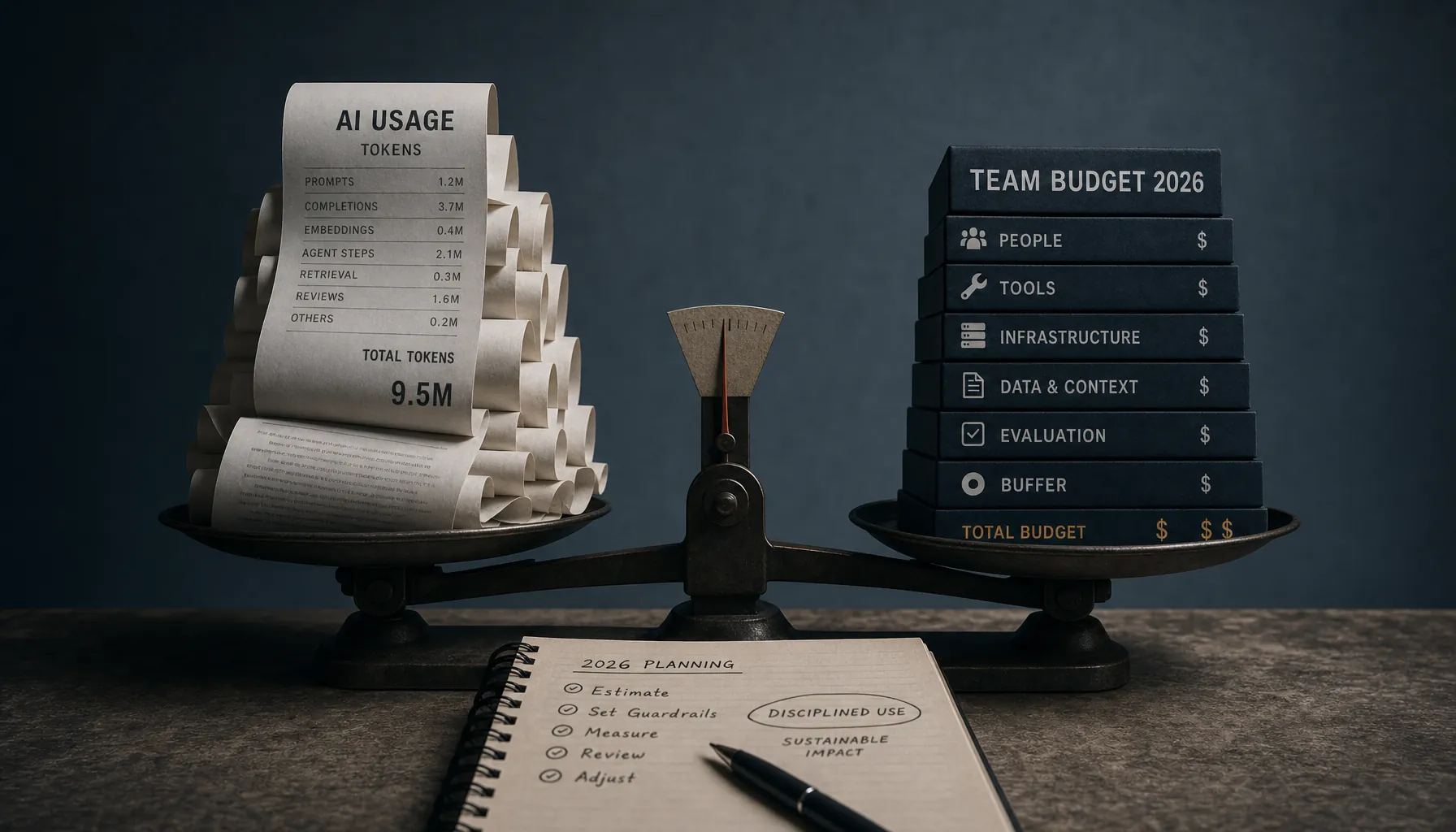
OpenAI, Anthropic, Google, and AWS charge for major AI models by token volume. So an AI token cost estimate is really a usage model, not a SaaS subscription line on a spreadsheet.
The mistake most teams make is treating AI spend like an individual productivity expense: one employee, one seat, one monthly fee. That misses where the money actually goes. Team AI spend comes from repeated prompts, long context windows, tool calls, agent retries, and human review loops.
This article lays out a simple way to estimate AI spend across those moving parts before usage spreads across a team and finance has to reverse-engineer the bill later.
Key Takeaways
- An AI token cost estimate should model input tokens, output tokens, retries, agent steps, and review loops separately.
- According to OpenAI's tokenizer documentation, one token is roughly four characters of English text, though token counts vary by language and content type.
- Vendor prices usually separate input and output tokens; according to Anthropic's Claude pricing documentation, cached inputs, fresh inputs, and outputs may carry different rates.
- Agents often cost more than chat because they generate hidden intermediate steps: planning, tool calls, memory reads, retrieval, and self-correction.
- The best budget forecast is built per workflow, not per person: support triage, code review, research, recruiting, analysis, and sales writing each have different token shapes.
AI Token Cost Estimate: The 5-Part Formula
An AI token cost estimate is the expected cost of model usage based on input tokens, output tokens, model price, frequency of use, and workflow overhead. The version that helps in the real world gets calculated at the workflow and team level, because shared agents, review cycles, and retries often cost more than the original prompt.
The basic formula is:
Monthly AI token cost = ((input tokens × input price) + (output tokens × output price)) × workflow runs × overhead multiplier
The overhead multiplier is where the clean spreadsheet meets real work. A single prompt rarely stays single once a team gets involved. Someone asks for a draft. Then a rewrite. Then a fact check. Then a shorter version. Then somebody pastes the same work into another tool because they do not trust the first answer.
For a basic chat workflow, the multiplier might be 1.2 to 1.8. For an agentic workflow, it can be 3 to 10, depending on tool calls and failed attempts. For more on those workflow-specific cost drivers, see Provn's supporting piece on Agentic AI Costs (2026): Token Usage and Workflow Controls.
| Cost variable | What it means | Why teams undercount it |
|---|---|---|
| Input tokens | User prompt, system instructions, documents, chat history, retrieved context | Long context gets resent or retrieved repeatedly |
| Output tokens | The model's generated answer, code, summary, plan, or analysis | Outputs are often longer than the original prompt |
| Workflow runs | How often the task happens per user or team | Daily habits spread faster than budget owners notice |
| Retries | Regenerations, corrections, failed tool calls, alternate drafts | Bad prompts make the same task run multiple times |
| Review loops | Human checks, second-model reviews, QA passes | Review gets treated as governance instead of cost |
According to OpenAI's API pricing page, model costs are published per token volume and vary by model tier. According to Google's Gemini API pricing page, pricing can also vary by model, context length, and input type. That is why the formula matters more than any neat benchmark somebody posts on LinkedIn.
How to Estimate AI Token Costs for a Team
The right way to estimate AI token costs for a team is to inventory workflows, measure sample token counts, apply vendor rates, and then add an overhead factor for retries, agents, and review. Seat count is a weak proxy unless every person uses AI in exactly the same way, which almost never happens.
Use this sequence before approving a broad rollout:
- List the five workflows where AI is already being used or is likely to spread first.
- Capture 10 real examples from each workflow, including prompts, source material, outputs, and retries.
- Measure input and output tokens with the vendor tokenizer or usage logs.
- Apply the current input and output token prices from the selected model provider.
- Multiply by expected monthly workflow volume rather than number of employees alone.
- Add an overhead multiplier for regenerations, retrieval, tool calls, memory, and human review.
- Set a budget threshold per workflow and review actual usage every two weeks during rollout.
The key move is sampling real work. A recruiting sourcer using AI to summarize 40 candidate profiles has a different cost pattern than an engineer asking for code review on a 900-line file. A customer support team using AI on every ticket has a different cost curve again.
For broader budget comparison against labor and operating spend, Provn's pillar analysis on AI cost vs employees covers the larger headcount tradeoff. This page stays narrower: estimating token cost before the invoice does it for you.
Prompt and Output Size: The Quiet Budget Driver
Prompt length matters, but output length often matters more because premium models commonly price output tokens higher than input tokens. A short instruction that produces a long report can cost more than a long prompt that produces a tight classification.
According to OpenAI's tokenizer documentation, token counts are not the same as word counts. English text often averages around one token per four characters, but code, tables, non-English text, and structured data tokenize differently.
That matters in team budgeting. A product manager asking for a one-page summary may spend little. The same manager asking for 12 alternative go-to-market plans, each with tables, objections, and implementation steps, is buying a much larger output.
| Workflow | Typical token shape | Budget risk |
|---|---|---|
| Short classification | High input, tiny output | Usually predictable |
| Research synthesis | High input, high output | Context length and citations expand cost |
| Code review | Very high input, medium output | Large files get resent across iterations |
| Content generation | Medium input, high output | Draft variants inflate output tokens |
| Support agent | Medium input repeated often | Volume and retries dominate |
This is where prompt discipline turns into budget discipline. Shorter prompts are not always cheaper if they produce vague outputs that need five regenerations. The better target is complete context, a narrow output format, and a clear stopping condition.
Agents and Review Loops: Where Token Estimates Break
Token estimates usually break when a workflow stops being a single request and turns into a loop. Agents add planning steps, retrieval calls, tool outputs, memory reads, self-evaluation, and retries before a human sees the result.
A chat request is visible. An agent run is layered. It may read a document, plan the task, call a search tool, inspect the result, revise the plan, call a database, write a draft, check the draft, and then produce an answer. Every step can add input and output tokens.
According to Amazon Bedrock pricing, model usage is billed based on input and output tokens for many supported foundation models, with pricing varying by provider and model. According to Google Cloud Vertex AI generative AI pricing, grounding, tuning, context, and model selection can affect cost structure. The invoice follows the architecture, not your intention.
The practical rule is simple: estimate agents as workflows, not prompts. If an agent handles 2,000 support tickets a month and averages four model calls per ticket, the budget unit is not 2,000. It is 8,000 model calls, plus review and exception handling.
Teams planning higher-autonomy systems should read Provn's piece on Human-in-the-Loop AI Teams: Governance and Scale Models. Review loops are not abstract overhead. They are part of the operating model, and they belong in the token budget.
Team Budget Scenarios: What AI Spend Looks Like in Practice
A usable team estimate starts with scenarios, because token spend varies more by workflow design than by company size. Two 20-person teams can end up with very different AI bills if one uses AI for occasional drafting and the other runs agents inside daily operations.
The table below uses placeholder rates to show the math. Replace them with current vendor prices from official pages before making a budget decision.
| Scenario | Monthly volume | Estimated tokens per run | Overhead multiplier | Budget implication |
|---|---|---|---|---|
| Light internal assistant | 1,000 prompts | 1,500 input + 500 output | 1.3 | Low risk; seat fees may exceed token cost |
| Research and analysis team | 500 reports | 12,000 input + 3,000 output | 1.8 | Context size drives most spend |
| Support triage agent | 10,000 tickets | 2,000 input + 400 output | 4.0 | Volume and retries dominate |
| Engineering code assistant | 2,000 reviews | 20,000 input + 2,000 output | 2.0 | Large files and repeated context create spikes |
The hidden lesson is not that AI is expensive or cheap. It is that averages lie. One team member running a well-designed workflow may produce more value with lower token burn than ten people poking at a chatbot all day.
That is why budget review should be tied to output, not usage alone. Provn covers that distinction in AI Productivity vs Usage: Output Metrics and ROI Signals. High usage is not proof of productivity. Low usage is not proof of discipline. You have to judge the work.
Hiring Signal: Why Token Budgets Reveal Builder Judgment
AI token budgets reveal builder judgment because they show whether someone can design work, not just use tools. The strongest builders cut waste by choosing the right model, narrowing context, constraining outputs, and knowing when a human review is better than another model call.
This matters in hiring. A candidate who says they are “good with AI” has not shown much. A candidate who can show they cut a workflow from six model calls to two while keeping quality intact has real evidence. That is performance over pedigree.
For teams hiring AI-capable operators, token estimates can become part of the work sample. Ask candidates to inspect a messy AI workflow and reduce cost without lowering quality. The strongest answers usually mention context pruning, caching, model routing, evaluation criteria, and failure handling.
Provn's related guide on AI Judgment at Work: Examples and Evaluation Criteria breaks down those signals in more detail. The hiring point is simple: AI fluency is not prompt volume. It is judgment under constraints.
That is also why portfolio proof matters. Builders who can document actual cost, quality, and throughput changes have stronger evidence than candidates listing tools. See AI Skills in Hiring (2026): Portfolio Proof and Interview Signals for how those signals show up in interviews.
Frequently Asked Questions
How do I make an AI token cost estimate for a small team?
Start with five real workflows, measure 10 examples from each, calculate input and output tokens separately, apply the current model prices, and multiply by monthly volume. Add an overhead multiplier for retries, tool calls, and review. Small teams should forecast by workflow because one high-volume agent can cost more than several casual users.
What is the biggest mistake in estimating AI token costs?
The biggest mistake is estimating only the first prompt. Team usage includes copied context, regenerated answers, long outputs, retrieval calls, hidden agent steps, and human review loops. The invoice reflects all model calls, not the clean version of the workflow shown in a demo.
Are output tokens more expensive than input tokens?
Often, yes, depending on the model provider and model tier. Official pricing pages from OpenAI, Anthropic, Google, and AWS commonly list input and output pricing separately. Teams should check current vendor pricing before budgeting because rates and model options change.
Should AI token costs be budgeted per employee or per workflow?
Workflow budgeting is usually more accurate. Per-employee budgeting works for simple chat usage, but it breaks when shared agents, support workflows, code review systems, or research pipelines run across multiple people. The cost driver is repeated work volume, not headcount alone.
How often should a team review AI token spend?
During rollout, review usage every two weeks. Once workflows stabilize, monthly review is usually enough. Teams should compare token spend against output quality, turnaround time, and rework rate rather than treating lower usage as automatically better.