
How recruiters actually screen resumes in 2026
Out of 500 applications, recruiters read 20 to 50. Two talent leaders from Microsoft and IonQ explain how screening works and what gets you into that group.
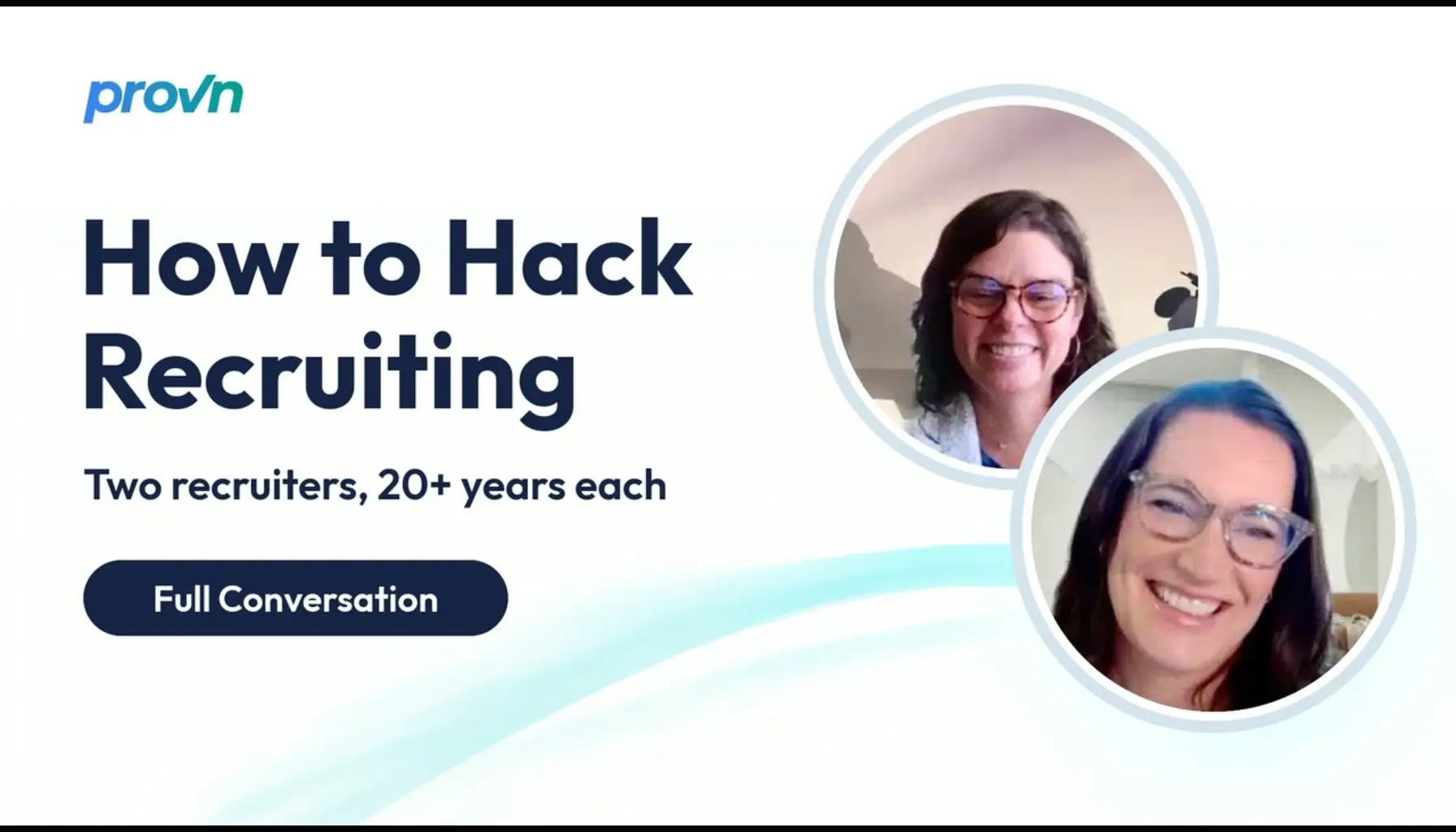
By Niki Parekh, Co-Founder and CEO, Provn · 7 min read

Annie Philipsen
Technical recruiter at IonQ, Blue Origin, Zillow, Trulia and Market Leader.

Abby Arvanitidis
Talent acquisition at PsiQuantum. Previously led talent acquisition at Microsoft and IonQ.
Every candidate I talk to says the same thing. “Get me to the interview and I’ll be fine. I just can’t get past the recruiter.”
So I asked two of the best recruiters I know. Annie Philipsen and I built the New Ventures team at Trulia together. Abby Arvanitidis ran talent acquisition at Microsoft and IonQ and is now at PsiQuantum. Each has 20+ years deciding who gets the call.
Here’s what they told me.
Chapters
- Introductions
- What happens after you apply
- How recruiters scan a resume
- Proof of work
- Referrals
- Microsoft vs. startups
- Getting past the ATS
- AI and fake applicants
- Videos and portfolios
- Speed round
- How they're job hunting
- Audience Q&A
- Visa sponsorship
- Cold emailing
- Salary expectations
In this post
- How long until a recruiter looks at my application?
- How many resumes do recruiters read?
- Does the ATS reject resumes automatically?
- Why are perfect resumes getting rejected?
- What makes a resume stand out?
- What kind of referral helps?
- Does cold emailing recruiters work?
- What do recruiters evaluate in the phone screen?
- How should I answer salary expectations?
- Does visa sponsorship hurt my chances?
- Speed round
- Quick answers
How long until a recruiter looks at my application?
Usually one to two weeks. Recruiters collect resumes, calibrate with the hiring manager, then reach out once three to five candidates look strong.
Annie put it simply: “We’re sitting on it. We’re looking at it. We’re talking about it.” Silence in week one doesn’t mean no.
How many resumes do recruiters actually read?
Fewer than you think. Out of 500 applications, Annie reads about 20. Abby reads 20 to 50.
Big companies are harder. Abby said Microsoft recruiters can carry up to 40 open roles at once. The applicant tracking system (ATS) ranks resumes, and many never get seen by a person. You’re also competing with internal candidates who can call the hiring manager directly.
Apply early. Position matters.
Does the ATS automatically reject resumes?
Mostly through knockout questions. Answer “no” to relocation, work authorization or sponsorship and you can be rejected automatically.
Abby was clear: there’s no secret blacklist scanning your resume. But keywords still matter. If the role’s core requirements aren’t on your resume, you get ranked low.
Why are perfect resumes getting rejected?
Because AI made perfect easy, and fraud followed.
At IonQ, Abby’s team saw near-identical software engineering resumes. Same companies. Same polish. On the phone, candidates wouldn’t turn on their camera, didn’t show up, or recited the company website back.
of applicants for one remote IonQ role matched fraud patterns, based on IP addresses and details that didn’t line up. Once a job is targeted, recruiters stop trusting anything that comes through it.
Fake resumes share a look: a clean run of big-name companies with nothing messy in between. Real careers have startups and odd turns. Keep yours.
Other red flags they named:
- A new job every 12 to 18 months. Annie reads it as “Are you a finisher?”
- No white space. If she can’t find what you did, she moves on.
- “Dear Sir.” Annie is not a sir.
What makes a resume stand out in 2026?
Proof of work. Describe one project end to end, with measurable results, and link to the real thing: GitHub, a portfolio, a project plan.
We’re living in a sea of generic. When you see something specific and tangible, that really sticks out.
Abby Arvanitidis, PsiQuantum, formerly Microsoft and IonQ
I asked them to pick: a Stanford grad with no portfolio, or a no-name-school grad with an amazing one. Both picked the portfolio. Instantly.
Recruiters won’t grade your code. They forward it to the hiring manager. If it’s good, you jump the stack.
Video works too. Annie said a short video of you talking in real time would end her worry that you’re a fake applicant. Abby said it shows how you think before anyone invests an hour in a call. Keep it tight. Hiring managers skip to the middle.
It democratizes somebody being able to show up in a different way and prove something that may be hard to prove on paper.
Abby Arvanitidis, on video walkthroughs
What kind of referral actually helps?
One from someone who has worked with you. A real referral moves you to the top of a 100-person pile. A friend of a friend forwarding your resume doesn’t.
It doesn’t have to be the hiring manager. Anyone inside the company who will vouch for you counts, because they’re putting their reputation on the line. Early in your career, someone who can speak to your character still carries weight.
On timing, they do it differently:
- Abby finds an inside contact before applying, because applying first can weaken the referral. She waits about 24 hours, then applies anyway.
- Annie applies first, then messages the recruiter on LinkedIn: “I’m in your database. Here’s my resume again if helpful.” Make it easy for them.
Does cold emailing recruiters work?
Sometimes. Send it to the talent team, not HR. Messages to hiring managers usually get forwarded to the recruiter.
I pushed back here. We post jobs and get flooded with “Hi, I’m interested” emails. When 100 people send the same note, it’s noise.
Abby’s answer: lead with proof. “I read your job. Here’s a project that shows what I’d bring.” That message is rare. That one stands out.
What do recruiters evaluate in the first phone screen?
Research, curiosity and listening. In the first 15 minutes, Annie checks whether you know what they’re building and whether you had an interesting conversation.
What kills it:
- Saying you’ve applied to 200 jobs. You’re supposed to want this one.
- Leading with “What’s the culture like?” or “What’s the work-life balance?” Abby is softer here, but her point stands. You’re always selling.
- Treating the recruiter as a gate on the way to the “real” interview.
What wins: Annie still remembers a candidate who answered a three-part question with “One, this. Two, this. Three, this.” She had lost track of her own questions. That person got hired.
Abby bets on four traits: curiosity, growth mindset, listening and systems thinking, meaning how you break down a problem and bring people along.
And take the application text boxes seriously. Annie spends about two hours per application and uses Claude to tighten her answers. The thinking still has to be hers.
How should I answer “What are your salary expectations?”
If a range is posted, say you’re comfortable within it. If not, ask about the full package first.
Annie asks what can move and what’s fixed. Abby names a number at the higher end and says it may change as she learns more. Asking for 50% over a posted range wastes everyone’s time.
If the range is below your current pay, Annie’s line works: “The range looks good. It’s lower than where I am today. I hope we can make up the difference in equity.”
Recruiters don’t pick the cheapest candidate. If pay drops after you apply, it’s usually leveling or a grading mistake. Annie says mistakes happen more than anyone admits.
Does needing visa sponsorship hurt my chances?
At smaller companies, often yes. Large companies with immigration teams barely notice.
A startup with a two-person people team may not have the budget or time. Sponsorship adds cost and delay. Hiring managers on a deadline pick certainty. Target companies that sponsor, expect more competition, and let your portfolio do more of the work.
Speed round
| Question | Annie Philipsen | Abby Arvanitidis |
|---|---|---|
| Biggest red flag on a resume | No white space. And “Dear Sir.” | Job hopping |
| Stanford with no portfolio, or no-name school with a great one? | The portfolio | The portfolio |
| AI fluency: requirement or buzzword? | Requirement | Requirement |
| Out of 500 applications, how many do you read? | About 20 | 20 to 50 |
| The candidate I’d bet on… | Respects the recruiter’s job | Shows curiosity and listens |
| Cover letters? | Only to explain a move | Straight to the trash |
| If every resume is AI-generated, what replaces it? | Your network | Video. Maybe holograms. |
How are recruiters job hunting themselves?
Network first, applications second. Both Annie and Abby were searching when we recorded this.
Annie writes to dream companies that aren’t hiring for her role. She explains why she’s knocking, finds someone on the talent team she knows, and asks a friend to email them: she’s worth your time.
Abby uses AI to research each company (funding stage, headcount, product, domain) and figure out where she fits. Then she works her network. Almost every job she’s had came through a person, often someone two connections away.
Both still applied. Neither sent 200. And it worked: Abby has since joined PsiQuantum.
Quick answers
Do recruiters read cover letters?
Rarely. Abby sends them to the trash. Annie reads one only to understand a relocation question.
What is the biggest red flag on a resume?
Job hopping every 12 to 18 months, and resumes so dense nothing can be found.
Should I send a video with my job application?
Yes. Short and real. It proves you’re not a fake applicant, and almost nobody does it.
Is AI fluency required to get hired in 2026?
Yes. Both recruiters called it a requirement, not a buzzword.
What will replace the resume?
Annie says your network. Abby says video.
Niki Parekh is Co-Founder and CEO of Provn, the AI Talent Draft. He has built five startups, including Suplari, acquired by Microsoft in 2021, and has hired at companies from founding team to scale.
Show the work. Skip the pile.
Every answer pointed the same way. Recruiters can’t trust paper anymore. They want to see how you think, what you’ve built, and that you’re real.
That’s why we built Provn. Complete a real challenge for a real role. Record a short walkthrough of your thinking. Get scored on a structured rubric. Hiring managers see your work before your pedigree. Performance over pedigree. Proof over polish.
Here’s what that looked like at Brilliant Earth:
Alexandrea Ramnarine was hired as their AI Product Strategist. She showed her work.
What’s working in your job search right now? I’d love to hear.