
Prove AI Skills in an Interview - Provn AI Career Hub
Saying someone is “AI fluent” doesn’t carry much weight anymore. Candidates need to show the work: real projects, live walkthroughs, examples of judgment, and cost-aware choices that led to actual results.
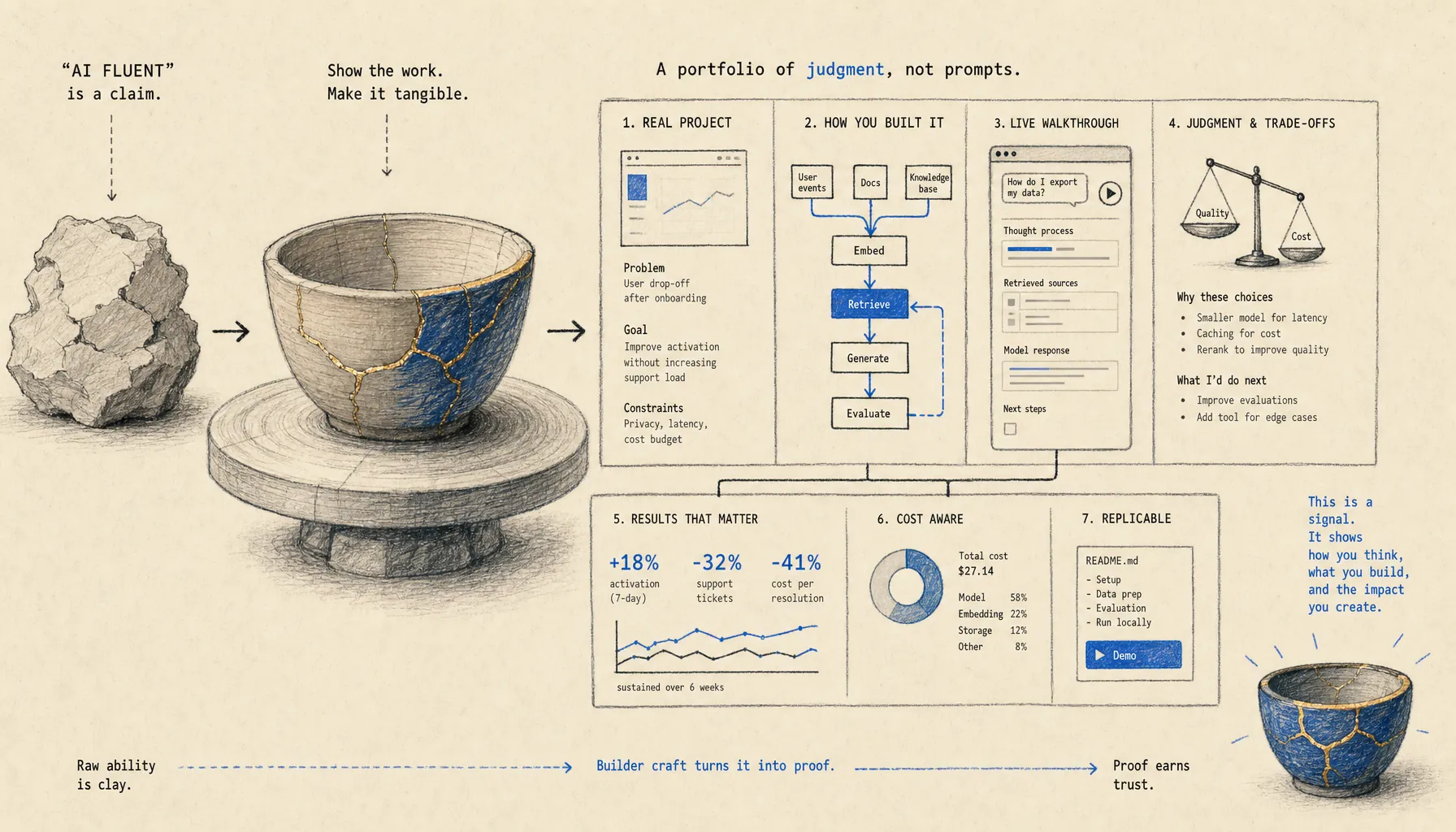
How to Prove AI Skills in an Interview
In Microsoft and LinkedIn’s 2024 Work Trend Index, 75% of knowledge workers said they already use AI at work. So “I use ChatGPT every day” does not move the needle anymore. To prove AI skills in an interview, you need evidence: shipped work, decision logs, live reasoning, measurable output, and a clear explanation of where AI helped, where it fell short, and what you changed.
The hiring bar moved from tool familiarity to judgment you can prove. Provn’s view is simple: performance over pedigree, proof over polish.
Key Takeaways
- AI fluency is a weak claim on its own. According to Microsoft and LinkedIn’s 2024 Work Trend Index, 75% of knowledge workers already use AI at work.
- The strongest interview evidence is a 90-second project story: the problem, workflow, tools, human review step, measurable result, and one mistake you caught and fixed.
- Hiring managers look for judgment. They want to hear when you rejected output, switched models, added retrieval, narrowed scope, or stopped using AI altogether.
- Strong candidates talk about token usage, latency, review time, and error risk instead of acting like AI output is free.
- A live walkthrough should show how you think, not a polished demo that hides the actual work.
How to Prove AI Skills in an Interview
Show a real project where AI changed the work. Then walk through your inputs, review process, tradeoffs, measurable result, and failure points. A strong answer proves you can use AI to do better work, not just crank out faster drafts.
The weak answer is a tool list. ChatGPT. Claude. Midjourney. Copilot. That tells an interviewer you know the storefronts. It does not tell them you built anything useful.
A better answer sounds like this: “I used Claude to classify 1,200 support tickets, but I did not trust the first pass. I sampled 100 outputs, found misclassification around billing disputes, rewrote the rubric, added examples, and cut manual triage time from six hours to about two.” That answer has actual work in it. It has measurement. It has judgment. It has a correction.
That is why interviews are moving toward portfolio proof. The AI skills in hiring signal that matters is not whether a candidate has touched AI. It is whether they can explain what changed because they used it.
Use Concise AI Project Stories Instead of Tool Lists
A good AI project story is short, specific, and easy to test. It gives the interviewer enough detail to ask real follow-up questions and enough evidence to separate real work from résumé wallpaper.
Use this structure. Keep it under two minutes unless they want more.
- State the business or user problem in one sentence.
- Name the AI task: summarization, classification, generation, retrieval, analysis, coding, testing, or workflow automation.
- Describe the inputs you gave the model, including examples, constraints, or reference material.
- Explain the human review step you used to catch errors or weak reasoning.
- Report the result with a number, even if it is approximate.
- Identify one failure and the change you made after finding it.
Do not oversell it. Interviewers who have actually shipped AI workflows can hear the difference between “I built an agent” and “I connected a form to an API and reviewed the output manually.” Honestly, the second answer is often better if it is true and measurable.
| Weak answer | Stronger answer | What it proves |
|---|---|---|
| “I use AI to save time.” | “I used AI to draft first-pass QA test cases, then compared them against production bugs from the prior quarter.” | Workflow design and validation |
| “I’m good at prompting.” | “I changed the prompt after the model missed edge cases involving refunds and renewals.” | Iteration and judgment |
| “I built an AI assistant.” | “I built a support macro recommender with human approval before sending any customer response.” | Risk control |
Show AI Judgment With Before-and-After Decisions
AI judgment shows up in the decisions. Can you explain what you changed to improve accuracy, reduce risk, cut cost, or protect the user? That is what the interviewer is listening for. They want the moment where you stopped accepting model output at face value and started managing the work.
According to the National Institute of Standards and Technology AI Risk Management Framework, trustworthy AI work depends on managing risks like validity, reliability, safety, security, accountability, and transparency. You do not need to quote the framework in an interview. You do need to show that you worked like someone who understands those risks.
Examples that usually land well:
- Accuracy: “The model summarized customer calls well, but it missed cancellation intent. I added a separate check for churn language before routing.”
- Privacy: “I removed customer identifiers before sending text into the model and kept the original record in the internal system.”
- Scope control: “We did not let the model send customer replies. It drafted options, and a human approved the final response.”
- Model choice: “A larger model gave better reasoning, but a smaller model handled simple tagging at lower cost.”
That last one matters. The best candidates do not talk about AI like it is magic. They talk about constraints, because constraints are the job. For a narrower treatment of workplace judgment signals, see AI judgment at work.
Run a Live Walkthrough Without Turning It Into Theater
A live AI walkthrough should show how you think when conditions are imperfect. It should not feel like a memorized demo where everything works because the problem was staged in advance.
The clean version is simple. Bring one real artifact: a prompt, a small dataset, a before-and-after output, a screen recording, or a repo. Explain what the model saw, what it produced, what you rejected, and what you shipped.
Show the messy middle, not only the final artifact
The most believable walkthrough includes a wrong answer somewhere. A candidate who can say “this output looked fluent but was wrong because it ignored the refund policy” sends a much stronger signal than someone showing a perfect slide deck.
This is where proof beats polish. A polished final answer can be copied. A reasoning trail is much harder to fake. Hiring teams on Provn look for builder evidence: how a person frames the problem, tests output, catches errors, and explains tradeoffs.
Keep the walkthrough narrow enough to finish
A strong interview walkthrough usually covers one task in five to seven minutes. Do not try to show an entire automation stack unless the interviewer asked for architecture detail.
Keep it tight: one input, one model response, one review step, one improvement. That gives the interviewer room to figure out whether you understand the work or just clicked around in the interface.
Talk About Cost, Tokens, and Tradeoffs Like an Operator
Cost-aware AI answers separate builders from casual users. If you understand token usage, latency, review time, and rework risk, a hiring team can trust you with a real budget.
AI work has a unit cost. According to the OpenAI API pricing page and the Anthropic pricing page, model usage is priced by input and output tokens, and rates vary by model. So a candidate who sends every task to the largest model, without caching, batching, or narrowing the prompt, can rack up costs that never show up in a neat little demo.
You do not need to turn the interview into a finance lecture. You do need to show that you understand the economics. Mention when you used a smaller model, when retrieval reduced repeated context, when human review was cheaper than another agent pass, or when automation simply was not worth building.
This connects directly to the broader question of AI cost vs employees. AI does not automatically lower costs. Blind automation can just move the spend from salaries to tokens, vendors, review queues, and rework. Candidates who understand that are more useful than candidates who promise speed like a sales deck.
| Interview signal | Weak version | Proof-based version |
|---|---|---|
| Token awareness | “I used the best model.” | “I used the larger model only for ambiguous cases and a smaller model for routine tagging.” |
| Workflow cost | “The agent handled it.” | “The agent created too many tool calls, so I replaced it with a two-step review flow.” |
| ROI thinking | “It saved time.” | “It cut first-pass research time by about 40%, but still needed human review before client use.” |
If the role involves automation, read the related cost mechanics in Agentic AI Costs and AI Token Costs. Do not try to sound like the team’s procurement lead in the interview. Just show enough fluency that they know you will not automate blindly.
Answer the Question When Every Candidate Claims AI Fluency
When every candidate claims AI fluency, the winning answer is evidence. The interviewer wants proof that your use of AI changed output quality, cycle time, decision-making, or team capacity.
The labor market explains the pressure. According to the World Economic Forum Future of Jobs Report 2025, employers expect 39% of workers’ core skills to change by 2030, and AI is one of the main forces behind that shift. That creates a lot of noise. Candidates add AI language to résumés faster than hiring teams can verify it.
The answer is not louder buzzwords. It is contrast.
Say: “A lot of candidates can prompt a model. My edge is that I can turn output into a controlled workflow. I can show you where I validated it, where I rejected it, and what changed after deployment.”
Then stop talking and show the artifact. A prompt log. A test set. A Loom walkthrough. A GitHub commit. A before-and-after metric. Right now, the market rewards candidates who can produce evidence under inspection.
A Practical Interview Script for Proving AI Skills
The best AI interview answer follows a repeatable sequence: project, workflow, judgment, result, limitation. This script gives you structure without making you sound rehearsed.
- Choose one AI project that produced a measurable work outcome.
- Describe the original problem in plain business or user terms.
- Explain the AI workflow, including the model’s role and the human review step.
- Show one artifact such as a prompt, output sample, repo, dashboard, or screen recording.
- Identify one model failure and explain how you corrected it.
- Quantify the result using time saved, error reduction, throughput, cost avoided, or quality improvement.
- State one boundary where you would not use AI without additional review.
Here is the compact version:
“I used AI on a customer research project where the goal was to cluster 800 open-text responses. The model’s first pass created categories that were too broad, so I sampled the output, rewrote the taxonomy, and added examples for edge cases. The final workflow cut manual sorting time from roughly two days to half a day. I still kept human review for any category that affected product roadmap decisions.”
That answer does four things. It proves tool use. It proves review discipline. It proves measurement. And it proves you know where the model should not be trusted.
For candidates building a larger body of evidence, the same logic applies to portfolios. See AI builder jobs, show AI judgment in a portfolio, and AI productivity vs usage for related proof patterns.
Frequently Asked Questions
What is the best way to prove AI skills in an interview?
Show a real project with measurable output, then explain the workflow, review step, failure point, and correction. A hiring manager should be able to see what you built, what AI did, what you did, and why the result got better.
Should I mention ChatGPT, Claude, Gemini, or Copilot by name?
Mention the tool when it explains a decision. Saying “I used Claude for long-context synthesis and a smaller model for routine classification” is stronger than naming five tools. The tool matters less than the workflow, validation method, and result.
How do I answer if I have no formal AI job experience?
Use a project from school, freelance work, open-source work, operations, customer support, research, or personal automation. The standard stays the same: show the problem, artifact, result, and limitation. A small real project beats a vague claim about AI fluency every time.
How much technical detail should I include for a non-technical interviewer?
Start with the work outcome, then add technical detail only where it clarifies judgment. For a non-technical interviewer, “I added human approval before customer messages were sent” is usually more useful than a long explanation of model parameters.
Do AI interview expectations vary by location or market?
Yes. In markets with dense AI hiring, such as San Francisco, New York, London, Toronto, and Bangalore, candidates are more likely to get portfolio reviews, live walkthroughs, or workflow questions. In smaller markets, AI questions may be less formal, but proof still carries more weight than buzzwords.