
AI Judgment Examples for Daily Work - Provn AI Career Hub
Real examples of AI decision-making that show how candidates narrow the task, question the output, check sources, avoid wasted effort, and pick the right tool.
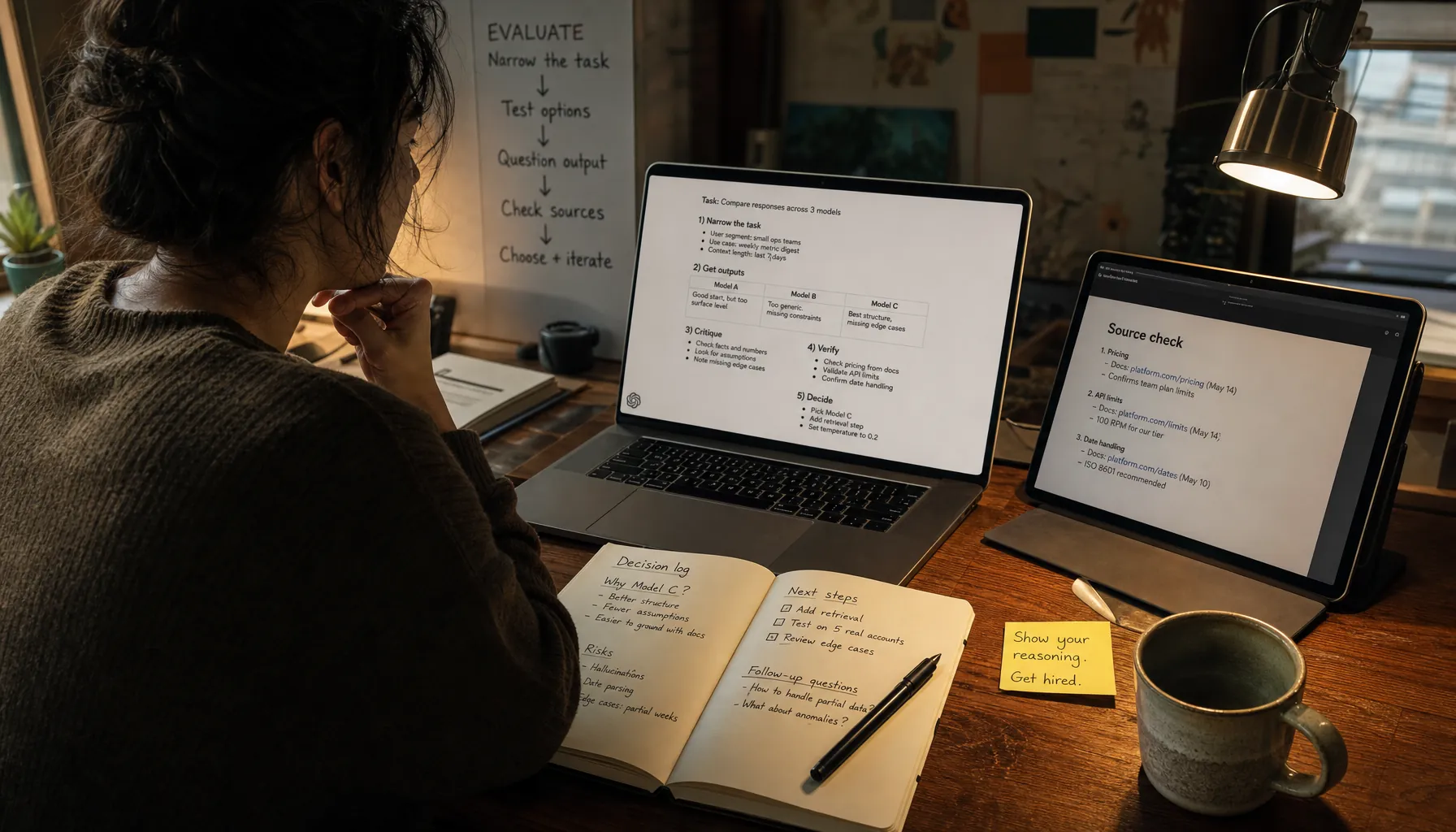
AI Judgment Examples: Daily Work Signals Candidates Can Actually Describe
Microsoft and LinkedIn reported in 2024 that 75% of knowledge workers were already using AI at work, according to the 2024 Work Trend Index on AI at work.
AI judgment examples are the moments when someone improves, limits, verifies, or flat-out rejects an AI output instead of nodding along and moving on. Good examples look like this: narrowing an overbroad task, pushing back on a confident answer, checking primary sources, using a spreadsheet instead of an agent, or stopping a workflow before token burn turns into real money.
That distinction matters in hiring. “I use AI” tells a recruiter almost nothing. Showing where you stepped in tells them how you think.
Key Takeaways
Good AI judgment shows up in the constraint, the correction, and the trail of work left behind.
- AI judgment is not about how many prompts you wrote. It is deciding when AI should act, when it needs checking, and when it should be ignored.
- The strongest examples have a clear before-and-after: a vague task got scoped down, a wrong answer got caught, or an expensive workflow got stopped.
- Verification matters because AI systems can produce polished claims with nothing underneath them; OWASP lists prompt injection and output-handling failures among major risks in LLM applications.
- For candidates, the best language is operational: “I limited the model to three options, checked the sources, and shipped the simpler version.”
- In 2026 hiring, proof beats claims. A work sample that shows judgment usually matters more than a resume bullet about AI fluency.
What Counts as AI Judgment Examples
AI judgment is the human layer around the model: scoping the job, checking the answer, picking the tool, and knowing when to stop.
The common mistake is treating AI judgment like a personality trait. It is not. It is a series of small decisions made under real constraints. A builder shows judgment when they ask the model for a narrow comparison instead of a 3,000-word survey. A marketer shows it when they throw out a polished paragraph because the source is flimsy. A product analyst shows it when they use SQL instead of piping a full dataset through a chatbot.
NIST makes a similar point in the NIST Artificial Intelligence Risk Management Framework: AI risk is not just a software problem. The model is only one part of the system. The user, the data, the review path, the business context, and the failure mode all affect the result.
The visible signal is intervention. You changed the task. You challenged the output. You verified the claim. You cut the loop short. That is the part hiring managers can actually evaluate.
AI Judgment Examples for Daily Work
The best AI judgment examples are concrete enough that someone can picture the work on an ordinary Tuesday.
Use examples that show a decision, not just a tool. “Used ChatGPT for research” is weak. “Asked for five risks, checked two against primary documentation, and removed three unsupported claims” is much stronger. You can see the work in the second version.
| Daily work situation | Weak AI use | AI judgment example | What it proves |
|---|---|---|---|
| Narrowing a task | Ask for a full strategy memo. | Ask for three hypotheses, reject two, then expand only the strongest one. | You control scope before output volume gets out of hand. |
| Challenging an answer | Accept a confident model response. | Ask the model to identify assumptions, then test the riskiest assumption manually. | You know fluency is not proof. |
| Verifying sources | Paste citations into a deck. | Trace claims back to primary documentation before using them externally. | You protect accuracy and reputation. |
| Choosing a simpler tool | Use an AI agent for a basic cleanup task. | Use a spreadsheet formula or script because the task is deterministic. | You do not confuse automation with progress. |
| Stopping token waste | Let an agent retry the same failing step. | Stop after two failed loops, inspect the error, and rewrite the task boundary. | You manage cost and failure loops. |
| Escalating to review | Ship AI-written policy language. | Use AI for a draft, then route legal, medical, financial, or HR claims to a qualified reviewer. | You understand domain risk. |
Token cost is part of the judgment problem too. AI vendors usually price usage by input and output tokens, as shown in OpenAI API pricing and Anthropic Claude pricing documentation. Candidates do not need to memorize pricing pages. They do need to show they understand that uncontrolled AI usage has a real cost model.
That is why this topic connects to the economics of AI cost vs employees. Blind automation looks cheap in a demo. Then nobody owns the loop, and the bill shows up later.
How to Describe AI Judgment Examples Without Sounding Vague
Candidates should describe AI judgment as a sequence of decisions: task, constraint, intervention, verification, result.
Most AI claims fall apart in interviews because they are too broad. “I use AI to work faster” sounds like everyone else. A better answer has shape. It names the business task, explains the constraint, shows the human intervention, and points to a result.
- Start with the real task, not the tool.
- Name the constraint that made judgment necessary.
- Describe the AI output you questioned, narrowed, or rejected.
- Explain how you verified the final answer.
- Quantify the result with time saved, errors caught, cost avoided, or decisions improved.
- Attach a work sample when possible, such as a prompt log, source checklist, before-and-after draft, or evaluation note.
Candidate Language Examples
Strong candidate language sounds like a work log, not a slogan.
Use sentences like these:
- “The first output was too broad, so I narrowed the task to three user segments and asked for tradeoffs by segment.”
- “The answer cited a secondary blog, so I checked the primary documentation before adding the claim.”
- “The agent repeated the same failed step twice, so I stopped the run and converted the task into a manual checklist.”
- “I used AI for the rough classification, then reviewed the edge cases myself because the labels affected customer messaging.”
If you want those examples to count in hiring, pair them with artifacts. A short screen recording, annotated prompt log, or evaluation note is stronger than a resume claim. Provn’s related piece on AI skills in hiring goes deeper on how hiring teams read that material.
AI Judgment Decision Framework: Use AI, Use a Simpler Tool, or Stop
One of the fastest ways to show AI judgment is to explain why you did not use AI for part of the work.
Experienced builders do not throw every problem at the biggest model they can find. They route the task. Some work is generative. Some is deterministic. Some needs a person. Some should stop because the input is bad.
| Decision | Use when | Avoid when | Good phrase for candidates |
|---|---|---|---|
| Use AI | The task involves drafting, summarizing, clustering, comparison, or ideation. | The answer must be exact and easy to compute. | “I used AI to generate options, then selected against the constraints.” |
| Use a simpler tool | The task is deterministic: counting, sorting, matching, formatting, or calculating. | The task requires judgment, ambiguity, or synthesis. | “A spreadsheet was safer and cheaper than an agent for this step.” |
| Use human review | The output affects compliance, hiring, finance, safety, healthcare, or customer trust. | The review adds no real risk reduction. | “I used AI for speed, but kept the approval decision human.” |
| Stop the workflow | The agent is looping, the source data is poor, or the task is underspecified. | The failure is isolated and easy to correct. | “I stopped the run because the next retry would only compound the error.” |
This is where daily judgment meets operating cost. The related Provn pieces on AI Token Costs (2026): Pricing Forecasts and Budget Controls and Agentic AI Costs (2026): Token Usage and Workflow Controls cover the cost side in more detail. For candidate language, the useful point is simpler: judgment includes knowing when more model output will not improve the work.
Common AI Judgment Mistakes That Make Work Look Weak
Weak AI judgment usually shows up as overproduction, underverification, or plain old tool worship.
The first mistake is mistaking volume for quality. A long answer can hide a bad assumption just as easily as a short one. The second is treating citations like decoration. If a source cannot be opened, verified, or traced to a primary authority, it is not evidence. The third is using agents for tasks that need a fixed rule, not reasoning.
OWASP lists risks such as prompt injection, sensitive information disclosure, and improper output handling in the OWASP Top 10 for Large Language Model Applications. That may sound technical, but it shows up in ordinary work all the time. A pasted customer note may contain sensitive information. A model-generated link may be wrong. A tool-connected agent may act on a malicious instruction hidden in a webpage.
Candidates do not need to pretend they are AI security engineers. They do need to show they understand how things fail. That is the difference between someone who uses AI and someone a team can trust with it.
How Hiring Managers Read AI Judgment Examples
Hiring managers look for proof that a candidate can produce better work with AI without dumping hidden cleanup costs on the rest of the team.
The current signal is not “AI native.” That phrase is cheap. Anyone can claim it. The stronger signal is a work sample that shows the messy middle: the rejected answer, the source check, the tighter scope, the manual review, the decision to stop.
This is why Provn cares about proof over polish. A polished resume line says you improved productivity. A real artifact shows what you actually did. The candidate who can explain the tradeoff between automation, review, and output quality is easier to trust than the candidate who just names tools.
For broader evaluation criteria, see AI Judgment at Work: Examples and Evaluation Criteria. For candidates building public proof, the related pages on AI Builder Jobs (2026): Portfolio Proof and Team Scale and AI Productivity vs Usage: Output Metrics and ROI Signals explain how hiring teams separate usage from actual output.
Frequently Asked Questions
What are the best AI judgment examples for candidates?
The best AI judgment examples show a clear human intervention: narrowing a vague task, challenging an unsupported answer, checking primary sources, choosing a simpler tool, escalating risky output for review, or stopping an agent loop before it wastes time and tokens.
How do I describe AI judgment on a resume?
Describe the work, the decision, and the result. A strong bullet might say: “Used AI to classify 400 customer comments, manually reviewed ambiguous cases, corrected mislabeled themes, and produced a source-backed summary for product planning.”
Is using AI for every task a sign of strong AI skills?
No. Strong AI skills include knowing when AI is the wrong tool. If a spreadsheet formula, SQL query, checklist, or human review path produces a safer result, choosing that option is a better signal of judgment.
Why do hiring managers care about AI judgment examples?
Hiring managers care because AI can increase output while also creating verification work, security risk, source errors, and cost. Candidates who show judgment reduce cleanup burden for the team.
What artifact best proves AI judgment?
The strongest artifacts are annotated work samples: prompt logs with revisions, before-and-after drafts, source verification notes, evaluation rubrics, or short walkthroughs explaining why an AI output was changed, rejected, or approved.