
Curious and Resilient Builder Signals | Provn AI Career Hub
Curiosity and resilience matter in hiring only when they show up in the work: the questions someone asks, the experiments they run, the setbacks they absorb, and the decisions they change.
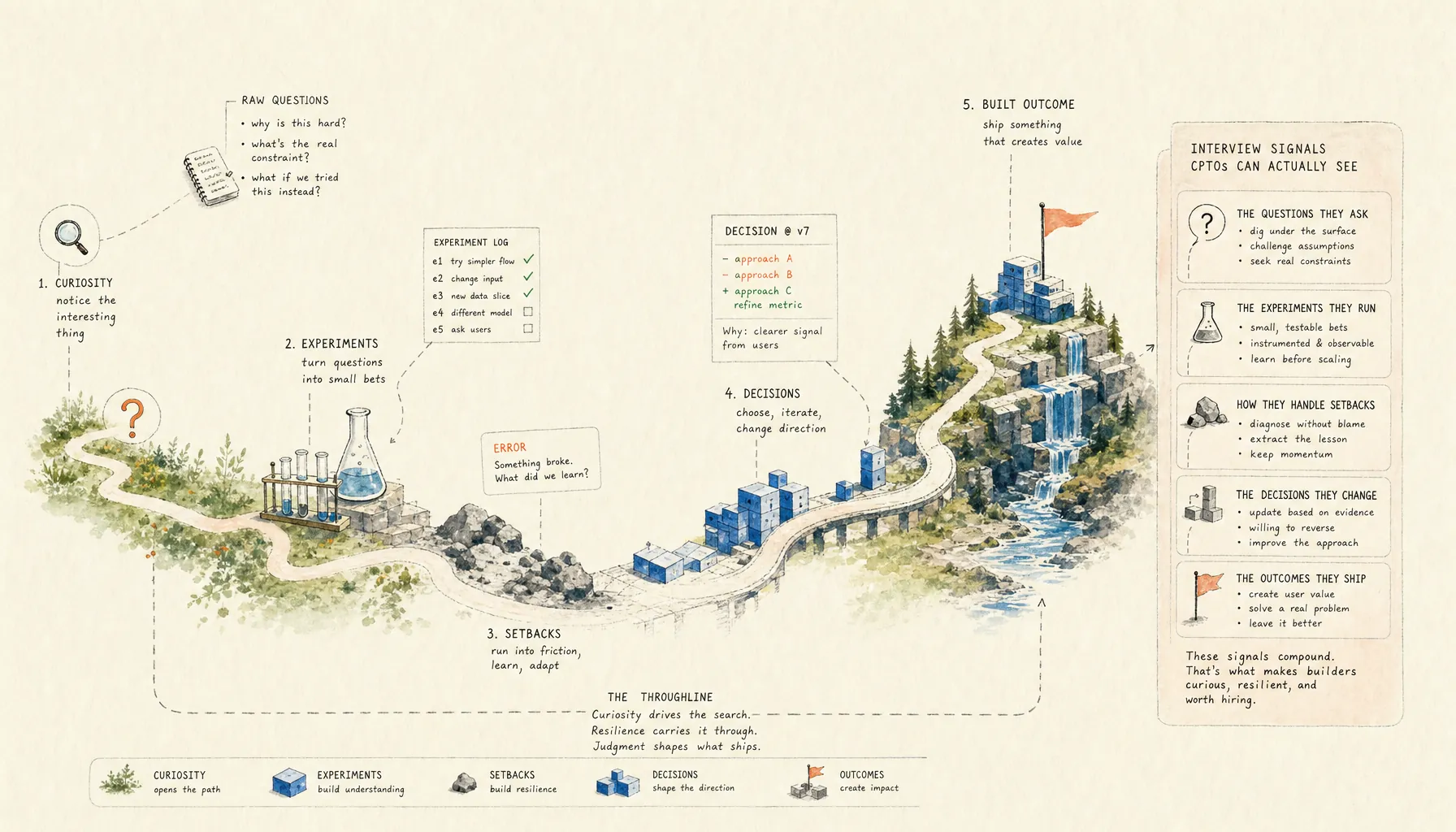
Curious and Resilient Builder: Interview Signals CPTOs Can Actually See
By 2026, when a CPTO says they want a curious, resilient builder, they usually mean something pretty concrete: show me you can learn fast, keep going when the first plan breaks, and make sound calls with incomplete information.
Those words can sound fuzzy on their own. They stop being fuzzy once you tie them to actual work. This article turns curiosity and resilience into behaviors a company hiring builders can spot in a portfolio review, challenge walkthrough, or live interview.
Key Takeaways
- A curious and resilient builder shows the work behind decisions: questions, failed paths, revisions, constraints, and final trade-offs.
- Curiosity is visible when a builder changes the problem definition after learning something specific from users, data, tools, or system behavior.
- Resilience is visible when a builder recovers from a bad assumption without hiding the failure or starting over for no reason.
- CPTOs should score behaviors, not personality traits, because observable criteria are easier to compare and defend.
- The strongest interview evidence is a work artifact with version history, decision notes, demo footage, and a short explanation of what changed.
What does a curious and resilient builder look like in an interview?
A curious and resilient builder can show how they learned, where they got stuck, what changed, and why the final version beat the first one.
That is the definition companies hiring builders can actually use. Curiosity is not a bright personality. Resilience is not some dramatic story about pushing through chaos. In builder hiring, both show up in the decision trail. A builder asks a sharper second question than the first. They catch when an AI-generated answer sounds plausible but is wrong. They cut scope without losing the real problem. They can point to the moment a prototype failed and say exactly what that failure taught them.
The NFL combine analogy still works. A coach does not draft a wide receiver because he says he is explosive. The coach watches release, route adjustment, separation, hands, and decision-making under pressure. Builder interviews need the same shift, away from adjectives and toward things you can actually see. The broader hiring model is covered in Get Hired as a Builder in 2026: Proof, Judgment, and Process, but this page stays focused on one question: how curiosity and resilience become visible.
Why do CPTOs care about curiosity and resilience in 2026?
They care because AI has made execution faster and judgment more valuable.
The old screen rewarded the person who already had the closest matching title. That was shaky before AI. Now it is worse. A builder can use AI to draft code, generate flows, summarize research, build prototypes, and test alternatives in a few hours. The harder question is whether they know what to ask, what not to trust, and when to change direction.
According to the World Economic Forum Future of Jobs Report 2025, analytical thinking, resilience, flexibility, agility, curiosity, and lifelong learning are all among the core skills companies expect to matter. According to Microsoft’s 2024 Work Trend Index, 75% of knowledge workers reported using AI at work. Tool access is not special anymore. The screen has to move up the stack.
A CPTO is usually looking for builders who can work in ambiguity without producing AI slop. The related CPTO lens is covered in Agentic Engineer Hiring in 2026: CPTO Signals and Requirements. The practical point here is simple: curiosity finds the next useful question, and resilience keeps the work moving after the first answer fails.
How do you show learning speed without performing confidence?
Show the before and after: the first assumption, the new input, the revision, and the result.
Builders often try to prove learning speed by talking fast or listing tools. That is weak evidence. Better evidence is the learning loop itself. Start with the first version of the problem. Then show the exact signal that forced a change. Maybe it was a failed user test, a confusing support ticket, an LLM hallucination, a latency issue, a low activation rate, or a design review that exposed a dependency nobody saw at first.
According to the National Association of Colleges and Employers career readiness competencies, career readiness includes communication, technology, professionalism, and critical thinking. In interviews, that only becomes useful when the builder can tie it to actual artifacts.
| Weak claim | Observable learning signal | What the interviewer learns |
|---|---|---|
| “I learn fast.” | Shows three prototype versions and explains what each version taught. | The builder can take in feedback and revise the work. |
| “I am curious.” | Shows the question list that changed after testing. | The builder updates the inquiry, not just the output. |
| “I use AI well.” | Shows prompts, rejected outputs, verification steps, and final edits. | The builder treats AI like a useful tool that still needs inspection. |
If the work is in a portfolio, include a short decision log. The format is covered more fully in Proof of Work Portfolio for Builders in 2026: Examples and Checklist. For this trait, the key evidence is revision under new information.
How do you prove resilience after a project breaks?
Resilience shows up when a builder can explain a failure without trying to polish it into a neat little success story.
Strong builders do not hide breakage. They name it clearly. The API rate limit broke the workflow. The model output passed a quick check and failed on edge cases. The onboarding flow looked clean in Figma and confused the first three users. The database choice worked for the demo and fell apart once the data shape changed.
Then they show the recovery path. Did they isolate the failure? Did they keep the part of the work that still had value? Did they cut scope to ship a working slice? Did they write down the new constraint so they would not repeat the same mistake two weeks later?
According to the National Institute of Standards and Technology AI Risk Management Framework, trustworthy AI work depends on mapping, measuring, managing, and governing risk. That framework is written for organizations, but the pattern holds for individual builders too. Good resilience is not stubbornness. It is disciplined recovery.
The interview answer should sound like this: “The first approach failed because retrieval quality dropped when documents used inconsistent headings. I tested three fixes, kept the chunking change, rejected a model swap because it hid the problem, and shipped a smaller workflow with source citations exposed.” That gives a CPTO something real to score.
What interview behaviors signal adaptive problem solving?
Adaptive problem solving shows up when a builder changes tactics without losing sight of the original user or business problem.
This is where a lot of interviews get mushy. A builder gets praised for being flexible, but nobody asks what stayed fixed. Real adaptability has a spine. The goal stays visible. The route changes. If the route keeps changing and the goal disappears, that is not adaptability. That is drift.
Use a simple rubric:
| Signal | Strong behavior | Red flag |
|---|---|---|
| Problem framing | Restates the user pain and constraint before proposing changes. | Starts building from the newest idea. |
| Tool judgment | Chooses tools based on accuracy, speed, cost, and failure mode. | Chooses the newest tool without a reason. |
| Trade-off clarity | Explains what was sacrificed and why. | Presents every decision as obviously correct. |
| Evidence handling | Separates observed facts from guesses. | Treats a single anecdote as proof. |
According to the Uniform Guidelines on Employee Selection Procedures, selection procedures should connect to the work being performed. For builder interviews, that points toward work samples, structured scoring, and observable criteria instead of vague personality impressions.
Trade-off explanation deserves its own prep. The related interview pattern is covered in Builder Interview Trade-Offs in 2026: Answers and Examples. For curiosity and resilience, the important move is to show how the trade-off changed after contact with reality.
How should builders prepare evidence before the interview?
Builders should prepare a compact evidence packet that shows the work, the learning loop, the failure point, and the recovery decision.
This does not require a polished performance. It requires receipts. A CPTO does not need a 40-slide life story. They need enough evidence to see how the builder thinks when the path is not obvious.
- Choose one project where the first version was meaningfully wrong.
- Capture the original problem statement, constraint, and first assumption.
- Collect artifacts that show the work changing, including commits, mockups, prompts, notes, tests, or demo clips.
- Identify the moment new evidence changed the direction of the project.
- Write a five-sentence decision log explaining what failed, what you tested, what you kept, what you cut, and what shipped.
- Prepare a two-minute walkthrough that connects the artifact to the final outcome.
The demo itself needs structure. If the interview includes a live walkthrough, use the pattern in Builder Interview Demo in 2026: Steps and Script. The goal is not polish. The goal is proof that the builder can learn, recover, and keep building.
Frequently Asked Questions
What is a curious and resilient builder?
A curious and resilient builder learns from new evidence, revises their approach, and keeps making progress after a plan fails. In an interview, that shows up through artifacts like version history, failed experiments, decision logs, prototype revisions, and a clear explanation of what changed.
How can builders show curiosity in an interview?
Builders can show curiosity by explaining how their questions changed during the work. Strong evidence includes user research notes, rejected assumptions, tool comparisons, prompt iterations, test results, and a final explanation of how the learning changed the product or workflow.
How can builders show resilience without sounding rehearsed?
Builders can show resilience by naming a specific failure and walking through the recovery path. A credible answer identifies the broken assumption, the diagnostic step, the options tested, the trade-off made, and the smaller or stronger version that shipped.
What should CPTOs ask to test curiosity and resilience?
CPTOs should ask builders to show a project that changed after contact with real evidence. Useful prompts include: “What did you believe at the start that turned out to be wrong?” and “Which failure changed the direction of the work?” These questions produce more signal than asking whether someone is curious or resilient.
Does a builder need elite credentials to prove curiosity and resilience?
No. Curiosity and resilience are better proven through work than credentials. A builder from Duke, Meta, Cal State Chico, Bellevue College, or no famous institution at all can show the same signals: learning loops, recovery from failure, judgment under constraints, and shipped artifacts.